49 works in this view — arrow keys or swipe to move between them.
Dance in Art
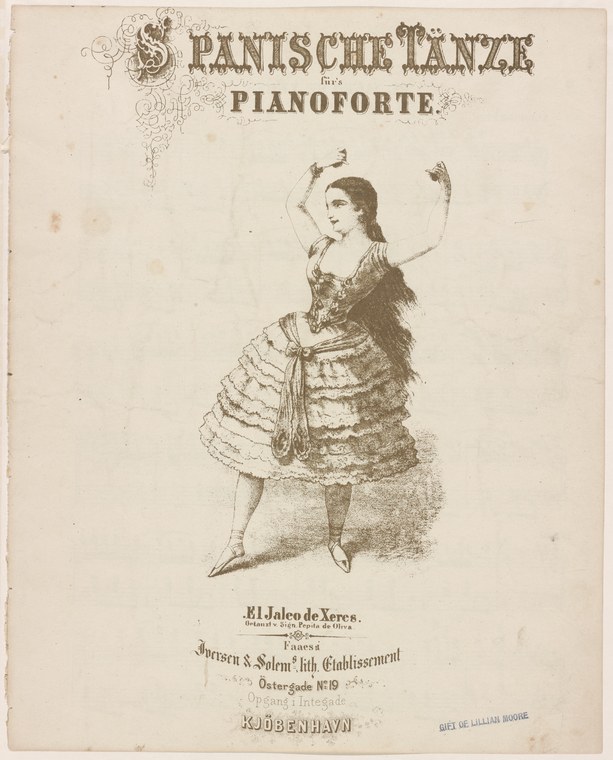
Spanische Tänze für's Pianoforte. El Jaleo de Xeres. Getanzt v. Sign. Pepita de Oliva
Unknown artist
- Collection:
- Prints depicting dance
- Source:
- New York Public Library
- Rights:
- Public domain — free to use, share and adapt.
- Recorded as:
- Public Domain
This cover documents how Spanish regional dances like the jaleo circulated in 19th-century Europe through commercial music publishing and star dancers, and shows the theatrical conventions applied to present Spanish dance to Northern European audiences. The prominence given to the dancer's name suggests the emerging importance of the performer as a marketable commodity in music publishing. For historians of Spanish dance, theatrical presentation, and 19th-century concert culture, this is primary source evidence of how vernacular traditions were adapted, costumed, and commodified.
What you are looking at
This is a sheet music cover for a Spanish dance piece arranged for piano. A single female dancer occupies the center of the composition, captured mid-performance against a plain background. She wears a voluminous Spanish-style dress with a fitted bodice, short puffed sleeves, and a dramatically gathered skirt with deep horizontal flounces or ruffles that fall to mid-calf. The skirt appears to be in motion, lifted or spread outward. She has long dark hair and stands in an animated pose with both arms raised and bent at the elbows, hands positioned expressively above shoulder height. Her weight appears to be on the balls of her feet, and her posture suggests dynamic movement—either captured mid-turn or mid-step. The engraving style is characteristic of 19th-century music publication, with fine cross-hatching rendering form and texture. The title "Spanische Tänze für's Pianoforte" (Spanish Dances for Piano) appears in decorative serif lettering at the top, with the specific dance "El Jaleo de Xeres" named below, along with an attribution to the dancer Señ. Pepita de Oliva. Publication information for a Copenhagen publisher appears at the bottom.
The dancing
The dancer stands alone, weight centered with knees slightly bent and legs positioned to support the dynamic upper body. Her arms are raised to approximately shoulder or ear height, with elbows bent and hands open in an expressive, animated gesture characteristic of Spanish dance. The pose suggests she has just executed or is executing a rapid movement—possibly a turn or rhythmic step. Her posture conveys energy and momentum rather than stillness; the skirt's gathered folds reinforce this sense of motion. No partner is present, and the figure dominates the composition entirely.
The dance depicted
The work depicts El Jaleo de Xeres (or Jaleo), a traditional Spanish dance from the Andalusian region, named after the city of Jerez de la Frontera. The dance was known for its spirited, rhythmic character and was popular in 19th-century European concert and theatrical settings. This particular print commemorates or advertises a performance by the dancer Señ. Pepita de Oliva, whose name appears on the cover. The image captures the theatrical presentation of the dance as it would have been performed in concert or music hall contexts of the mid-to-late 19th century, rather than its vernacular form. The costume—particularly the elaborate flounced skirt and upper-class styling—reflects the theatrical glamorization of Spanish regional dress for European audiences of the period.
How it was made
This is an engraving, likely wood engraving or steel engraving, used as the cover for a published piano score. The technique allowed for fine detail in rendering fabric texture and facial features, and the printing process enabled wide circulation through music publishers. The quality and style of the engraving suggests a professional production for a substantial Copenhagen publisher (Breitkopf & Härtel or similar establishment music house), indicating this was a commercial publication intended for amateur pianists and music lovers. Engraving was the standard medium for music covers of this era, allowing reproducible, high-quality images.
About this work
This is a mid-19th-century engraved music cover documenting a specific performance of El Jaleo de Xeres, a Spanish regional dance that had become fashionable in European concert halls. The image serves both as a commercial advertisement for the published piano score and as a historical record of how this Spanish dance was theatricalized and performed for bourgeois audiences in Northern Europe. The work sits at the intersection of vernacular dance practice, commercial music publishing, and the Romantic-era fascination with Spanish and exotic cultures. It matters because it captures a moment when Spanish regional dances entered the European concert tradition, transformed through costume, concert presentation, and arrangement for domestic music-making. The named dancer—Pepita de Oliva—suggests this was a known performer whose reputation could sell sheet music, though such performers have left little historical trace.
How to look at it
The artist has frozen the dancer at a moment of maximum energy and expressiveness—arms raised, skirt in motion, body alert. This compositional choice emphasizes the liveliness and theatrical appeal of the dance rather than capturing a technical moment of footwork. Notice how the engraver rendered the texture of the fabric and the delicate features, using the precision of the medium to create an image of refinement and Continental sophistication—important for marketing this as an appropriate dance for concert-going audiences. The pose is neither documentary nor purely classical; it is theatrical, designed to intrigue and excite the viewer (and potential sheet-music buyer).
The period
This work dates to the mid-19th century, an era when Spanish dance—and Spanish culture more broadly—held powerful appeal for European Romantic audiences. Spain was constructed in Northern European imagination as a site of passion, exoticism, and sensuality; Spanish dances like the jaleo, fandango, and bolero became fashionable concert pieces. The professional touring dancer, often a woman, became a vehicle for this interest, and publishing houses capitalized on their celebrity by issuing sheet music arrangements of the dances they performed. This was also the period when the piano had become the center of domestic music-making among the middle classes, and music publishers produced vast quantities of dance arrangements and character pieces for amateur performers. The engraved music cover with a portrait or scene of the performer was a standard commercial device.
Where it lives
This object is housed in the New York Public Library's collection of prints depicting dance, from which the image was sourced. It is a published music cover, part of the commercial apparatus of 19th-century music and dance culture.
Dance in this work
Questions about this work
What is El Jaleo de Xeres?
El Jaleo (or Jaleo de Jerez) is a traditional Spanish dance from Andalusia, known for its energetic, rhythmic character and use of rhythmic hand-clapping and foot-stamping. It was popularized in 19th-century European concert halls and parlor music through arrangements like this one. The name refers to the lively, celebratory atmosphere of the dance; "jaleo" roughly means "commotion" or "celebration" in Spanish.
Who was Pepita de Oliva?
Pepita de Oliva was a dancer who performed El Jaleo de Xeres in the mid-19th century, at least in European concert contexts. The fact that her name appears on this published score suggests she was a known performer whose celebrity could drive sheet-music sales. However, biographical details about her life and career have been largely lost to history.
Why did Spanish dances become popular in Northern Europe?
Spain held a powerful romantic appeal for 19th-century Northern European audiences, associated with passion, sensuality, and exoticism. Spanish dances like the jaleo, bolero, and fandango fit the Romantic era's fascination with color, emotion, and foreign cultures. They were especially popular as concert pieces and domestic music arrangements for amateur pianists.
What does this engraving tell us about how dance was presented to audiences?
The theatrical costume, graceful pose, and refined engraving style show that vernacular Spanish dances were adapted and glamorized for bourgeois concert audiences. This was not documentary representation but commercial performance designed to appeal to European notions of Spanish elegance and spirit.
More dance artwork





