49 works in this view — arrow keys or swipe to move between them.
Dance in Art
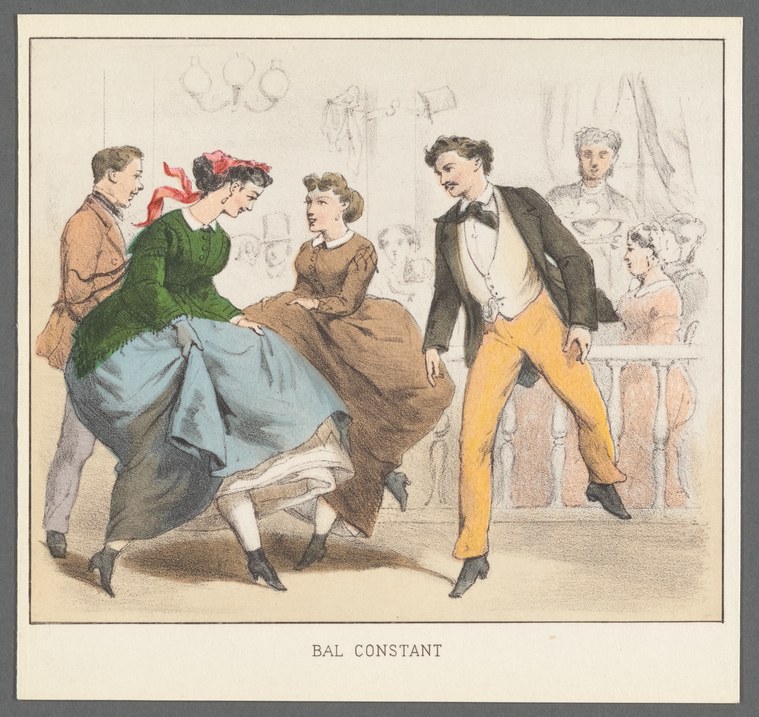
Bal constant
Unknown artist
- Collection:
- Prints depicting dance
- Source:
- New York Public Library
- Rights:
- Public domain — free to use, share and adapt.
- Recorded as:
- Public Domain
This image is crucial evidence of how the waltz and ballroom dancing operated as social performance and courtship ritual in the Gilded Age. For dancers and historians, it captures the exact moment and setting where partner dancing merged with fashion, flirtation, and class performance—not in a theater, but in the ballroom itself.
What you are looking at
A lively ballroom or dance hall scene, rendered in hand-colored engraving or lithograph, captures a moment of social dancing among well-dressed figures of the 1880s-1890s. In the foreground, a couple mid-dance dominates: the woman wears a forest-green jacket over a voluminous pale-blue skirt with a red ribbon at the nape of her neck, her body twisted in motion as she leans away from her partner; the man in a tan jacket guides her with his right hand at her waist. To their left, a second couple watches or waits to dance—the woman in a dark green dress, the man in brown. At right, a man in formal evening dress with yellow/gold trousers and black tailcoat stands with hand on hip, engaged in conversation or flirtation with the dancing woman; his posture is animated and proprietary. In the background, at least two more figures appear on a balcony or upper level, and the setting suggests an indoor venue with tall windows or architectural features sketched lightly in the upper portion. The composition is crowded and bustling, emphasizing the social nature of the occasion and the interplay between dancers and spectators.
The dancing
The primary couple adopts what appears to be a waltz or similar ballroom closed hold, with the man's right hand positioned at the woman's waist and her body angled away in a characteristic pivot or turn. Her weight is distributed dynamically across her feet, suggesting forward momentum and rotation. The woman's lifted skirt reveals her lower leg and heeled boot—fashionable footwear of the period. The man at right maintains an open, confident stance with one hand on his hip, a gesture typical of male ballroom etiquette: present but not dancing, he remains socially engaged. The spectators in the background are rendered more lightly, establishing spatial depth and the layered social hierarchy of the ballroom.
The dance depicted
This is almost certainly a waltz or a related ballroom closed-hold dance of the 1880s–1890s, the era when such dances dominated fashionable social occasions. The title *Bal constant* (constant or continuous ball) suggests the endless social whirl of elite entertainment. The hold, the woman's angled posture, and the forward momentum of the couple are consistent with the Viennese or American waltz as danced in this period. The presence of spectators, the formal evening dress of the men, and the fashionable day dresses of the women confirm this as a formal ballroom or dance hall, not a folk or theatrical dance. The image documents not just steps but the social ritual of partner selection and male display that surrounded ballroom dancing.
How it was made
This is a hand-colored engraving or lithograph—the fine linear work, the tonal gradation achieved through cross-hatching, and the careful outline work are consistent with commercial printmaking of the 1880s–1890s. Hand-coloring (visible in the distinct application of green, blue, tan, and yellow pigments) was typical of popular prints produced for periodicals, satirical sheets, or collected as loose illustrations. The technique allowed for rapid reproduction and wide circulation, making such images affordable to middle-class readers. The loose, gestural quality of the background figures and the careful detail of the foreground couple suggest this was both a commercial product and an observed scene, possibly drawn from a specific ballroom or social event.
About this work
This hand-colored print documents the ballroom dancing culture of the Gilded Age, capturing the waltz—the dominant partner dance of elite and upper-middle-class social life in the 1880s–1890s. The title *Bal constant* evokes the relentless social calendar of the period, when dancing was not a performance but the central social ritual of courtship and status display. The work is important as visual evidence of ballroom dress, deportment, and the gendered dynamics of partner selection: the woman is the focus of display and male attention, while her partner guides and frames her movement. The print's commercial origin and hand-coloring suggest it was created for a broad audience—newspaper readers, satirical publications, or collectors—making it a window into how ordinary people understood and consumed images of fashionable dance.
How to look at it
Attend to the woman's posture and the angle of her body relative to her partner—this is the signature waltz frame, in which the woman's body leans away and turns while the man provides stable support and direction. The heeled boot visible beneath her skirt is not accidental: it was part of fashionable ballroom dress and essential to the footwork of the waltz. Notice also the social hierarchy encoded in the composition: the dancing couple occupies the center and is rendered in bright color and detail, while the watching man at right and the spectators in the background are less elaborated, yet his presence and posture suggest the constant negotiation of social rank and eligibility that ballroom dancing embodied.
The period
The 1880s–1890s were the height of the ballroom waltz's cultural dominance in Europe and America. The waltz, which had sparked moral panic in the early 1800s for its closed hold and rapid rotation, had become thoroughly respectable—even obligatory—among the elite and aspiring middle classes. This was also the era of the 'Gilded Age' in America and the Belle Époque in France, periods of economic expansion, conspicuous consumption, and an explosion of leisure entertainment. Ballroom dancing became a major subject for popular prints, caricatures, and illustrations in newspapers and periodicals. At the same time, theatrical ballet was undergoing profound change, moving toward the Romantic era's emphasis on narrative and the otherworldly (Tchaikovsky's Swan Lake premiered in 1895), but social dancing remained anchored in the ballroom and partner-based forms.
Where it lives
The work is held in the New York Public Library's collection of prints depicting dance, a broad archive assembled to document the visual culture of movement. Such prints were typically published as single sheets, in bound collections, or as illustrations in periodicals, and this example's hand-coloring and subject matter suggest it was aimed at a middle to upper-middle-class readership interested in fashion and social life.
Dance in this work
Questions about this work
Is this a real ballroom, or an imagined scene?
The image shows stylized ballroom architecture and dress consistent with the 1880s–1890s, but we cannot confirm that it documents a specific event or venue. The rendering is detailed enough to be recognizable as contemporary social dancing, yet the composition and hand-coloring suggest it was intended for broad circulation as a print, not as a record of a particular occasion. It is more likely a type scene—a generalized image of ballroom life as the artist and audience understood it.
Why is the woman's skirt so full?
The voluminous skirt was fashionable dress in the 1880s–1890s, achieved through multiple petticoats and often structured with bustles or crinolines. The full skirt made rapid rotation and momentum visible to spectators, which was part of the visual appeal of the waltz. The artist has carefully depicted how the skirt's weight and volume move with the dancer's body, emphasizing the dynamism and difficulty of the dance.
What is the man in the yellow trousers doing?
He is a spectator or a man waiting to dance, engaging in conversation or flirtation with the dancing woman. His hand-on-hip posture and his direct engagement with the couple suggest the social tension of the ballroom: men vied for partners, and a woman's participation in dancing was a form of social display and status negotiation. His presence also underscores that ballroom dancing was not an isolated performance, but a social ritual watched and judged by others.
More dance artwork





