49 works in this view — arrow keys or swipe to move between them.
Dance in Art
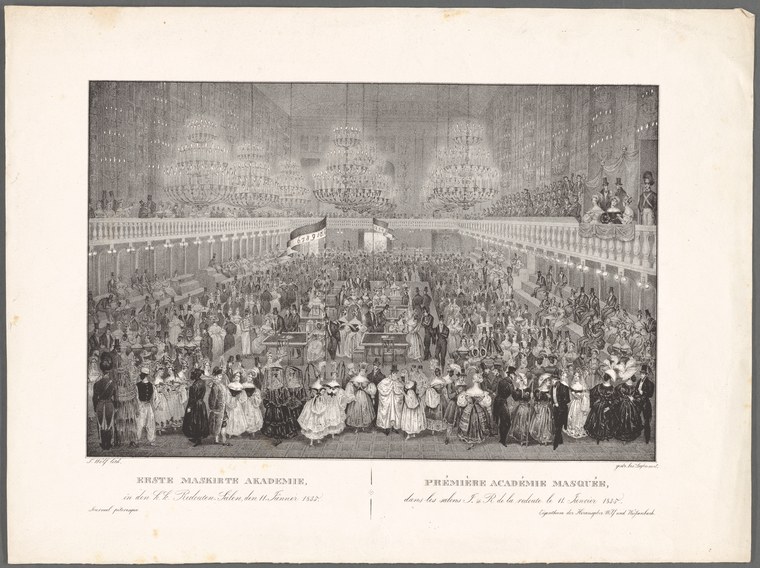
Erste Maskirte Akademie in den k.k. Redouten-Sälen, den 11. Jänner 1835
Unknown artist
- Collection:
- Prints depicting dance
- Source:
- New York Public Library
- Rights:
- Public domain — free to use, share and adapt.
- Recorded as:
- Public Domain
The image documents a pivotal moment in European dance history: the moment when the waltz and the quadrille had become the dominant forms of aristocratic social expression, and when the formal ball was a primary site of political and social performance. For historians of Viennese court culture and the ballroom era, the image provides evidence of scale, decorum, and the role of masked entertainment in Habsburg ceremonial life. For students of dance representation, it shows how the 19th century chose to memorialize dance—not through close study of individual movement, but through the spectacle and order of the ensemble.
What you are looking at
A grand masked ball in a Vienna Redoutensaal (ballroom), January 11, 1835. The composition presents a bird's-eye perspective of an immense hall with multiple crystal chandeliers illuminating the space from above. The floor is filled with hundreds of figures in evening dress and masquerade costumes, many in elaborate gowns and dark formal wear. At the center of the composition, a raised platform or dais appears to host the orchestra or dignitaries. The scene is bounded by white balustrades along the sides, beyond which seated spectators occupy gallery seating. The architectural setting emphasizes the scale and formal pageantry of the occasion: this is an official state ball rather than a private entertainment, with the density of figures, the architectural grandeur, and the careful arrangement of the composition all serving to underscore the magnificence of the event.
The dancing
The figures are rendered at a scale that prevents individual gesture analysis, which is the point of the composition: no single dancer is the subject. The hundreds of attendants appear to be in pairs or small groups, standing, promenading, or in the preparatory stances of ballroom figures. Some clusters suggest couples about to begin or mid-movement in a dance; others suggest social grouping and conversation. The women's voluminous skirts and the men's tailcoats and dress uniforms are clearly visible even at this distance. The elevated perspective flattens the scene, turning bodies into elements of pattern and pageantry rather than individual agents.
The dance depicted
This is a Viennese court ball during the height of the ballroom era, when the waltz, quadrille, and cotillion dominated aristocratic social dancing. The date—11 January 1835—and the title's reference to a masked academy ball (`Erste Maskirte Akademie`, the First Masked Academy ball) suggests this was an official or semi-official court entertainment. Multiple dances would have been performed across the evening, but the image captures the general assembly and promenade rather than a specific choreographic moment. The scale of the image and its composition emphasize the social and political spectacle of the ball—the demonstration of order, elegance, and Hapsburg authority—over individual dancing technique.
How it was made
This is an engraving, identifiable by the fine parallel line-work (hatching and cross-hatching) used to render tone and shadow, the clarity of architectural detail, and the precision with which hundreds of figures are rendered at a uniform distance. The technique is steel engraving or hand-colored engraving, which allowed for wide distribution and sale as a print. The bird's-eye perspective and the composition itself suggest a commissioned work, likely made for the Vienna nobility or court circles to commemorate the event. The print format means this image circulated beyond the hall itself, serving as a record and a celebration of Habsburg grandeur for those who attended and for collectors of contemporary engravings.
About this work
This engraved print documents a masked ball held in Vienna's Redoutensaal on 11 January 1835, during the height of the Austro-Hungarian ballroom era. Rather than isolating individual dancers or steps, the composition presents the ball as a total social spectacle—hundreds of costumed and formally dressed figures arranged within a grand architectural space. The engraving is both a historical record and a work of celebration, emphasizing the order, elegance, and political authority embodied in the formal ball. It belongs in a gallery of dance in art as evidence of how ballroom culture was imagined and commemorated in its own time: not as individual technique or romantic narrative, but as pageantry and social order made visible.
How to look at it
Look first at the architecture and the composition rather than individual figures: the balustrades, the chandeliers, the platform at the center, the galleries above. These elements frame the dancers and establish the formal, hierarchical nature of the event. Then zoom into the crowd and observe the clustering of figures, the direction of movement, and the distinction between those in motion and those standing in conversation. Notice the range of costume—some figures in elaborate masquerade dress, others in formal evening wear and military uniforms. The artist has chosen to represent the ball as a moment of general assembly and promenade, not at the climax of a particular dance; the effect is more pageant than choreography.
The period
Vienna in the 1830s was in the full flowering of the ballroom age. The waltz—still danced in the closed position that had scandalized the previous generation—had become respectable among the nobility, while the quadrille, imported from Paris, was the dominant formal dance of the court ball. The Redoutensaal was one of Vienna's premier ballroom venues, and masked balls were a traditional part of the winter carnival season. The year 1835 falls during the reign of Emperor Franz II, in the period of Metternich's political dominance and relative musical conservatism. This was the world of Lanner and the early Strauss, when dance music and ballroom dancing were central to Viennese identity. The print itself belongs to a flourishing market for commemorative engravings of court spectacles, which allowed the nobility and the upper bourgeoisie to own images of events they had attended or aspired to attend.
Where it lives
The print is held in the New York Public Library's collection of prints depicting dance. It is likely a commemorative engraving, possibly published in Vienna or as a luxury print for the European market, though no publication information is recorded in the available catalogue entry.
Dance in this work
Questions about this work
What dances would have been performed at this ball?
By 1835 in Vienna, the dominant ballroom dances were the waltz, the quadrille (or contredanse), and the cotillion. The quadrille was the most formal and would have opened the ball; waltzes in closed position would have followed, along with variations and optional dances. The masked element suggests this was a more entertainment-focused ball than the stiffest court occasions, so there may have been more variety and informality than a typical state ball.
Why is the perspective from above?
The bird's-eye view serves both practical and symbolic purposes. Practically, it allows the artist to represent the vastness of the hall and the hundreds of attendants in a single frame. Symbolically, it emphasizes order, control, and the geometric beauty of the arrangement—a view no attendant could have had, but one that conveys the magnificence and orchestration of the event. This perspective was common in prints of grand ceremonies and spectacles of this period.
Who attended these balls?
Viennese court balls were attended by the Habsburg nobility, high-ranking military officers, wealthy merchants and professionals, and select members of the upper bourgeoisie. A masked ball was slightly more permissive than a strict court occasion and allowed for some anonymity and social mixing. Women's attendance and visibility was important to the social function of the ball; the composition emphasizes the presence of women in elaborate gowns.
What does 'Maskirte Akademie' mean?
'Maskirte' means masked; 'Akademie' refers to an academy ball, which was a formal, organized entertainment often sponsored by a musical or artistic organization. This suggests the ball had some semi-public or institutional character, not purely private court entertainment. The title's use of 'Erste' (first) suggests this was a new or inaugural event of some kind.
More dance artwork





