49 works in this view — arrow keys or swipe to move between them.
Dance in Art
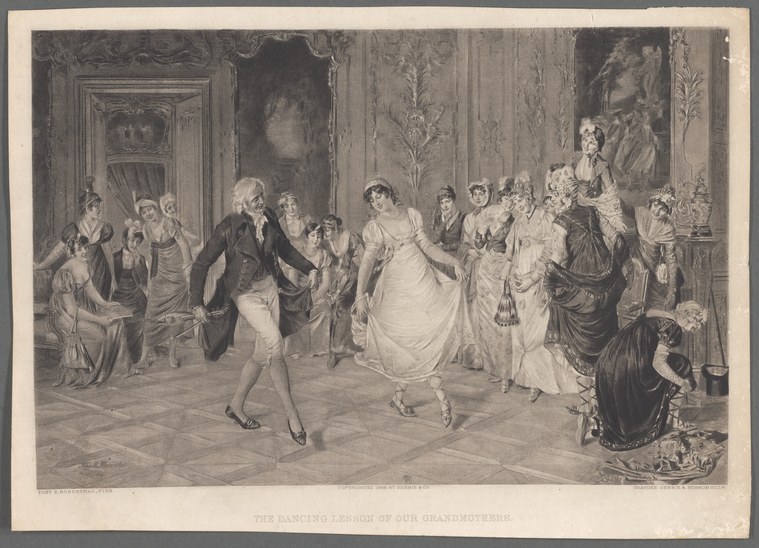
The dancing lesson of our grandmothers
Unknown artist
- Collection:
- Prints depicting dance
- Source:
- New York Public Library
- Rights:
- Public domain — free to use, share and adapt.
- Recorded as:
- Public Domain
This image is one of few surviving visual records of ordinary social dancing in the Regency period. It shows the actual spacing, dress, and comportment of dancers in their moment, offering far more precise information than written descriptions or later romantic retellings. For dancers and choreographers, it documents the physical grammar of a repertoire that shaped European social practice for over a century but left almost no notation or filmed record.
What you are looking at
A crowded ballroom or salon scene depicts a moment of social dancing among elegantly dressed figures. In the center, a woman in a white Empire-waist gown dances with a man in dark formal wear, their bodies angled in conversation and movement. Around them, spectators in dark silhouettes—women in high-waisted muslin gowns and men in tailcoats—form an intimate audience, seated and standing. The space is defined by classical architectural details: framed doorways, fluted pilasters, and decorative wall panels. The composition is lit to emphasize the central couple against the darker background figures, creating depth and focus. A small dog occupies the foreground, and scattered objects—perhaps refreshments—sit on low surfaces, grounding the scene in domestic rather than theatrical space. The print technique reveals fine cross-hatching and delicate modeling of light across the figures' bodies and the room's surfaces.
The dancing
The central couple stands in an upright, formal posture characteristic of Regency-era social dancing. The woman's right arm extends toward her partner while her left hangs naturally; the man mirrors this hold with an attentive, slightly forward inclination of his torso. Neither figure shows the weight-shifted, flowing line of Romantic ballet. The surrounding figures are poised in the attitudes of conversation and spectatorship—some seated on chairs, others standing with arms gesturing in social interaction rather than dance. The ensemble reinforces the reading of a social gathering rather than a staged performance.
The dance depicted
This is almost certainly a Regency-era cotillion, quadrille, or country dance, likely the cotillion based on the intimate scale and spectator arrangement. The title emphasizes 'our grandmothers,' suggesting this documents a form of social dance associated with an earlier generation—possibly from the perspective of the 1840s–1860s looking back to Regency fashion (c. 1811–1820). The setting and dress indicate parlor dancing rather than professional performance. The formal but unextravagant movement and the presence of attentive onlookers reflects the social protocols of Regency ballroom culture, where such dances were central to courtship and community.
How it was made
This is an engraving or steel engraving, identifiable by the fine parallel hatching, precise linear definition, and grayscale tonal modeling. The technique allowed for mass reproduction and wide circulation, typical of 19th-century popular prints. The careful modeling of fabric—the sheen of the woman's gown, the texture of the men's coats—and the atmospheric depth created through diminishing line weight in the background suggest professional execution. Such works were distributed to middle-class households as both documentary and aspirational images of refined social life.
About this work
This engraving documents the ballroom social dances of the Regency era or offers a nostalgic retrospective on them from a later 19th-century vantage. It captures a specific moment—two dancers in the center of a room while friends observe—that exemplifies how social dancing functioned as intimate, participatory entertainment within domestic and semi-public spaces. The work sits at the intersection of social history, fashion documentation, and the visual culture of courtship. For historians of dance, it provides rare evidence of how bodies were arranged, held, and presented in the most common and socially significant form of dance in this period: the cotillion or quadrille among peers.
How to look at it
Observe first the central couple: notice the formality of the frame, the slight distance between their bodies, and the upright carriage that differs markedly from ballet positions. The woman's posture is constrained by her corsetry and high-waisted gown; her movement would have been small, controlled, and articulated from the hip downward. Look at the onlookers: their placement and attention establish dancing as a shared social act, not a performance for passive consumption. The architectural setting—a parlor, not a stage—is essential to understanding what form of dance this is. Finally, attend to the print's date and inscription: 'our grandmothers' signals that the maker is already at historical distance from the dance being depicted.
The period
The Regency era (1811–1820) and the decades immediately following saw an explosion of printed social commentary, fashion plates, and leisure-time imagery aimed at the expanding middle class. Dancing was central to this culture: the cotillion and quadrille were not elite court dances but participatory social forms practiced in assemblies, private houses, and public rooms by merchants, professionals, and the gentry. By the 1840s–1860s, when this print may have been made, nostalgia for Regency elegance was fashionable, and prints depicting 'our grandmothers' would have had market appeal. The same decades saw the rise of Romantic ballet on the professional stage, creating a visual distinction between theatrical dance and social dance that this image usefully captures.
Where it lives
Held in the NYPL Prints collection as 'Prints depicting dance,' this work is catalogued with minimal metadata. It is a popular print, likely produced for broad distribution in the 19th century, and was preserved as part of an institutional effort to document visual representations of dance across periods and media.
Dance in this work
Questions about this work
What dance is being shown here?
Most likely a cotillion or quadrille, the two dominant social dances of the Regency and early 19th century. The intimate setting, the formal posture of the central pair, and the arrangement of onlookers are all consistent with these dances. The title's reference to 'grandmothers' suggests the image documents or recalls these forms from the perspective of a later generation.
Why are people watching?
In Regency-era social dancing, it was normal for people to take turns dancing while others watched, conversed, or waited for the next set. Dancing and socializing were interwoven; the spectators here are not passive audience members but participants in the social occasion.
How can you tell this is not a ballet?
The setting is a private parlor, not a stage. The woman is not on pointe, wears a high-waisted Empire gown rather than a tutu, and holds herself in an upright, constrained posture. The scale and intimacy of the scene, and the presence of named onlookers, indicate social rather than professional theatrical dance.
When was this made?
The catalogue record does not give a date. The dress and style of the engraving technique suggest the 19th century, likely mid-century (1840s–1860s). The title's nostalgic tone—'our grandmothers'—suggests it was made as a retrospective on an earlier era, perhaps 30–50 years after the dances it depicts.
More dance artwork





