49 works in this view — arrow keys or swipe to move between them.
Dance in Art
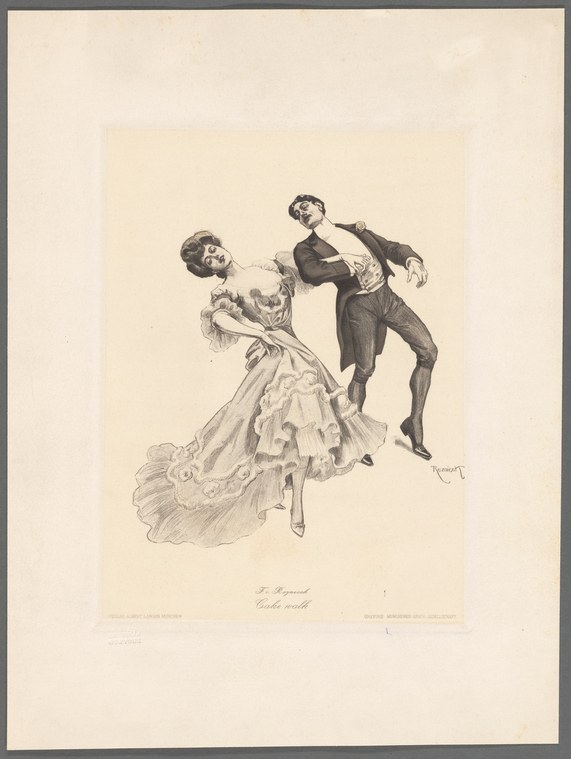
Cake walk
Unknown artist
- Collection:
- Prints depicting dance
- Source:
- New York Public Library
- Rights:
- Public domain — free to use, share and adapt.
- Recorded as:
- Public Domain
The Cake Walk is a crucial but often overlooked chapter in dance history—a social dance born in Black culture that became a craze across racial and class boundaries. This print is primary source material for understanding how the dance was performed, promoted, and visualized in its moment. It also documents a complex cultural history in which forms of Black artistic expression were embraced, adapted, and commodified by broader audiences.
What you are looking at
A man and woman in formal evening dress perform a social dance in an intimate moment captured mid-movement. The woman wears a pale, heavily ruffled gown with a train that extends dramatically across the composition, its layers of fabric rendered in delicate cross-hatching. The man is dressed in dark formal wear—tailcoat and trousers—and leans forward with his body angled toward his partner. The woman's head tilts back, her body responding to his lead, creating a sense of momentum and playful abandon. The composition is set against a plain background with soft shading that gives the figures subtle volume and presence. The drawing style is elegant and economical, capturing the essential gesture of the dance through minimal line work.
The dancing
The male dancer guides from a position of clear lead, his weight forward and his frame open. The woman follows with her body curved away from him in a counterbalance typical of turn-based social dances of the era. Her right arm extends while her left appears to be in contact with her partner. Both figures display the upright posture and deliberate poise of ballroom dancers, though the woman's abandoned head position suggests a moment of theatrical joy or abandon in the movement. The spacing between them is consistent with a closed or semi-closed hold.
The dance depicted
This work depicts the Cake Walk, a social dance that emerged in African American communities and became a widespread ballroom craze in the late 19th and early 20th centuries. The Cake Walk combined high-stepping, promenading movements with a strutting, theatrical quality, and was frequently performed socially and on stage. The print captures the essential character of the dance: the gentleman's proud, forward carriage and the woman's responsive, exuberant follow, with particular emphasis on the display and movement of her elaborate skirt. The artist has chosen to show not competition or rigid form but the playful, sociable energy for which the dance was known.
How it was made
This is an engraving or lithograph on paper, executed in black ink with careful cross-hatching to create tonal values and volume. The signature visible in the lower right appears to be 'Penot' or similar. The technique allows for fine linear detail in the figures' silhouettes while the shading gives the clothing, especially the woman's gown, sculptural presence. The clarity and delicacy of line suggest this was likely a mass-produced print intended for periodicals or popular distribution, consistent with its housing in a collection of dance imagery.
About this work
This is a late 19th or early 20th-century print documenting the Cake Walk at the height of its popularity as a social dance. The work captures the characteristic posture and energy of the dance through skillful figure drawing and compositional balance. It belongs in a gallery of dance in art because it records not a classical or staged performance but a living social practice, showing how the dance was understood and marketed to a general audience during a period of significant cultural exchange and appropriation. The image serves as evidence of how the Cake Walk, created in African American communities, became a phenomenon in mainstream ballroom culture.
How to look at it
Observe the tilt of the woman's head and the forward pitch of the man's body—the artist has frozen a moment of dynamic exchange rather than static posture. Notice how the woman's layered skirt fills the lower half of the composition, making the costume itself nearly as much the subject as the movement. The elegant, economical line work emphasizes gesture over anatomical detail, allowing the viewer to read the dancers' intent and mood instantly. The composition is deliberately intimate and graceful, presenting the Cake Walk not as a spectacle but as a moment of connection between partners.
The artist
The artist is not recorded in the catalogue. The signature appears to read 'Penot,' and the style is consistent with fin-de-siècle commercial illustration and music-hall ephemera. Without further documentation, the artist's identity and practice remain uncertain.
The period
The Cake Walk emerged in the 1880s from African American culture, initially as a parody of European ballroom etiquette and later as an independent dance form with its own aesthetic. By the 1890s it had become a mainstream ballroom craze, performed in dance halls, on vaudeville stages, and in fashionable ballrooms across Europe and America. The same period saw a surge in popular music and dance prints aimed at amateur dancers and society audiences. In the fine arts, there was growing interest in capturing movement and contemporary social life, influenced by photography and the graphic innovations of the period.
Where it lives
This print is held in the New York Public Library's collection of prints depicting dance. It is part of a larger archival effort to document dance imagery and its circulation in popular culture.
Dance in this work
Questions about this work
What is the Cake Walk and why is it historically important?
The Cake Walk was a social dance created in African American communities in the 1880s, initially as a satirical performance response to European ballroom conventions. It became a mainstream craze by the 1890s and spread across the United States and Europe. The dance is historically significant as a source and symbol of Black creativity that was widely adopted and adapted by mainstream culture, raising important questions about cultural ownership, appropriation, and exchange in American dance history.
How was the Cake Walk performed?
The Cake Walk combined high-stepping, prancing movements with a strutting, exaggerated posture. Dancers moved in couples or sometimes in processional lines, emphasizing the movement of the skirts and the proud carriage of the body. The dance had a playful, theatrical quality and was often performed to ragtime or syncopated music. This print shows the typical couple formation and the forward, responsive posture of the partners.
Who would have made and used prints like this?
This print was likely created for a mass audience of amateur dancers, society audiences, and ballroom enthusiasts. It could have been published in a music or dance periodical, sold as a separate print for home display, or distributed as sheet music cover art. The quality of the engraving and the clarity of the image suggest it was produced for commercial distribution rather than as a unique work.
More dance artwork





