49 works in this view — arrow keys or swipe to move between them.
Dance in Art
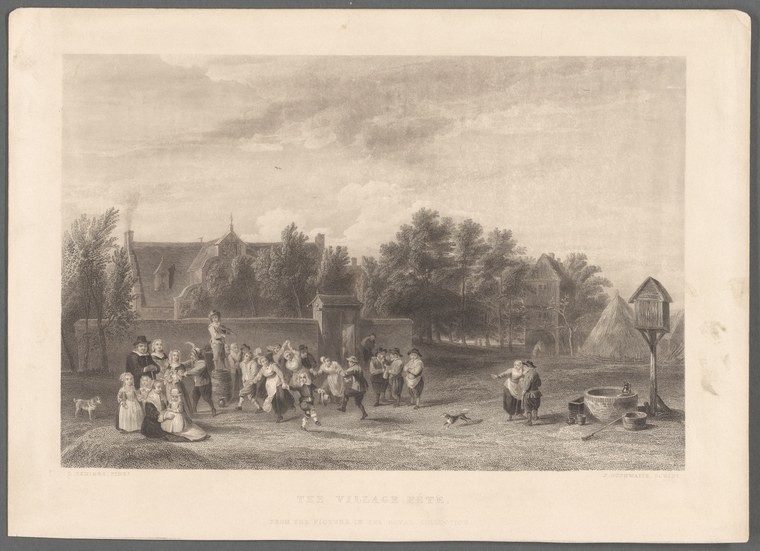
The village fete, from the picture in the Royal Collection
Unknown artist
- Collection:
- Prints depicting dance
- Source:
- New York Public Library
- Rights:
- Public domain — free to use, share and adapt.
- Recorded as:
- Public Domain
This work documents the visual vocabulary and social practice of country dancing in the early 19th century, showing dancers in their actual context of community use rather than in the stylized forms of ballet or urban ballroom. The engraving's faithful reproduction of an earlier painting preserves the Romantic era's vision of peasant and village life at a moment when that vision was already nostalgic—the working landscape and social forms it depicts were already changing under industrialization.
What you are looking at
A village celebration unfolds in an open space before a church with a tall steeple, rendered in the soft tonal range of a 19th-century engraving. Two dozen figures gather in clusters across the foreground—some dancing, others standing in conversation, a few seated on the ground. The composition is loosely organized around the dancing figures at left-center, where couples move together while onlookers form a semi-circle. The architecture frames the scene: the church with its Gothic windows and steep roof anchors the background left, while domestic cottages with pitched roofs line the middle distance. Trees punctuate the landscape; a well or wayside shrine stands on the right. The light is even and diffuse, suggesting an afternoon gathering. The figures' dress—long skirts, jackets, bonnets—places the scene in the 19th century, but the print technique and composition suggest it copies an earlier painted work, possibly from the Romantic era's enthusiasm for rural and peasant subjects.
The dancing
The dancers visible in the left group appear to move in couple formation, with men and women in face-to-face or side-by-side orientation typical of country dances. Their posture is upright, arms held in a restrained manner appropriate to formal country dancing of the period. The engraving's soft cross-hatching limits fine detail of footwork, but the dancers' weight appears grounded and their movement social rather than virtuosic. Several figures stand with arms at rest, watching the dance; one or two seated figures occupy the foreground, creating a sense of leisure rather than performance.
The dance depicted
This is a village or country dance, almost certainly a reel, cotillion, or quadrille as danced in rural 19th-century Britain or Europe. The outdoor setting, the mix of dancers and spectators, and the couple-based formations all point to a social community event rather than a stage performance. The artist has chosen to show the informal, participatory character of village festivity—not the isolation of a dance as spectacle, but its integration into the gathering and conversation of the community. No musicians are visible, though they may stand beyond the frame, or the music may be implied as ambient to the scene.
How it was made
The catalogue record does not specify a medium, but the image is plainly an engraving or possibly a lithograph, executed in the linear and tonal vocabulary of 19th-century printmaking. The soft modeling, fine line work, and monochromatic finish are characteristic of steel or copper engraving; the catalogue description notes this is a reproduction of a painting in the Royal Collection, making this a reproductive print—a common form of circulation for celebrated paintings before photography. The technique allowed wide distribution of the image among educated audiences and collectors who could not see the original painting.
About this work
This engraving reproduces a Romantic-era painting of village festivity, capturing the social dance of rural life in the early 19th century. The work exemplifies the period's aesthetic interest in the picturesque and authentic life of the countryside, rendered with careful attention to costume, character, and the mingled business of a community gathering. It preserves a moment of country dancing as social practice rather than theatrical spectacle—the dance as one strand in the woven fabric of village life, not the center of a staged performance. The print's circulation suggests the appeal of such scenes to middle-class audiences of the Victorian era and beyond.
How to look at it
Attend to the composition's careful balance between the dancers and the crowd: the artist has made the dance active but not dominant, integrated into the larger texture of village gathering. Notice the spectators' postures and placements—the seated figures, the standing watchers, the clusters in conversation—which together suggest that dancing is one expression of community life rather than a performance for an audience. The soft, even light and the careful rendering of dress and architecture convey the artist's respectful, documentary interest in the scene; this is not burlesque or grotesque caricature, but a faithful record of how rural people gathered and moved together.
The period
The early 19th century saw a surge of romantic and picturesque interest in rural life and folk customs, particularly among educated urban audiences. Painters and printmakers created idealized scenes of village festivals, harvest gatherings, and country dances, investing peasant life with moral virtue and aesthetic charm. At the same time, the codification of ballroom dancing in the Regency and early Victorian era—waltz, quadrille, cotillion—was creating new formal standards for dance among the elite, which made traditional country dances appear quaint and historically remote. This print sits at that intersection: a reproduction of a painting celebrating the beauty of a social form that was already becoming a memory of rural England or continental Europe.
Where it lives
The print is held in the New York Public Library's collection of prints depicting dance. The catalogue note identifies it as a reproduction of a painting in the British Royal Collection, indicating it was created as a dissemination of a significant painted work.
Dance in this work
Questions about this work
What dance are they doing?
Most likely a reel, cotillion, or quadrille—the standard couple-dances of rural Britain and Europe in the early 19th century. The engraving does not capture enough detail of footwork or formation to be certain, but the outdoor setting and informal grouping point to country dancing rather than the formal ballroom versions of these same dances.
Is this a painting or a print?
It is an engraving—a reproductive print made after a painting in the Royal Collection. The painting is the original work; this engraving is a dissemination of it, created for circulation to collectors and audiences who could not see the painting itself.
When was it made?
The date is unknown, but the style and technique suggest the 19th century. The painting it copies is likely from the Romantic era (early 1800s) or possibly earlier, but the engraving could have been made decades later as part of a campaign to reproduce celebrated paintings in the Royal Collection.
Where in the world is this set?
The architectural style and dress suggest rural Britain or northern continental Europe in the early 19th century, but the work is not inscribed with a specific location. The artist has created a generic but convincingly detailed village landscape that could stand for rural life in several regions.
More dance artwork





