49 works in this view — arrow keys or swipe to move between them.
Dance in Art
Carro di Teti
Unknown artist
- Collection:
- Prints depicting dance
- Source:
- New York Public Library
- Rights:
- Public domain — free to use, share and adapt.
- Recorded as:
- Public Domain
This work preserves evidence of intermedio—the elaborate, short-lived court spectacle form that was central to Renaissance artistic culture but survives now primarily through prints and written descriptions. For historians of dance and theater, such engravings are primary documents: they show how professional performers and courtiers moved, how gesture and narrative were integrated, and how allegorical meaning was encoded in the body. The work demonstrates that Renaissance dance extended far beyond the ballroom into a theater of myth and power.
What you are looking at
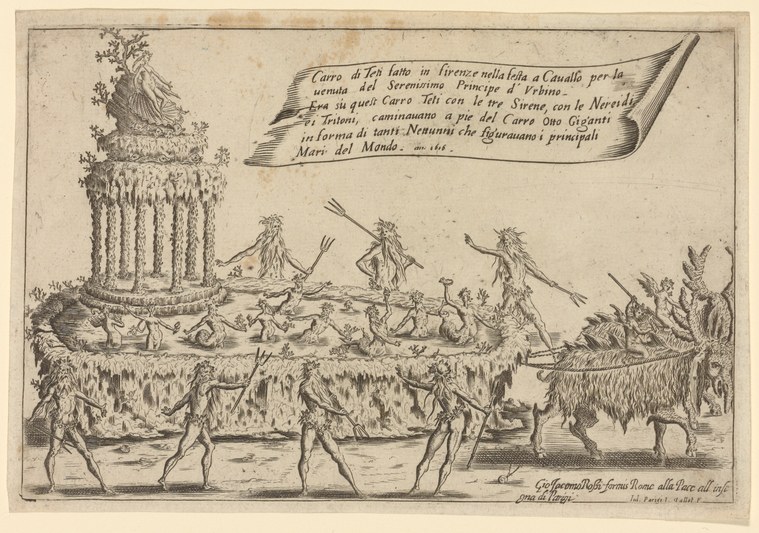
This is an engraving depicting an elaborate allegorical procession or triumphal car (carro), likely from sixteenth-century Italian court spectacle. At the center stands a tall cylindrical structure resembling a decorated tower or temple, crowned with ornamental foliage and topped by a figure. The structure is supported by a platform decorated with relief sculptures and draped fabrics. Below, a procession of figures—mostly unclothed or lightly draped in classical style—surrounds and carries the car. Some appear to be dancing or gesturing expressively with raised arms and extended limbs, while others stride or gesture in what may be representations of mythological or allegorical figures. The composition is crowded and theatrical, with figures overlapping in depth. The inscription in the banner at top identifies this as the "Carro di Teti" (Chariot of Tethys), connected to festivities in Florence honoring the Serene Prince of Urbino. The engraving technique creates fine hatching and linear detail, rendering the scene in black and white with strong contrasts that emphasize the dramatic poses and rich architectural ornament.
The dancing
The dancers and attendant figures display highly expressive classical poses: arms raised overhead, extended to the sides, and reaching outward in open gestures characteristic of Renaissance interpretations of antique ecstasy or triumph. Bodies are depicted in various orientations—some frontal, others in profile or three-quarter view—creating a sense of movement and circulation around the central car. The figures are unclothed or draped in flowing classical garments, with musculature rendered through line and shadow. There is no closed partner hold; instead, the figures move as a group or processional ensemble, some in animated poses suggestive of the vigorous movement vocabulary of Renaissance court spectacle and allegorical dance. The framing suggests these are not refined ballroom dancers but mythological attendants or personified abstractions acting out a narrative of procession and celebration.
The dance depicted
This represents an intermedio or court spectacle of the type that flourished in Renaissance Florence and across Italian courts. The chariot of Tethys (the sea nymph) was a common allegorical subject in court pageantry, often appearing in wedding festivities and celebrations of princely power. The figures surrounding the car enact the mythological drama through expressive gesture and bodily movement rather than the structured, codified steps of court dance; they function more as performers in a theatrical drama set to music. The dance vocabulary here is gestural and narrative rather than technical—open arm positions, dynamic weight shifts, and exuberant movement suggest the influence of classical rhetoric and interpretations of ancient tragedy and comedy. Such spectacles were designed to be spectacular rather than participatory, combining architecture, sculpture, music, poetry, and bodily movement into a unified courtly experience.
How it was made
This is an engraving, identifiable by the fine parallel lines (hatching) used to create tone and shadow, the crisp linear definition of form, and the characteristic black ink on white paper. The technique allowed for detailed rendering of both architectural ornament and human anatomy across a complex multi-figure composition. Engravings of court spectacles were commissioned as commemorative prints and circulated widely among courts and educated collectors, functioning as both documentary records and artistic prestige objects. The inscription in Italian at top indicates this was created for a Florentine audience, likely produced shortly after the event it depicts to commemorate and immortalize the spectacle for those who witnessed it and for distant patrons. The fine quality of the engraving suggests it was made by a professional printmaker, not a casual artist.
About this work
The Carro di Teti is a Renaissance court spectacle engraving documenting an allegorical procession created for Florentine princely celebration. It captures a moment from the intermedio tradition—the elaborate multimedia performances that bridged drama, music, dance, and architecture in sixteenth-century Italian courts. The work records not a ballroom dance or folk tradition but rather the theatrical and gestural movement vocabulary of court spectacle: expressive, narrative-driven, and grounded in classical allusion. The dancing figures are mythological attendants activated by the spectacle's narrative rather than trained dancers executing a choreographic form.
This engraving belongs in a gallery of dance in art because it documents how Renaissance courts understood and deployed movement as a medium of political and cultural meaning. The dancers here are not performing a dance form we can name—no specific steps, holds, or technical vocabulary are visible—but rather embodying abstract and mythological concepts through the language of the body. It is a record of movement as spectacle, allegory, and courtly power.
How to look at it
Attend first to the central architectural monument: it anchors the composition and explains why these figures are gathered and moving. Then trace the procession of attendant figures around it, noting how the engraver has differentiated their poses and gestures to suggest different roles in the narrative—some more active and animated, others more statuesque. Look at the arms especially: the raised, open positions and extended reaches are characteristic of how Renaissance artists rendered classical ecstasy and expressive gesture. The engraver has frozen a moment of movement-in-progress—these figures are not posed at rest but caught mid-gesture, suggesting the fluid, dynamic character of the spectacle. The dense overlapping of figures and the layered spatial construction convey the scale and complexity of an actual court performance.
The artist
The artist is not recorded. The engraving was likely commissioned by Florentine court or by the workshop of a court artist, created to commemorate and circulate the spectacle. Such commemorative prints were often made by professional engravers working from sketches or firsthand observation of court performances. The technique and inscription suggest a trained hand working within the established conventions of Renaissance court documentation.
The period
This engraving dates from the mid-to-late sixteenth century, during the height of the intermedio tradition in Italy. Intermedi were elaborately staged entertainments that punctuated dramatic performances or celebrated princely occasions; they combined music, poetry, machinery, costume, and dance into a unified spectacle. Florence was a center of this culture under the Medici, who commissioned such works to demonstrate their artistic patronage and political power. Concurrently, the codification of court dance was underway in works by Domenico da Piacenza and later by Baltazarini and others—but these formal court dances were distinct from the more overtly theatrical and narrative movement of the intermedio. The allegorical and classical subject matter reflects the Renaissance recovery and reinterpretation of antique literature and philosophy.
Where it lives
This engraving is held in the New York Public Library's collection of prints depicting dance. It is a commemorative print created to document and circulate a court spectacle, functioning as both a historical record and an artwork in its own right.
Dance in this work
Questions about this work
What is an intermedio?
An intermedio was an elaborate theatrical entertainment performed at Italian courts, especially in Florence, during the sixteenth and early seventeenth centuries. Intermedi were typically inserted between the acts of a dramatic performance or staged to celebrate a wedding, diplomatic visit, or princely occasion. They combined music, poetry, elaborate scenery and stage machinery, costume, and dance into a unified allegorical spectacle. Unlike court dances, which followed codified steps and holds, intermedi emphasized theatrical narrative and expressive gesture.
What is the Carro di Teti and why is it significant?
The Carro di Teti (Chariot of Tethys) was a specific allegorical structure created for a court celebration in Florence. Tethys is a figure from classical mythology—a sea nymph associated with fertility and abundance. Such chariots were standard elements of court spectacle, combining sculpture, architecture, and mythology to flatter the prince and demonstrate the court's artistic sophistication. The inscription indicates this particular spectacle was created to honor the Prince of Urbino and celebrate his relationship with Florence.
How do we know what people danced like in the Renaissance if there are no videos?
We rely on primary documents: written descriptions of spectacles, treatises on dance technique (like those by Domenico da Piacenza), and visual records like this engraving. Engravings and paintings show us body positions, gesture, costume, and the spatial relationship between dancers. Combined with written sources, these images allow historians to reconstruct movement vocabulary, understand social contexts, and see how dance was integrated into larger cultural forms like the intermedio.
Is this the same as ballet?
No. This is intermedio—a court spectacle that combines dance with theater, music, and architecture. Ballet as a codified dance form was still developing during this period. While both were court forms, ballet emphasized technical training and a specific vocabulary of steps and positions, whereas intermedi prioritized narrative and expressive gesture. Later, ballet would become more prominent and intermedi would decline.
More dance artwork





