49 works in this view — arrow keys or swipe to move between them.
Dance in Art
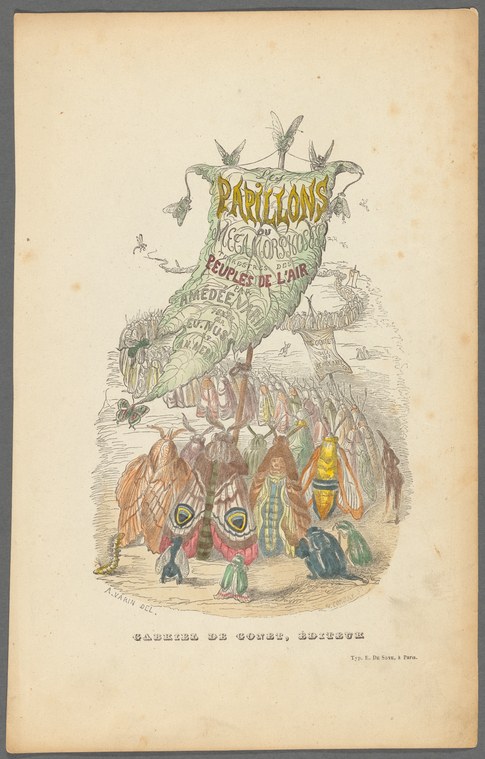
Les papillons, ou metamorphoses terrestres des peuples de l'air
Unknown artist
- Collection:
- Prints depicting dance
- Source:
- New York Public Library
- Rights:
- Public domain — free to use, share and adapt.
- Recorded as:
- Public Domain
This image preserves evidence of a theatrical dance tradition—the insect spectacle—that is now largely lost. It shows how 19th-century choreographers and designers used costuming, stacking, and pyramidal composition to create visual metaphors for transformation and metamorphosis, techniques that influenced later avant-garde and experimental theater. For historians of theatrical dance and costume, it documents a moment when the boundaries between natural history, fantasy, and bodily performance were deliberately collapsed for popular entertainment.
What you are looking at
This is a whimsical allegorical engraving depicting a towering fantastical structure built from insects and their metamorphic forms. The composition is vertically stacked: at the base, a crowd of human figures in 19th-century dress gaze upward in wonder or consternation. Above them rises an elaborate architecture of butterflies, caterpillars, moths, and other insects, each labeled in French with their common and scientific names. The structure is crowned with the word "PAPILLONS" (butterflies) in large golden letters. The entire construction has the quality of a cabinet of curiosities rendered as performance—a tower of living forms that seems simultaneously natural history lesson, decorative fantasy, and social commentary. The setting is spare but suggests an exhibition or theatrical presentation; the human figures below are dressed in the fashion of the 1830s–1840s, with women in bonnets and men in top hats, arranged as if witnessing a spectacle.
The dancing
The human figures at the base are arranged in loose groupings, heads tilted back, bodies in attitudes of observation or amazement rather than active dance. Their poses suggest spectatorship rather than participation. The insects above are rendered in precise naturalistic detail despite their fantastic stacking, with wings spread, antennae raised, bodies in postures that read almost as frozen mid-flight or mid-transformation. There is no human body-to-body contact or partnering; the relationship is observer to observed.
The dance depicted
This is not a depiction of a recognizable dance style in the conventional sense. However, it is a theatrical or carnival spectacle—a form of popular entertainment that incorporates movement, disguise, and metamorphosis as central concepts. The title *Les papillons, ou metamorphoses terrestres des peuples de l'air* (Butterflies, or the terrestrial metamorphoses of the peoples of the air) suggests this may represent an actual theatrical production, likely a pantomime or féerie (fairy play) that was popular in Paris during the 1830s–1840s. Such productions frequently featured elaborate transformations, insect choruses, and costume spectacles. The 'dance' here would be implicit in the choreographed movement of costumed performers representing insects, organized into an architectural or pyramidal composition—a form of ensemble spectacle dance.
How it was made
This is a hand-colored engraving or possibly a lithograph with hand-coloring (the soft tones and the naturalistic rendering of insect coloration suggest color was applied after printing). The technique allowed for precise reproductive detail—each insect is individually rendered and labeled—combined with imaginative composition. The hand-coloring in greens, golds, browns, and flesh tones gives the image immediacy and visual richness; it would have circulated as a popular print, likely as an illustration to a playbill or as a souvenir of a successful theatrical production. The fineness of line and the architectural precision suggest a skilled printmaker working from a design that may itself have been preparatory to stage design.
About this work
This work documents or imagines a 19th-century Parisian spectacle—a theatrical event in which human performers disguised as insects created a living architecture of metamorphosis and wonder. The image is simultaneously natural-history document, stage design, and popular print, capturing the moment when Romantic-era theater embraced spectacular transformation and the fantastic. It belongs in a gallery of dance imagery because it records a form of ensemble spectacle in which the human body was reorganized, hidden, and reanimated as something other—a practice central to 19th-century popular theater and its cousins in circus, pantomime, and féerie.
How to look at it
Notice how the artist has rendered the insects with the same precision and scientific accuracy as a naturalist's plate, while organizing them into an impossible, theatrical architecture. The human figures below are essential: they mark scale, amazement, and the boundary between the real and the fantastical. Attend to the poses of the insects—wings spread, bodies twisted—as if caught mid-flight or mid-performance. The composition's verticality and its framing within a proscenium-like border suggest this may have been a stage design or an illustration of an actual stage spectacle.
The artist
The artist is not recorded in the catalogue. The style and execution suggest a professional Parisian printmaker of the 1830s–1840s, working in the naturalistic-fantastical tradition that flourished around theatrical illustration. The inscription at the bottom indicates publication by a Parisian house (partially legible as "V. de l'Estoc, r Pres"), suggesting this was a commercial print with wide circulation.
The period
The 1830s–1840s were the heyday of the Parisian féerie and pantomime, genres that grew from earlier harlequinade traditions but embraced spectacular set design, transformation scenes, and ensemble choreography. The reign of Louis-Philippe saw a boom in commercial theater, and prints like this one documented and advertised theatrical successes. Simultaneously, natural history was becoming fashionable among the middle classes, and fantastical natural-history imagery (particularly insects and metamorphosis) was a common trope in children's literature and popular prints. This work sits at the intersection: it marries theatrical spectacle with the aesthetics of scientific illustration, in service of both entertainment and popular education.
Where it lives
This is a hand-colored print from the New York Public Library's collection of prints depicting dance. It was likely created as a theatrical souvenir or playbill illustration, and its survival in a collection focused on dance suggests it was recognized as such by earlier cataloguers.
Dance in this work
Questions about this work
Was this an actual theatrical production?
Almost certainly. The precision of the design, the theatrical framing, and the commercial printing technique all suggest this documented or promoted a real performance. Insect ballets and metamorphosis spectacles were popular féerie subjects in 1830s Paris. This print likely served as advertisement or souvenir.
How would performers have danced this?
Costumed dancers would have been arranged in close formation or stacked on tiered platforms, wearing elaborate insect costumes with wings, antennae, and painted or sculpted body pieces. The 'choreography' would have been primarily about stillness, synchronized poses, and slow transformations between formations, rather than individual footwork.
What does 'metamorphoses terrestres des peuples de l'air' mean?
It translates roughly as 'terrestrial metamorphoses of the peoples of the air'—playing on the classical myth of metamorphosis while suggesting the transformation of aerial creatures (insects) into earthly, bodily, human form through costume and performance.
More dance artwork





