49 works in this view — arrow keys or swipe to move between them.
Dance in Art
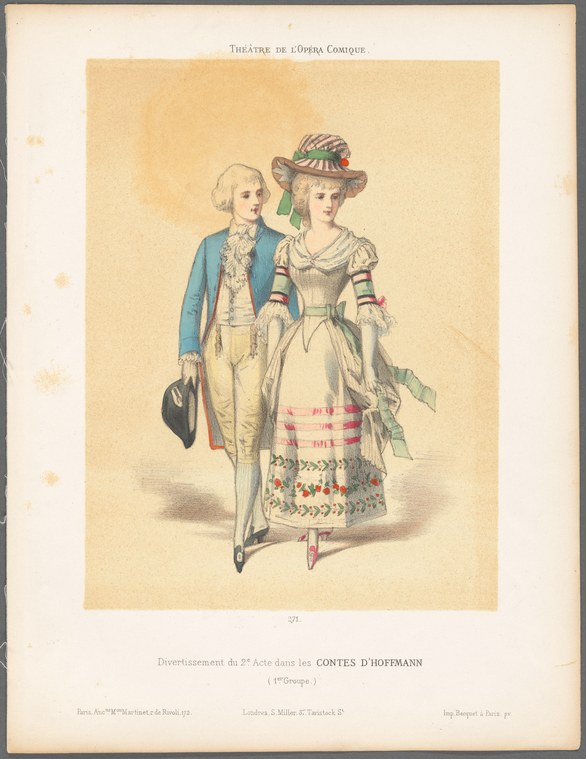
271. Divertissement du 2e. acte dans Les contes d'Hoffmann (1er groupe), Théâtre de l'Opera Comique
Unknown artist
- Collection:
- Prints depicting dance
- Source:
- New York Public Library
- Rights:
- Public domain — free to use, share and adapt.
- Recorded as:
- Public Domain
For dance historians, this print is evidence of how choreography and costume worked together in 19th-century opera, and of the divertissement as a formal narrative device. For costume and theater historians, it is a precise record of Empire-waist dress, bonnet styling, and men's formal wear of the period, rendered at a moment when such documentation was being industrialized and distributed as a form of theatrical marketing and memory.
What you are looking at
A man and woman stand together in a moment of theatrical courtship or flirtation, rendered in hand-colored engraving in the style of 19th-century opera costume documentation. The man, at left, wears a blue coat with elaborate lace cravat and holds his hat in one hand, his posture leaning slightly toward his companion in a gesture of attention and charm. The woman, at right, is dressed in an Empire-waist white gown with short puffed sleeves decorated with green ribbon, and wears a fashionable bonnet trimmed with feathers and a green bow; her skirt displays delicate embroidered or printed borders in pink and gold that cascade toward the hem. Both figures stand on an implied stage floor against a warm ochre background. The drawing style is precise and elegant, capturing the finesse of formal costume design rather than the energy of movement—this is a fashion plate for operatic dress, not a scene of active dancing.
The dancing
The two figures are posed in a formal, slightly tilted conversation—the man inclined toward the woman in a posture of courtship, the woman facing forward with a demure or coquettish expression. Neither figure is in motion; both stand with weight evenly distributed and arms relaxed at their sides or held naturally. There is no suggestion of a closed or open dance hold; the spatial relationship is one of social proximity rather than partnership in movement. The composition emphasizes the elegance and detail of their clothing over the physicality of dance.
The dance depicted
This image depicts a divertissement (entertainment or dance interlude) from Act 2 of Offenbach's *Les Contes d'Hoffmann* (*The Tales of Hoffmann*), one of the most celebrated opéras comiques of the 19th century. The work belongs to the tradition of the opéra comique, which typically included ballet or dance scenes as part of the dramatic narrative. A divertissement in this context is a choreographed interlude, often featuring ensemble or solo dance, that advances the plot or provides visual spectacle. The couple shown here likely represents two characters from one of Hoffmann's romantic adventures. However, this particular print does not capture the dance itself—it is a costume study, documenting the dress worn by performers in this scene rather than recording the movement or choreography.
How it was made
This is a hand-colored engraving or lithograph, typical of 19th-century theatrical documentation. The base image is printed in fine black lines; color has been applied by hand in watercolor or gouache, a labor-intensive method that made these prints valuable records of costume and character design. The technique allowed for precision in rendering textile detail—the lace, ribbons, embroidery, and trim are rendered with clarity and nuance that would not survive a photograph of the stage. Such prints were published as souvenirs and costume reference, circulating among theater practitioners, costume makers, and opera enthusiasts, making them primary sources for the visual history of 19th-century opera performance.
About this work
This is a hand-colored theatrical costume print documenting two performers in a scene from Offenbach's *Les Contes d'Hoffmann* as staged at the Théâtre de l'Opéra Comique. The work belongs to a rich tradition of operatic fashion documentation in which costume studies were published and circulated separately from the libretto or score, serving both as mementos for audiences and as reference material for future productions. The image captures the aesthetic of opéra comique in the 19th century—a genre that synthesized music, spoken dialogue, and theatrical spectacle, including dance interludes. Although the print itself shows figures in static pose rather than in motion, it testifies to the importance of the visual and choreographic dimension of opera, and to the care with which operatic companies curated the appearance of their performers.
How to look at it
This image should be read as a costume document rather than a dance record. Attend to the precision of the textile rendering—the embroidery, trim, and ribbon work—which suggests the economic investment in stage costume at a major opera house. The formal, slightly tilted poses of the two figures capture the refined social codes of 19th-century operatic courtship scenes, in which gesture was restrained and expression communicated through posture and costume rather than through energetic movement. The warm background color, the careful attention to light and shadow on the fabrics, and the elegant line work throughout reveal the hand-coloring process and the skill of the artisans involved in producing these theatrical souvenirs.
The artist
The artist is not recorded in the catalogue. The print bears the marks of professional theatrical printmaking: it was published by the Parisian firm Ault & Cie and printed by Imp. Bourgot à Paris, indicating it was part of a commercial series of operatic costume documentation. Such prints were typically created by staff artists or minor illustrators working within publishing houses, and rarely attributed by name, making individual artists difficult to recover.
The period
This print dates to the era following the 1881 premiere of *Les Contes d'Hoffmann*, when Offenbach's opera had become a staple of European opera houses and was widely performed. The 19th-century opéra comique, despite its name, was not comic but rather a sung opera with spoken dialogue, and it regularly included ballets and divertissements as structural elements. The theatrical costume print was a product of industrial lithography and hand-coloring, a technology that allowed opera houses and publishers to mass-produce images of celebrated performers and fashionable stage costume, feeding a robust market for operatic memorabilia among middle-class audiences.
Where it lives
This print is held in the New York Public Library's collection of prints depicting dance, an archive that brings together theatrical and choreographic imagery across media and centuries. The catalogue identifies it as documentation from the Théâtre de l'Opéra Comique and notes that it shows the first group (1er groupe) in the divertissement of Act 2, indicating that multiple scenes or ensemble configurations existed within this single theatrical sequence.
Dance in this work
Questions about this work
Is this a record of what the dance actually looked like?
No. This is a costume study created for circulation as a theatrical souvenir and reference document. It captures the dress and social positioning of two performers in a moment of operatic courtship, but not the choreography, movement quality, or spatial organization of the divertissement itself. To understand the actual dance, one would need to consult the choreographer's notes, reviews, or photographs from a later performance.
Who were the performers shown here?
The catalogue does not identify them. Theatrical costume prints of this period were often published without naming individual performers, especially in ensemble scenes or minor roles. The image documents a 'type'—the romantic male and female characters in a Hoffmann episode—rather than specific historical figures.
What is a divertissement in opera?
A divertissement is a choreographed interlude or entertainment scene, often danced, that appears within an opera or play to advance the plot or provide spectacle. In *Les Contes d'Hoffmann*, the second-act divertissement is part of the action in which Hoffmann pursues one of his romantic interests, and it typically featured elaborate costumes, multiple dancers, and sometimes elaborate stage machinery.
Why was this printed and distributed?
Theatrical costume prints served multiple purposes: they were souvenirs for audiences to purchase and keep as mementos of a performance; reference documents for costume makers and theaters producing future performances; and marketing materials that celebrated the visual splendor of the opera house. Hand-colored prints were labor-intensive and relatively expensive, making them a luxury good that also signaled the cultural prestige of the theater.
More dance artwork





