49 works in this view — arrow keys or swipe to move between them.
Dance in Art
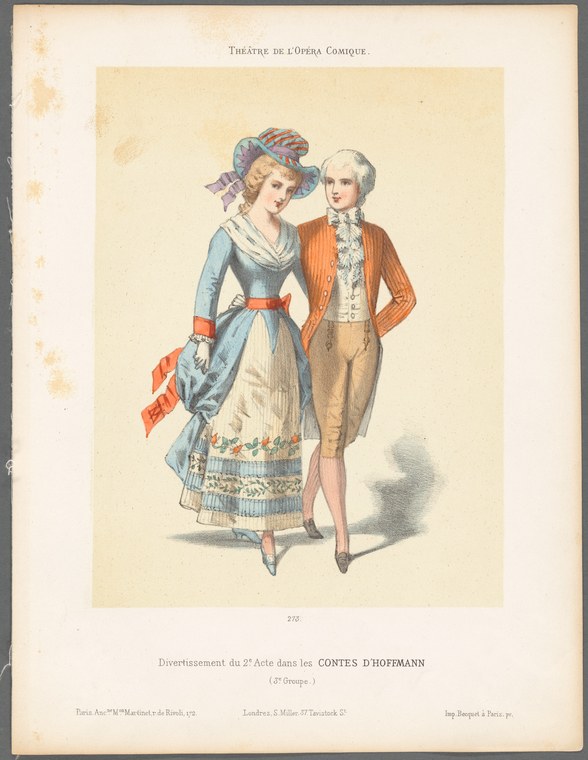
273. Divertissement du 2e. acte dans Les contes d'Hoffmann (3e groupe), Théâtre de l'Opera Comique
Unknown artist
- Collection:
- Prints depicting dance
- Source:
- New York Public Library
- Rights:
- Public domain — free to use, share and adapt.
- Recorded as:
- Public Domain
This image records a form of theatrical dance—the operatic divertissement—that was central to 19th-century popular entertainment but is often overlooked in dance history, which tends to privilege concert ballet. The engraving preserves both the physical gesture and the costume design, showing how dance was integrated into narrative spectacle and how gender was performed through dress, posture, and social positioning on stage. For anyone studying the history of theater dance, operatic conventions, or Victorian stagecraft, this is direct evidence of what an audience saw and how the scene was remembered and circulated.
What you are looking at
A hand-colored engraving depicts two elegantly dressed figures in a moment of theatrical courtship or flirtation, likely from a mid-19th-century opera production. The woman on the left wears a blue silk dress with a fitted bodice, red cuffs, and a white underskirt trimmed with decorative blue bands; a large blue bonnet with ribbon trim frames her face. She holds a red fan in her gloved hand and turns slightly toward her companion with a composed, sidelong gaze. The man on the right, dressed in a rust-orange coat and buff breeches in the style of the 1840s–50s, stands in profile with his hand raised in a gesture of attentive address. The composition is set against a plain cream background with a soft shadow beneath their feet, emphasizing the theatrical artificiality of the moment. The print's title identifies this as a scene from Act 2 of Offenbach's *Les Contes d'Hoffmann*, specifically a divertissement or entertainment number within the opera.
The dancing
Both figures are upright and formally composed, their bodies angled toward each other in a conversation or wooing pose typical of operatic pantomime. The woman's posture is poised and controlled, with her weight settled, her fan held at waist level as a prop of feminine refinement. The man's raised arm and forward-leaning torso suggest courtly address or gallant persuasion. Neither figure shows the strenuous movement or athletic extension associated with classical ballet; this is gestural and social rather than virtuosic. The spatial relationship—close but not in formal dance hold—suggests a moment of dramatic business rather than an executed dance step.
The dance depicted
This is almost certainly not depicting a ballet dance proper but rather a danced or semi-danced theatrical scene—a divertissement—within an opéra comique production. The *Contes d'Hoffmann* (Offenbach, 1881) was a sung drama that integrated music and spectacle; such intermezzos often included balletic elements, processions, and pantomimic tableaux rather than formal dance composition. The styling and the title's reference to "groupe" (group number) suggest this was one moment within a larger ensemble scene. The dress and bearing are consistent with mid-Victorian theatrical convention rather than with the aesthetic or technique of concert ballet.
How it was made
This is a hand-colored engraving or chromolithograph, a reproduction technique ideal for theatrical costume reference and audience memory. The fine lines and precise rendering of fabric detail—the pleated underskirt, the ribbon trim, the texture of silk—allowed spectators to study the elaborate production design. The coloring is applied after printing, with careful separation of hues: the blue dress, rust coat, cream ground, and red accents are laid down in distinct zones. This technique, typical of mid-19th-century theater documentation, was economical enough to allow wide distribution among opera-goers and theater enthusiasts, making it a form of theatrical publicity and souvenir.
About this work
This engraving documents a moment from a divertissement in Offenbach's *Les Contes d'Hoffmann*, a comic opera that wove together music, spectacle, and theatrical dance within a sung narrative. It is not a ballet image per se but a record of how dance and dramatic pantomime functioned within the opéra comique tradition—a popular European form that blurred the boundaries between sung drama, spoken dialogue, comedy, and dance. The work belongs in a dance gallery because it shows the range of theatrical movement beyond the concert ballet stage: the choreography of courtship, the grammar of operatic gesture, and the role of costume and prop in theatrical storytelling. For dance historians, it documents the aesthetic of mid-Victorian stagecraft and the way the dancing body was dressed and positioned within a mixed-media spectacle.
How to look at it
Look at the posture and hand position: both figures are frozen in a moment of social address rather than physical exertion. The woman's stillness and the man's gesture-in-mid-address suggest this is a pause for dramatic effect, not an executed step. The costume is the primary focus—note how the engraver lavished detail on the fabric, trim, and silhouette, which tells us that the visual spectacle of dress was as important as movement. The composition itself, with both figures shown in three-quarter or profile view against a blank ground, is typical of theatrical prints meant to be studied as costume and character reference rather than as a dynamic action scene. This is documentation of theatrical presence, not choreographic virtuosity.
The artist
The artist is not recorded. The print was published by Martinet & Marchand (Paris) and printed by Becquet & Noël (Paris), firms specializing in theatrical portraiture and costume documentation in the mid-19th century. These publishing houses made their business from producing hand-colored engravings of operatic and dramatic scenes, sold to aficionados of the theater and to actors and singers as records of celebrated performances. The unsigned engraver was a skilled technician working within an industrial theatrical-print enterprise.
The period
This print dates to the era of opéra comique's greatest popularity in France and Europe—the 1840s–50s. Offenbach's *Les Contes d'Hoffmann*, if this is from that specific production, premiered in 1881, but the style and publishing house suggest this may be from an earlier operatic divertissement of the same title or tradition, or a later revival. The 1840s–50s were the heyday of theatrical lithography and hand-colored theatrical prints; this format allowed rapid dissemination of costume and scene designs to a paying public. Simultaneously, concert ballet was establishing itself as a distinct art form (Romantic ballet, *La Sylphide*, *Giselle*), but operatic dance remained a major venue for choreography and spectacle. The two forms were gendered differently and occupied different social spaces: ballet appealed to a refined, elite audience; opéra comique drew a broader, more commercially oriented public.
Where it lives
This engraving is held in the New York Public Library's collection of prints depicting dance. It is part of a broader archival practice of documenting theatrical spectacle through chromolithographic reproduction, a standard method of theater publicity and souvenir production in the 19th and early 20th centuries.
Dance in this work
Questions about this work
Is this a ballet?
Not in the classical concert sense. This is a scene from an opéra comique—a sung theatrical drama that incorporated dance, pantomime, and spectacle. The divertissement was an entertainment number within a larger narrative, more akin to modern musical theater than to concert ballet. The movement shown here is gestural and social rather than virtuosic.
What is an opéra comique?
Opéra comique was a French theatrical form that combined sung arias, spoken dialogue, comedy, and spectacle. Despite the name, it was not necessarily comic; the term simply meant a drama with music, as opposed to grand opera (which used only sung recitative). It was enormously popular in the 19th century and was the dominant form of musical theater outside of concert venues.
What was a divertissement?
A divertissement was an interlude or entertainment number inserted into a larger work—a dance, procession, comic scene, or musical number that allowed a change of pace and showcased the theater's spectacle. In ballet, divertissements were non-narrative dance showpieces; in opera, they were often more theatrical and less purely choreographic.
How does the costume tell us about the dance?
The elaborate dress, bonnet, and fan signal that this is a scene of social and erotic drama rather than of physical exertion. Heavy fabrics, restrictive silhouettes, and decorative excess would have constrained large movements. The dance of this period was often a dance of pose, gesture, and controlled spatial positioning rather than of virtuosic extension or speed.
More dance artwork





