49 works in this view — arrow keys or swipe to move between them.
Dance in Art
Vignettes
Unknown artist
- Collection:
- Prints depicting dance
- Source:
- New York Public Library
- Rights:
- Public domain — free to use, share and adapt.
- Recorded as:
- Public Domain
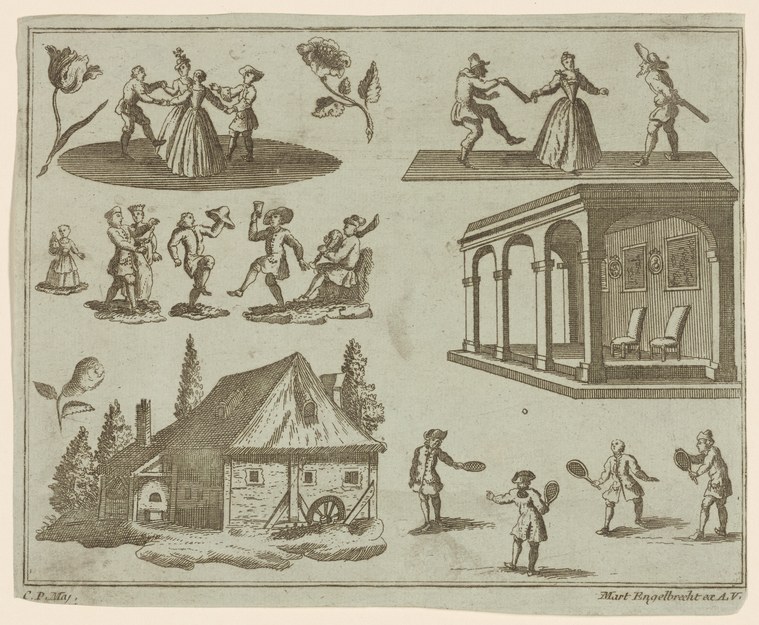
This print documents the social role of dance in early modern life and the visual conventions used to represent it. Dancers and historians of courtly dances benefit from seeing how contemporaries understood and depicted the mixture of formal and informal movement, the clothing, and the occasions that generated social dance. The inclusion of garden architecture and multiple simultaneous scenes also shows that early modern dance was not isolated or staged but embedded in entertainment, courtship, leisure, and social hierarchy.
What you are looking at
This is a composite print showing multiple vignettes of social entertainment, likely from the 17th or 18th century. The composition is divided into six distinct scenes arranged across the page. The upper scenes depict couples and groups in what appear to be garden or courtyard settings, with figures in formal dress engaged in social interaction and movement. A woman in a long dress with a full skirt stands at the center of the upper left vignette, flanked by male figures in period costume. The upper right shows similar courtly figures in motion. The lower left contains a group of smaller figures in rapid movement or play, suggesting folk or comic entertainment. The lower center shows a substantial architectural structure—a pavilion or garden house with classical columns, striped awning, and ornamental details, establishing the setting as a place of leisure and entertainment. The lower right depicts three figures in simpler dress engaged in what appears to be a more vigorous or athletic form of play. A large decorative flower or tulip extends from the upper left margin. Throughout, the figures wear the structured garments typical of early modern court or aristocratic society: long skirts for women, breeches and jackets for men, and period headwear.
The dancing
The bodies are rendered in the style of early modern prints: schematic rather than anatomically precise, with emphasis on the silhouette of dress and the direction of movement rather than musculature or weight distribution. The couple in the upper left stand nearly upright in a formal arrangement, with the woman's arm held by the male figure. In the group scene (lower left), multiple figures are shown in exaggerated postures of play—leaning, bending, and reaching—suggesting energetic or comic action. The three figures in the lower right adopt wider stances and more dynamic arm positions, suggesting faster or more athletic movement. None of the figures show the turned-out positions or specific technical vocabulary of ballet; the movement is social and recreational rather than codified.
The dance depicted
These appear to be depictions of aristocratic social dancing and entertainments, most likely from the 17th century based on costume and architectural style. The formal couples suggest courtly dances such as the pavane or galliard, which were central to court life in this period. The group scenes and the more vigorous lower figures suggest also the inclusion of folk or comic entertainments that would have been performed at garden parties or country houses—the kind of mixed entertainment documented in period sources. The architectural structure points toward the garden as the setting for such occasions. Without inscription or clearer identifying details, the specific dances cannot be named with certainty, but the image appears to be a kind of social calendar or anthology of approved entertainments.
How it was made
This is an engraving or etching, identifiable by the fine parallel lines used to create tone and shadow, the regular linear hatching, and the characteristic appearance of the printed line. The maker has used a single plate and printed it on laid paper; there is wear visible in some lines and the overall softness of impression suggests later rather than early printing from the plate. The technique allowed for wide circulation among educated and courtly audiences—such prints were common as pattern-books for behavior, fashion, and entertainment, distributed in collections or bound into albums. The small scale and multiple scenes per sheet suggest this was economical to produce and distribute, making it a commercial print rather than a unique or luxury object.
About this work
This composite print documents the social entertainments of the aristocracy or upper mercantile classes in early modern Europe, most likely the 17th century. It shows dancing, play, and courtyard leisure as integrated parts of garden or country-house life. The image is valuable not for depicting a single choreographic moment but for showing the contexts in which social dance occurred—the dress codes, the architectural settings, the mixture of formal couples and informal groups, the presence of music or accompaniment. It belongs in a gallery of dance in art because it captures the function and appearance of dance in daily aristocratic life, before dance became primarily a theatrical or professional practice.
How to look at it
Look first at the architectural frame—the garden pavilion in the lower center grounds all the other scenes in a specific social and spatial context. Then observe the progression from the most formal couple (upper left) through increasingly informal groups and more athletic play (lower scenes), which may represent a sequence of entertainment or a catalog of acceptable behaviors. Notice the costume details: the width of skirts, the length of jackets, the style of headdresses—these anchor the print to a specific moment in fashion history. Finally, attend to the proportions of the figures and the schematic way the print-maker has rendered their gestures: these are not studies from life but conventional signs meant to be read quickly and understood by anyone familiar with courtly society.
The artist
The print is unsigned and the artist is not recorded. The mark 'C.P. fecit' and the signature 'Mord Spedrocke ex A.V.' or similar (the print is difficult to read in these areas) suggest it may be a copy or state from a Northern European print series, possibly Dutch or Flemish, from the 17th century. The style and subject matter are consistent with the large commercial production of social-conduct and fashion prints that circulated in this region and period.
The period
In the 17th century, dance was undergoing significant change. At court, the pavane and galliard were gradually giving way to newer forms like the minuet, which would dominate the 18th century. Simultaneously, printed images of social life and fashion became a major medium for teaching and normalizing aristocratic behavior. This print sits at the intersection: it shows dancing as a visual marker of courtliness and rank, but also as something that could be instructed, learned, and regulated through printed models. The garden setting also reflects the period's investment in the country house and landscape as places where social life could be refined and displayed.
Where it lives
The work is part of the NYPL's collection of prints depicting dance. It is catalogued as a vignette or composite print and is a representative example of the commercial prints of social entertainment that were widely distributed in early modern Europe. The collection preserves such prints as primary sources for understanding how dance and courtly behavior were visualized and taught.
Dance in this work
Questions about this work
What dances are shown in this print?
The specific dances cannot be identified with certainty from the image alone. The formal couple in the upper left may depict a pavane or galliard; the group scenes suggest folk entertainments or games. The print appears to be a composite or anthology of social amusements rather than a documentation of a single dance form.
When and where was this made?
The costume, architecture, and printmaking style suggest a date in the 17th century, most likely the second half. The artist is not recorded, but the style and signature suggest a Northern European, possibly Dutch or Flemish, origin. Such prints were widely produced and circulated as commercial objects.
Who would have used or looked at this print?
Prints like this served multiple audiences: courtiers learning fashion and behavior; artists and designers seeking models; wealthy households decorating albums; and the curious or leisured public interested in depictions of aristocratic life. They were practical teaching tools as well as entertainment.
Why is the garden pavilion so prominent?
The architectural setting emphasizes that social dance in this period was not confined to ballrooms or theaters but was part of everyday aristocratic life in gardens and country houses. The pavilion signals both luxury and leisure, marking this as entertainment of the wealthy.
More dance artwork





