49 works in this view — arrow keys or swipe to move between them.
Dance in Art
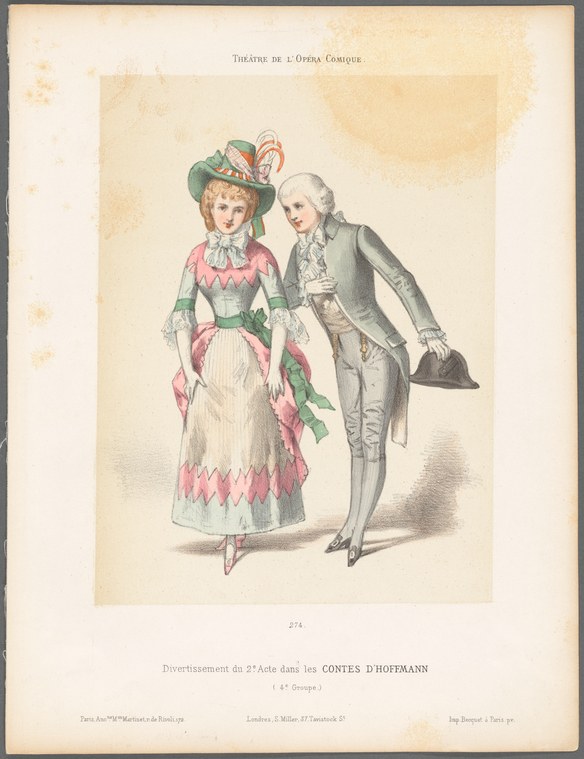
274. Divertissement du 2e. acte dans Les contes d'Hoffmann (4e groupe), Théâtre de l'Opera Comique
Unknown artist
- Collection:
- Prints depicting dance
- Source:
- New York Public Library
- Rights:
- Public domain — free to use, share and adapt.
- Recorded as:
- Public Domain
For historians of 19th-century theatrical dance, this print documents the visual and sartorial conventions of the opéra comique, a form in which dance and mime were inseparable from music and stagecraft. It shows how dancers and singers moved and posed in a professional theatre of the 1880s—not as virtuosos executing technique, but as actors and entertainers inhabiting a narrative moment. The print is also evidence of how operatic performance was commodified and circulated to the public through illustrated series, making theatre visible to those who could not attend the Opéra Comique itself.
What you are looking at
A fashionably dressed couple in a theatrical interior presents a divertissement—a light entertainment number—from the second act of Offenbach's *Les Contes d'Hoffmann* (The Tales of Hoffmann). The woman wears an elaborate costume in shades of green and pink: a fitted bodice with a pink collar and cuffs, a white skirt with deep pink scalloped trim at the hem, and a green hat adorned with feathers and ribbon. She stands in a relaxed, conversational pose with her weight on one leg, one arm extended. The man, in gray breeches and a tailored jacket, leans slightly toward her in a posture of attention and gallantry, holding his hat in one hand. The scene is rendered in hand-colored lithography with fine detail, the figures set against a soft wash background that suggests an interior stage space. The poses and dress place this unmistakably in the theatrical fashion and manners of the 1880s–1890s, and the scene captures a moment of social interaction rather than active dance movement—a typical structure for operatic diversissement.
The dancing
Both figures are upright and relatively still, positioned in a three-quarter view that presents them to the viewer as if on stage. The woman's posture is graceful but static; her raised arm is soft and conversational rather than lifted for movement. The man bows slightly from the torso in a gesture of courtship, his frame open and responsive to the woman's presence. Neither figure shows the tension or extension of active dance technique; instead, they embody the stylized mime and deportment expected of operatic soloists in a sung scene. The composition is intimate rather than kinetic—two individuals in social interchange.
The dance depicted
This is an operatic divertissement from *Les Contes d'Hoffmann*, which premiered in Paris in 1881. The work calls for light, sung entertainment with stylized movement and mime rather than ballet proper. The moment depicted appears to be a flirtation or romantic scene between two characters in the opera's narrative, shown at the threshold between gesture and dance. The theatrical dress, the indoor setting, and the posed but not-quite-dancing quality of the figures are all consistent with the French opéra comique tradition of the 1880s, where such interludes mixed song, spoken dialogue, and choreographed but fundamentally theatrical movement. The image does not document an actual dance step or formation, but rather the costuming and social staging through which opera presented light musical theatre.
How it was made
This is a hand-colored lithograph, a technique that allowed rapid production and wide circulation of theatrical imagery. The outline and forms are rendered in fine detail, with the color applied afterward by hand or in a limited lithographic key, creating the soft, layered appearance visible here. The technique was standard for French theatrical prints of the late 19th century, produced and sold to the opera-going public as souvenirs and as documentation of costume and casting. The relative delicacy of the line and the careful registration of color suggest a Paris-based publisher (the credit line indicates London and Paris publishers). Such prints were often distributed as part of a numbered series depicting scenes from a single work, making them collectible records of operatic productions.
About this work
This hand-colored lithograph documents a moment from the second act of Offenbach's *Les Contes d'Hoffmann* as performed at the Théâtre de l'Opéra Comique in Paris, likely in the 1880s or early 1890s. It is one of a numbered series of prints (marked "274") that recorded scenes from the opera's production for sale to theatregoers and collectors. The work sits at the intersection of theatrical documentation and dance imagery: while it depicts costumed figures in a staged interior, it captures the divertissement tradition in which operatic entertainment blended sung vocal performance, mime, and light choreography. The image preserves both the costume design and the social mise-en-scène of French opera, showing how spectacle and social interaction were bound together on the operatic stage.
How to look at it
Attend to the stillness of these figures. Neither is caught in active movement; instead, they are posed in a moment of social exchange. The artist has chosen to freeze a gesture of courtship or flirtation—the man's bow, the woman's open but graceful stance—rather than a moment of dance technique. This reflects the operatic tradition in which movement was always yoked to narrative and character interaction. Notice too the precision of the costume: every trim, every feather, every fold of fabric is rendered with theatrical clarity. For a 19th-century theatregoer, this print served partly as a record of what was worn, what was seen, and how the stage looked. The soft background wash and the frontal presentation of the figures locate them in a theatre space, not a dance studio.
The artist
The artist is not recorded in the catalogue. The print is credited to Paris and London publishers, suggesting a commercial theatre-print workshop of the 1880s–1890s. Such prints were produced by specialist firms in Paris who employed engravers and colorists to create costume documentation and scene illustrations for operatic and theatrical works. The numbering and series format suggest institutional production rather than individual artistic practice.
The period
In the 1880s, *Les Contes d'Hoffmann* was a major success of the French operatic stage, having premiered at the Opéra Comique in 1881. The work is a fantastical opera combining music, spectacle, and theatrical machinery, with a structure built around three episodes (acts) in which the protagonist encounters different women in different dramatic registers. The second act, set in Venice, features lighter, more comedic material than the supernatural and tragic sections. This was the era of the operatic divertissement as a form: a brief, showy interlude of song and stylized movement designed to entertain without advancing the plot. French opera of this period was heavily invested in costume, visual spectacle, and the blending of musical and choreographic elements. The lithographic series documenting such productions was a new form of theatrical merchandise, making the opera house visible to a broader public.
Where it lives
This print is part of the New York Public Library's collection of prints depicting dance, drawn from the Prints and Photographs division. It is numbered 274 in a series documenting scenes from *Les Contes d'Hoffmann* at the Théâtre de l'Opéra Comique. The series format and the publishing credits to both London and Paris printers suggest wide distribution and commercial value.
Dance in this work
Questions about this work
Is this actually a dance scene?
Partially. It documents an operatic divertissement—a light theatrical interlude that combined song, mime, and choreographed movement. The moment frozen here is one of social gesture and flirtation rather than active dance technique, which reflects how such scenes were performed. The figures are costumed performers on a stage, and the print records the visual spectacle of theatrical performance in the 1880s.
Who created this print?
The artist's name is not recorded. It was produced as part of a commercial series by a Paris and London publishing firm, likely around the 1880s–1890s, during or shortly after the opera's premiere. Such prints were created by workshop teams of engravers and colorists.
What is an opéra comique?
Despite its name, French opéra comique was not necessarily comic. It was a theatrical form combining music, spoken dialogue, and spectacle, distinct from grand opera. *Les Contes d'Hoffmann* is one of the most famous examples. Divertissements like the one shown here were brief interludes of entertainment—sung, acted, and lightly choreographed—inserted into the narrative.
Why is this in a dance collection?
The print documents theatrical performance, costume, and choreographed movement in a professional opera house of the 1880s. For historians of dance, it provides evidence of how performers moved, posed, and dressed in an era before film or photography could record live performance in detail. It is a primary source for the visual culture of theatrical dance.
More dance artwork





