49 works in this view — arrow keys or swipe to move between them.
Dance in Art
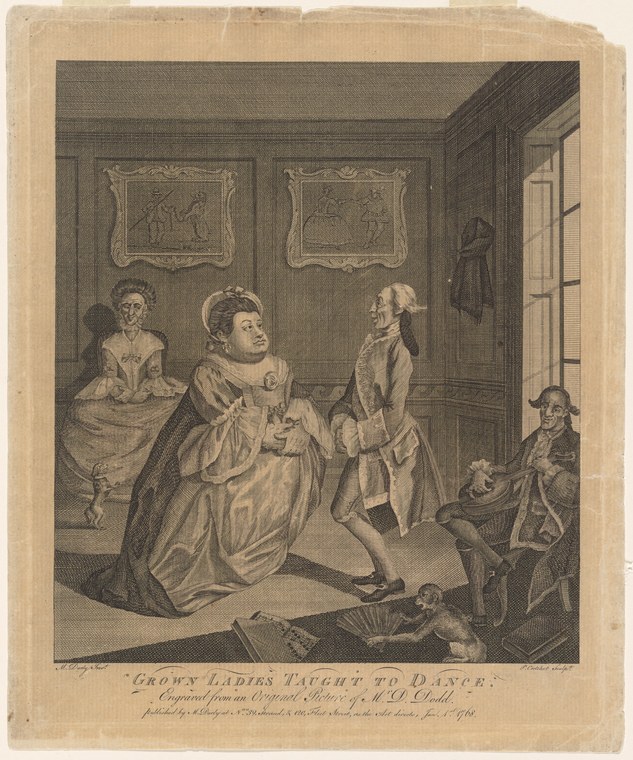
Grown ladies taught to dance
Unknown artist
- Collection:
- Prints depicting dance
- Source:
- New York Public Library
- Rights:
- Public domain — free to use, share and adapt.
- Recorded as:
- Public Domain
This engraving reveals the cultural anxieties surrounding adult female dance instruction in the eighteenth century, showing that learning to dance was a contested marker of gender and age. For dance historians, it documents not technique but perception—how the dancing body became a site of social ridicule when it belonged to an older woman attempting to acquire skills marked as youthful. The print's circulation in the NYPL collection means it reached a broad audience, making satire itself a historical form of discourse about dance practice.
What you are looking at
An engraved satirical scene showing five figures in an interior space with paneled walls and two framed pictures above. A woman in the center wears an elaborate gown with a train and stands with exaggerated posture, her body arched backward in an unnatural position. To her left, a seated woman watches; to her right, a thin man in coat and breeches gestures with one arm extended. Two additional figures occupy the lower right, including what appears to be a child or youth. The floor is bare except for scattered objects. The architectural setting suggests a drawing room or salon, with tall windows visible on the right side. The composition emphasizes the central woman's contorted pose as the focal point, while the other figures react with expressions ranging from attentiveness to indifference.
The dancing
The central female figure displays an exaggerated backward arch with arms positioned across her torso and extended limb—a pose that defies natural balance and suggests mockery rather than skillful dancing. The male instructor or partner on the right leans forward with one arm raised in a teaching or guiding gesture, his body language suggesting demonstration or correction. The seated woman on the left maintains an upright posture typical of an observer or chaperone. The overall arrangement shows the clarity of satirical convention: an awkward pupil, an instructing master, and witnesses to the absurdity unfolding.
The dance depicted
The title 'Grown Ladies Taught to Dance' identifies this as a satire on adult women learning to dance—a social practice that appears to have been considered ridiculous or improper in the period depicted. The exaggerated backward arch of the central figure is not recognizable as any period dance technique but rather a caricature of a failed or grotesque attempt at dance movement. The male figure's teaching posture suggests instruction in a fashionable ballroom style, likely minuet or cotillion, but the print ridicules the female pupil's inability or unwillingness to execute it properly. This is social commentary on gender, age, and the pretensions of adult female self-improvement rather than documentation of actual dance practice.
How it was made
This is an engraving, identifiable by the fine parallel lines (hatching) used to create tone and shadow, the precise linear definition of forms, and the characteristic printed quality. The technique allows sharp satirical detail: the exaggerated proportions of the central figure's pose, the telling expressions on bystanders' faces, and the precise rendering of period costume and furnishings are all enhanced by engraving's capacity for fine, controlled line work. The medium's expense and labor-intensity suggest this was a commercial print intended for a paying audience, likely circulated among the educated classes who would recognize the social satire.
About this work
This is an eighteenth-century satirical engraving depicting the cultural anxieties around adult women learning fashionable dance. Rather than showing actual dance instruction, it mocks the very idea through exaggeration and caricature—the central female figure's grotesque backward arch is presented as the humorous failure of a mature woman attempting to master a young person's accomplishment. The print belongs to a tradition of social satire that used the body and movement as vehicles for commentary on gender roles, aging, and social aspiration.
For dance historians, the work is valuable not as evidence of how dance was actually taught or performed, but as insight into how dance instruction—particularly for women—was perceived and ridiculed in period culture. It shows that adult female dance education was a visible enough social practice to merit satirical treatment in commercial prints, and that the body positions of fashionable dance could be rendered grotesque through exaggeration to comic or scornful effect.
How to look at it
Attend to the central figure's pose: the backward arch is rendered with anatomical precision precisely to make it look unnatural and ridiculous. The engraver has captured the exact moment of failure or absurdity, freezing the body in a position no competent dancer would hold. Notice too the reactions of the other figures—particularly the man's instructional gesture and the seated woman's composed observation—which frame the central figure's pose as an object of scrutiny and judgment. This compositional device is characteristic of satirical prints, which present the ridiculous body as a spectacle for the viewer's judgment.
The artist
The artist is not recorded. The style, subject matter, and execution are consistent with eighteenth-century English or continental European satirical printmaking, a commercially successful genre that produced works for middle-class consumption. Satirical engravings of this period often targeted social pretension, gender roles, and the manners of the rising merchant and professional classes, making the print part of a substantial visual literature of social commentary.
The period
In the eighteenth century, dance instruction and fashionable dance were marks of gentility and social standing, but they were conventionally associated with youth, particularly young unmarried women. Adult women, especially older women, engaging in dance instruction would have appeared incongruous—a violation of age-appropriate behavior. Simultaneously, the period saw increasing commercialization of dance instruction and the rise of dance as entertainment and social practice across broader social classes. Satirical prints like this one document the cultural boundaries around who should dance and when, even as those boundaries were being tested by changing social practices.
Where it lives
The work is held in the NYPL's Prints collection depicting dance, one of a substantial subset of satirical and documentary images from the eighteenth and nineteenth centuries. As a commercial engraving, it was produced for sale and distribution, making it representative of how dance was discussed and judged in the print media of its period.
Dance in this work
Questions about this work
Is this about actual dance instruction?
No. This is satirical social commentary using exaggerated body positions and facial expressions to mock the idea of adult women learning dance. The central figure's backward arch is not a real dance technique but a caricature of failure. The print ridicules the very notion of grown women pursuing dance instruction, suggesting it was seen as socially inappropriate or absurd.
What style of dance is being taught?
The male figure's posture and the formal interior setting suggest instruction in fashionable ballroom dance of the period—likely minuet or cotillion. However, the satire deliberately prevents us from seeing actual technique: the female pupil's pose is grotesque precisely because it is meant to be unrecognizable as proper dance.
Why would adult women learning dance be considered funny?
In eighteenth-century culture, dance instruction and performance were conventionally markers of youth and marriageability, especially for women. An adult woman, particularly an older one, pursuing such instruction violated cultural expectations about age-appropriate behavior. The satire suggests that mature women should accept their social position rather than attempt to acquire youthful accomplishments.
More dance artwork





