49 works in this view — arrow keys or swipe to move between them.
Dance in Art
Folk and ethnic dancing in wood engravings
Unknown artist
- Collection:
- Prints depicting dance
- Source:
- New York Public Library
- Rights:
- Public domain — free to use, share and adapt.
- Recorded as:
- Public Domain
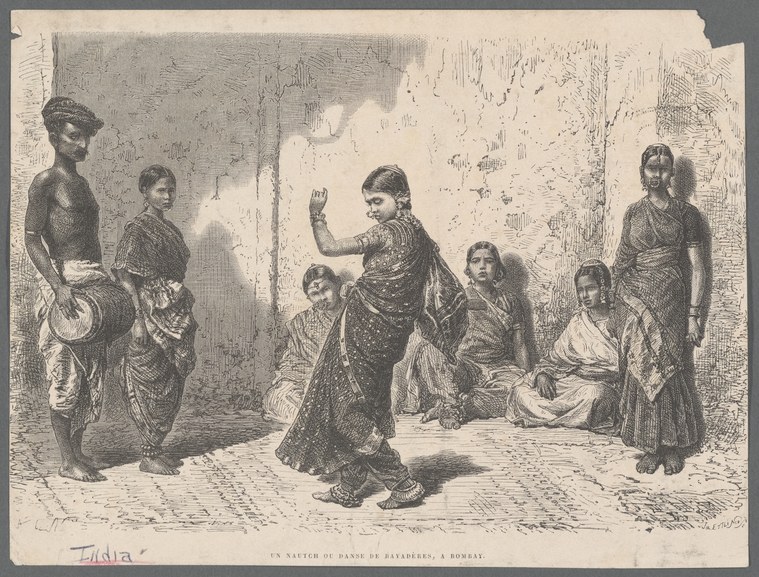
The work documents how Indian dance traditions were observed, interpreted, and visualized for Western audiences at a moment when colonial power structures shaped both the dance itself and its representation. The reference to 'Bayaderes' (temple dancers, often conflated with courtesans in European accounts) reveals how colonial discourse transformed and sexualized Indian female performers. For dance historians, the image preserves both the physical vocabulary of the performance and the social context in which it was embedded—information that formal written records often omit.
What you are looking at
A wood engraving depicting a street scene in Bombay (Mumbai) where a woman in an ornate sari with decorative bindi and jewelry stands at the center, gesturing expressively with raised arm. She is surrounded by seated and standing onlookers—women and children in traditional dress—who watch her intently. The setting appears to be a narrow alleyway with textured stone or plaster walls rendered in fine crosshatching. The gathered crowd and the woman's animated posture suggest a moment of performance or spiritual expression, captured with the observational detail characteristic of Victorian-era travel reportage. The composition draws the eye to the central figure's movement against the static frame of the assembled witnesses.
The dancing
The central dancer stands with weight forward, one arm raised at approximately shoulder height with palm open and fingers extended—a gesture suggesting blessing, invocation, or emphasis. Her torso is engaged and turned slightly, shoulders mobile. Around her, five to seven figures remain seated or standing at varying distances, creating a performing space. The gathered crowd suggests both audience and intimate participation in a social or spiritual act. No visible dance hold or partnering; the movement appears solo and gestural rather than footwork-based.
The dance depicted
The image likely depicts a form of Indian street performance or devotional expression, possibly related to temple dancing, folk narrative performance, or ecstatic religious practice. The ornate sari, bindi, and jewelry identify the subject as South Asian female. The gathered crowd in a narrow street suggests an impromptu or semi-formal public performance rather than staged theatre. The raised arm and expressive upper body are consistent with Indian classical or semi-classical dance vocabulary, but the street setting and informal assembly suggest this may be documenting vernacular or devotional movement rather than formal Bharatanatyam or Kathak. The inscription partially visible at the bottom references Bombay and 'Danse de Bayaderes'—the French colonial term for temple dancers—which would place this within the tradition of Indian temple or courtesan dancing as understood by European observers of the period.
How it was made
This is a wood engraving, a relief printing technique executed with fine linear marks and careful crosshatching to create tone and shadow. The technique produces a high-contrast image suitable for mass reproduction in books, periodicals, and newspapers. The dense technical detail—the weave of the sari, the texture of the walls, the individual expressions of the crowd—suggests an engraving made from a drawn or painted original, likely created by a European artist working from sketches or memory. Wood engraving was the dominant medium for illustrated reportage in the mid-to-late nineteenth century, allowing rapid circulation of images from colonial territories to European and American audiences.
About this work
This wood engraving documents a moment of Indian street performance or devotional dance as witnessed and interpreted by a Victorian-era European observer. The work sits within a tradition of colonial visual reportage that rendered South Asian dance and daily life for metropolitan audiences, often through the lens of Orientalist aesthetics. The image captures both the physical language of the performance—the raised arm, the engaged torso—and the social context of gathering and attention that frames it as a performance event. As a work of popular illustration rather than fine art, it circulated widely and shaped European understanding of Indian dance practice during the nineteenth century.
How to look at it
Attend first to the geometry of attention: the artist has positioned the viewer as a member of the crowd, looking at the dancer from the same angle and distance as the other onlookers. This compositional choice creates empathy with the gathered witnesses while maintaining slight distance from the performance itself. Notice the animator's choice of gesture—the raised arm and forward weight capture a moment of emphatic expression rather than virtuosic movement, suggesting that the work documents presence and spiritual or emotional power rather than technical display. The careful rendering of dress, jewelry, and facial features insists on the specificity of the individual performer rather than a generic 'type,' even as the colonial framing of the image as exotic spectacle undermines that specificity.
The artist
The artist is not recorded. The style and subject matter suggest a European illustrator working in the mid-nineteenth century tradition of colonial reportage and travel illustration. The fine technical skill and detailed observation indicate professional training in wood engraving, a medium that required both artistic and craft expertise. Such illustrations were commonly produced by staff artists and engravers working for illustrated periodicals (such as the Illustrated London News) or for books of travel narrative, and often based on sketches by other hands or from photographic reference.
The period
This work dates to the height of European colonial expansion in India and the development of mass-circulation illustrated periodicals in the 1850s–1880s. During this period, Indian classical dance forms such as Bharatanatyam and Kathak were in decline due to colonial moral disapproval of dance and dancers, particularly of temple dancers (devadasis). Simultaneously, European appetite for images of 'exotic' colonial subjects—particularly female performers—drove the production of such engravings. The work reflects both genuine curiosity about Indian cultural practice and the Orientalist framework through which such practice was filtered, framed, and commodified for European consumption.
Where it lives
The work is housed in the New York Public Library's collection of prints depicting dance. It is catalogued as part of a broader collection of dance-related wood engravings, likely gathered as reference material or documentary records. The collection label suggests that these prints were preserved for their visual content rather than as fine art objects, indicating their original function as periodical illustrations or book illustrations designed for wide circulation.
Dance in this work
Questions about this work
What does 'Bayaderes' mean, and why is that term used here?
'Bayadères' is a French colonial term for Indian temple dancers (devadasis), often romanticized or sexualized in European accounts. The term reflects European misunderstanding and reframing of these dancers' social and spiritual roles. In colonial discourse, the term often conflated sacred temple dancers with courtesans, a conflation that shaped both how Indian dance was understood in Europe and how colonial policy affected Indian dancers themselves.
Is this depicting a real event or a generic scene?
The specificity of the Bombay location and the detailed attention to individual faces and dress suggest the artist intended to document an observed or reported scene rather than a generalized 'type.' However, as a work produced for European periodicals, it was shaped by editorial expectations about what Indian dance should look like and by the artist's own cultural assumptions. It documents both a real performance practice and the colonial gaze that filtered that practice.
What can we tell about the dance itself from this image?
The raised arm, engaged torso, and expressive gesture suggest upper-body movement, hand gestures (mudras), and facial expression rather than virtuosic footwork. The informal street setting and gathered crowd indicate this was likely devotional, narrative, or social dance rather than the formal classical dance of courts or temples. The performer's ornate jewelry and sari suggest high status, possibly indicating a professional or semi-professional dancer.
Why was this image preserved and circulated?
As a wood engraving, this work was created specifically for mass reproduction in illustrated periodicals and travel books. It circulated among European and American readers as evidence of the 'exotic' practices of the British colonies. Such images shaped metropolitan understanding of colonized peoples and reinforced the visual and narrative frameworks through which colonialism justified itself.
More dance artwork





