49 works in this view — arrow keys or swipe to move between them.
Dance in Art
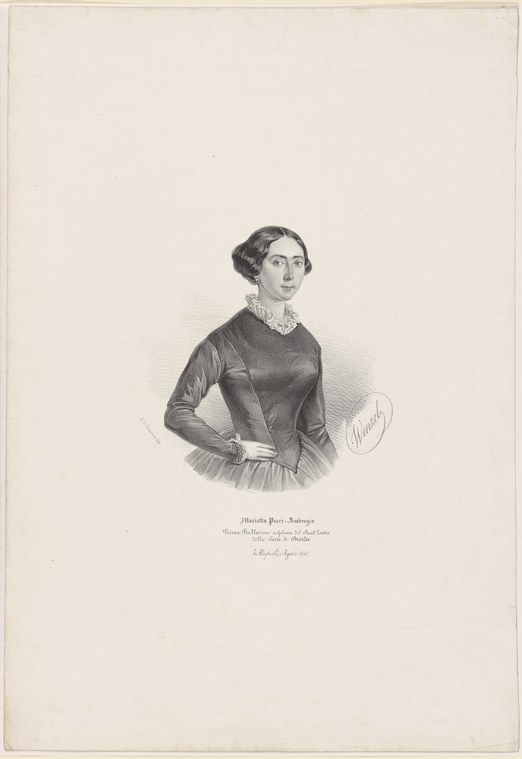
Marietta Pecci-Ambrogio, prima ballerina assoluta del real teatro della corte di Dresda, in Napoli, agosto 1850
Unknown artist
- Collection:
- Prints depicting dance
- Source:
- New York Public Library
- Rights:
- Public domain — free to use, share and adapt.
- Recorded as:
- Public Domain
Marietta Pecci-Ambrogio held the rank of prima ballerina assoluta, a status achieved by only a handful of dancers in 19th-century Europe, and this portrait is a document of her international fame and the way celebrated ballerinas were marketed and memorialized. The inscription in Italian marks her as a figure of significance in the Naples musical calendar, evidence of the circuits through which major dancers circulated across European opera houses and courts.
What you are looking at
A three-quarter-length portrait of a woman in mid-19th-century dress, rendered as an engraving or lithograph. She is shown from roughly the waist up, turned slightly to her left, gazing upward and away from the viewer with an expression of contemplative grace. She wears a dark, fitted bodice with short sleeves and a white collar, paired with a voluminous skirt of pale fabric gathered at the waist—the silhouette characteristic of 1840s–1850s fashion. Her dark hair is parted and pulled back smoothly. The figure is delicately cross-hatched to suggest volume and form against a plain background, with the skirt rendered in lighter lines to convey its fullness and texture. A signature or mark appears in the lower right of the composition. Below the figure runs an inscription in Italian identifying her as Marietta Pecci-Ambrogio, prima ballerina assoluta of the royal theatre of the Dresden court, noted in Naples in August 1850.
The dancing
The figure is posed in a stationary, contemplative attitude rather than mid-leap or mid-turn. The body is upright, the weight appears even, and the arms rest naturally—the right arm rests at the waist or hip, the left hangs at the side. The pose conveys elegance and poise but captures no moment of active dancing. The stance and bearing reflect the formal conventions of 19th-century portrait photography and engraving, showing the subject as a dignified theatrical personality rather than demonstrating any specific movement vocabulary.
The dance depicted
This is a portrait of a celebrated soloist, not a dance scene. Marietta Pecci-Ambrogio was a prima ballerina assoluta—the highest rank in the Italian and European ballet hierarchy of the mid-19th century—performing at the Dresden court. The inscription records her presence in Naples in August 1850, likely during a guest engagement. The image does not depict her dancing; rather, it presents her as a public figure worthy of commemoration through portraiture, a common practice for celebrated performers of the Romantic ballet era.
How it was made
This is an engraving or possibly a lithograph, a reproductive print technique that allowed wide circulation of images of celebrated performers without requiring an original painting. The fine cross-hatching and tonal modeling suggest engraving; the delicate line work and the way the light is suggested through parallel marks are characteristic of 19th-century theatrical portraiture. Such prints were collected, sold, and distributed through theatres and print sellers, making the performer's image accessible to a broad public and reinforcing her fame beyond the stage.
About this work
This is a commemorative portrait engraving of Marietta Pecci-Ambrogio, one of the leading ballerinas of mid-19th-century Europe, recorded during a performance engagement in Naples in 1850. It belongs in a dance history context not because it depicts dance in motion, but because it documents the celebrity and visual identity of a major historical figure in Romantic ballet. Such portraits were the primary means by which theatre-goers could possess and display images of their favorite performers, and they tell us much about how dancers were positioned as public personalities—dignified, refined, and worthy of artistic commemoration.
How to look at it
Attend to the contrast between the portrait's formal, stationary pose and what you know of Romantic ballet's emphasis on ethereal, weightless movement. The pose is deliberately composed and dignified—meant to convey her status as a celebrated artist, not to suggest the dynamism of her performance. The delicate cross-hatching and the attention to the texture of her dress show the engraver's care in creating a flattering, refined image suitable for circulation among the theatre-going public. The upward gaze was a conventional device in 19th-century portraiture meant to suggest nobility of character and spiritual elevation.
The artist
The artist is not recorded. The work is typical of mid-19th-century theatrical portraiture produced by professional engravers and lithographers who specialized in images of celebrated performers for commercial sale and theatrical distribution. Such prints were often unsigned or signed only by the engraver rather than any original designer.
The period
This portrait dates to the height of the Romantic ballet era, when the cult of the ballerina—as an idealized, almost supernatural figure—was at its peak in European culture. The 1840s–1850s saw the international circulation of famous dancers between major opera houses: Paris, Milan, Naples, Vienna, Dresden, and London. Dancers like Marie Taglioni and Fanny Elssler had become international celebrities, and engraved portraits were a key medium for their promotion and for fans' collecting habits. The Dresden court was a major centre of ballet patronage, and the notation of Pecci-Ambrogio's August 1850 appearance in Naples suggests she was on a guest engagement—a common practice for dancers of her rank.
Where it lives
This is part of the New York Public Library's Prints collection depicting dance. It is a reproductive print, likely produced and distributed through theatrical and commercial channels in the mid-19th century, making it a common type of object from that era but one that documents the celebrity system of the Romantic ballet period.
Dance in this work
Questions about this work
Was Marietta Pecci-Ambrogio a real person?
Yes. The title identifies her as prima ballerina assoluta (the highest rank) of the royal theatre of the Dresden court. The notation of her appearance in Naples in August 1850 suggests she was a major touring performer of the Romantic era, likely active across the major Italian and European opera houses of the 1840s–1850s. Prima ballerina assoluta was conferred only on dancers of the first rank.
Why is this a portrait and not a dance scene?
Mid-19th-century theatrical portraiture conventionally showed performers in stationary, dignified poses rather than in action. This format was suited to engraving and lithography, and served to present the dancer as a celebrated public figure rather than to document a specific moment of performance. Such prints were sold and collected much like photographs today.
What does 'prima ballerina assoluta' mean?
It is the highest rank in the hierarchy of Italian and European ballet companies, awarded only to the most celebrated and technically accomplished female dancers. It was a mark of exceptional status and typically came with special privileges and billing. Only a small number of dancers achieved this rank in any given era.
Why does the inscription mention Naples and August 1850?
This likely records the occasion of the portrait's creation or commission—a guest engagement by Pecci-Ambrogio at a Naples theatre. Guest appearances by celebrated dancers were major events, and portraits were sometimes commissioned or advertised to mark these engagements. The notation places her within the international touring circuit of the period.
More dance artwork





