49 works in this view — arrow keys or swipe to move between them.
Dance in Art
2 quadrilles brillants sur des motifs du 2e acte de Lady Henriette
Unknown artist
- Collection:
- Prints depicting dance
- Source:
- New York Public Library
- Rights:
- Public domain — free to use, share and adapt.
- Recorded as:
- Public Domain
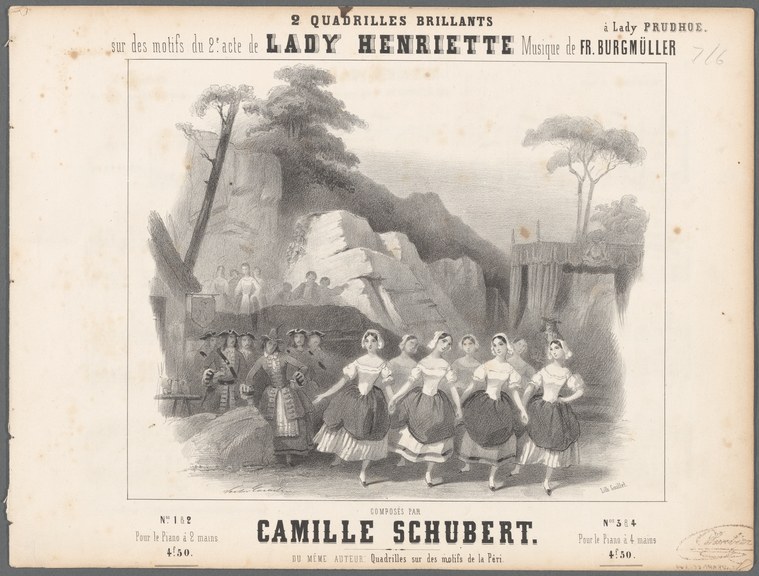
This image is a rare surviving record of choreography and staging from a mid-19th-century theatrical production, captured at a moment when dance was not yet being recorded photographically. The precision of the composition and the care taken in the engraving demonstrate that theatrical dance—and the bodies of ensemble dancers—was considered worthy of preservation and circulation to a paying public. For historians of dance and theater, such prints are primary documents of performance practice, costume, and spatial arrangement.
What you are looking at
A theatrical scene set in a rocky landscape with stylized trees and a distant fortification. Six women in white muslin dresses with dark skirts stand in a line facing left, their bodies angled in unison. They wear their hair in ringlets and their costumes suggest the 1840s–1850s romantic era. To the left, a group of figures in darker dress—soldiers or male characters—occupies the shadowed foreground, creating a narrative separation between the two groups. The lighting is dramatic, with the women brightly illuminated against darker background elements. The composition suggests a moment of encounter or display, with the women poised as if mid-movement or awaiting interaction. The engraving is finely worked, with careful attention to the drapery of the muslin and the texture of the landscape, creating depth through graduated shading.
The dancing
The six women are arranged in a loose, angled line, their bodies held upright with heads inclined. Their arms hang at their sides or rest lightly on their skirts in poses of composed elegance. The grouping suggests synchronized or coordinated movement rather than individual expression—they read as an ensemble. Their feet are obscured by the length of their skirts, making footwork invisible, but the overall posture and spacing suggest the formal carriage and alignment required of group social or theatrical dance. The bodies are elongated and graceful, rendered in a manner consistent with romantic-era idealization of the female form.
The dance depicted
This image appears to document a scene from the ballet or theatrical work *Lady Henriette* (likely Auber's *Le Domino noir* or another opéra comique of the period), of which this engraving reproduces "2 brilliant quadrilles on motifs from Act 2." The quadrille was the dominant group dance of the 19th-century ballroom and stage, typically performed by four couples in a square formation, though theatrical versions often featured larger ensembles. The women's alignment and formal grouping are consistent with quadrille choreography, which favored precise, synchronized figures performed in lines or squares. The costume, setting, and composition all point to a theatrical rather than social dance context—this is a stage quadrille from a professional production, likely performed at the Opéra or Opéra-Comique in Paris.
How it was made
This is an engraving on paper, a medium that allows for fine detail and wide circulation. The technique of engraving—cutting lines into a metal plate and printing from the incised surface—was ideal for reproducing theatrical scenes in the 19th century, enabling publishers to sell prints to audiences who had attended performances or wished to own images of popular works. The care and precision of the line work, particularly in the rendering of fabric texture and facial features, suggests a professional, skilled engraver, likely working from a drawing or painting. Such prints were common merchandise around theaters and served as both souvenirs and advertisements for upcoming performances.
About this work
This engraving documents a scene from *Lady Henriette*, a theatrical work of the romantic era that featured quadrille choreography in its second act. The print is specifically advertised as illustrating "2 brilliant quadrilles"—stage dances derived from the popular ballroom form. The composition captures a moment of formal theatrical display: six women in elegant white and dark dress, arranged in the precise alignment required of group dance, set within a romantic landscape. The work belongs to a substantial 19th-century genre of theatrical dance prints, which were essential tools for publicizing stage productions and preserving the memory of choreography in an era before photography or film.
Quadrilles occupied a unique position in 19th-century culture as both ballroom social dances and theatrical spectacles. Their appearance in opéra comique and ballet productions indicates their popularity and their suitability for ensemble work. This engraving, circulated as a print, would have reached audiences far beyond Paris, documenting not only the music and story of *Lady Henriette* but also the visual spectacle and bodily practices of stage dance.
How to look at it
Observe the careful alignment of the six dancers' bodies and heads—the precision of their spacing and orientation is the visual signature of quadrille choreography. Note how their white dresses stand out against the darker surrounding elements, drawing the eye to their formation. The engraver has chosen a moment of poised stillness or a sustained formation, not a dynamic leap or turn; this was typical of how theatrical dance was represented in prints, favoring clarity and legibility over motion. The landscape setting and the presence of the male characters on the left suggest a narrative context—this is not a social dance but a theatrical scene with plot and character.
The artist
The engraving is attributed to Camille Schubert, a French artist whose name appears in the inscription. The print is dated in the 19th century and appears to be a professional theatrical illustration—the kind of commercial work that would have been executed quickly for public sale around the time of the work's premiere or subsequent revivals. Schubert's practice appears to have included theatrical subjects, a common specialization for engravers of the period.
The period
This engraving dates to the height of the Romantic ballet era in Paris, when opéra comique and ballet were dominant forms of popular entertainment. The costume and setting—white muslin dresses, romantic landscape, female ensemble—are hallmarks of romantic-era aesthetics, which idealized grace, lightness, and supernatural or exotic femininity. The quadrille, originating in the 18th-century French court, remained enormously popular in both ballroom and theatrical contexts throughout the 19th century. Stage quadrilles often featured larger ensembles than their ballroom counterparts and were opportunities for spectacle and synchronization. The print itself is a product of commercial theater culture: theatrical prints were mass-produced and sold to audiences, making them a significant part of how dance was circulated and remembered before the age of photography.
Where it lives
This engraving is held in the New York Public Library's collection of prints depicting dance (*Prints depicting dance*). It is a commercial theatrical print, likely produced in the mid-19th century in Paris and circulated for sale to the public.
Dance in this work
Questions about this work
What is a quadrille?
A quadrille is a group dance for four couples (or in theatrical versions, larger ensembles) arranged in a square. It originated in 18th-century France and became the dominant ballroom dance of the 19th century. Quadrilles consist of five figures, each with repeated, geometric formations, and the choreography was codified and published so that dancers could learn and repeat the same figures. Stage quadrilles adapted the ballroom form, often enlarging the ensemble and adding spectacle.
Who was the music by, and what work is this from?
The title of the print states that the music was by Fr. Burgmüller (Friedrich Burgmüller), a German-French composer known for piano works and theatrical music. The work is titled *Lady Henriette*, though the specific theatrical production is not certain from the print alone. The print documents Act 2, second quadrille, indicating this was a multi-act work with several dance numbers.
How do we know these are stage dancers and not social dancers?
Several elements indicate a theatrical context: the landscape setting and fortification in the background, which are theatrical scenery; the coordination and precision of the ensemble; the professional quality of the costume and overall production; and the fact that the print is advertising the work as a theatrical production. Social dance would not have been set in such a narrative context.
Why would someone buy a print of a theatrical dance scene?
Theatrical prints served multiple purposes: as souvenirs for audience members, as advertisements for upcoming performances, as images of celebrity performers or famous dances, and as a record of a work for those who had not or could not see it in person. They were inexpensive mass-produced objects, similar to playbills or posters, and were sold in theater lobbies and by print sellers.
More dance artwork





