49 works in this view — arrow keys or swipe to move between them.
Dance in Art
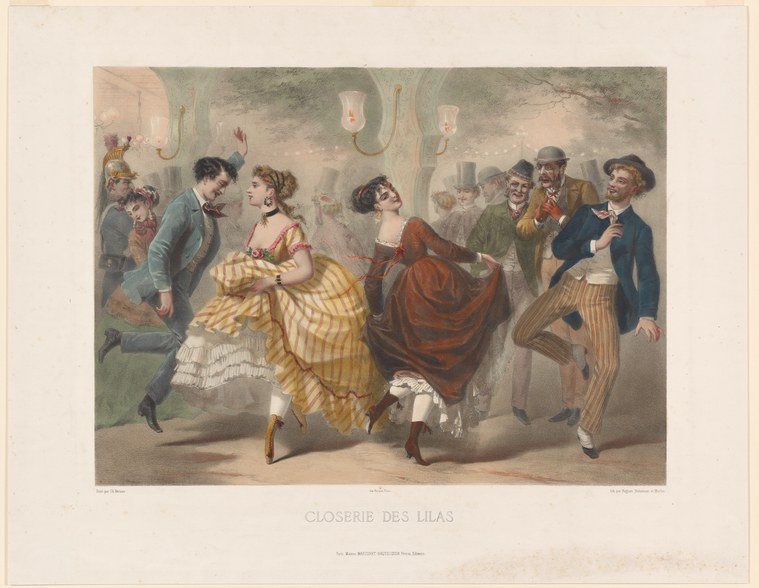
Closerie des lilas
Unknown artist
- Collection:
- Prints depicting dance
- Source:
- New York Public Library
- Rights:
- Public domain — free to use, share and adapt.
- Recorded as:
- Public Domain
This work is direct visual evidence of how 19th-century ballroom dancing looked and functioned as a social practice—the frame, the positioning of couples, the presence of spectators, and the evening-garden context all provide data inaccessible from written records alone. As a lithograph made for popular consumption, it also reveals what the era chose to celebrate and circulate about its own dancing practices. For historians of dance, costume, and courtship ritual, such prints are essential documents.
What you are looking at
A lively garden dance or social gathering, rendered in hand-colored lithographic style with soft, atmospheric tones. The scene is set outdoors among tall trees with hanging lanterns strung overhead, creating an evening festive mood. In the foreground, two couples dance prominently: a woman in a striking yellow-striped dress with white undergarments dances with a man in dark formal attire, while beside them a woman in burgundy-red drapery is partnered with another gentleman. Both pairs are caught mid-movement in what appears to be a waltz or similar ballroom dance. The background shows additional figures in fashionable dress—gentlemen in suits and hats, women in elaborate skirts—some watching, some engaged in conversation, creating the atmosphere of a garden soirée or public dance venue. The composition is energetic yet refined, with the foreground dancers commanding attention while the assembled company witnesses the spectacle.
The dancing
The central dancers are depicted in closed ballroom position, with upright posture and extended arms characteristic of 19th-century waltz or galop technique. The woman in yellow leans slightly into her partner with visible engagement; both couples show weight distributed through the frame in a manner consistent with partnered rotational dances. The artist captures mid-turn momentum—skirts are swept outward and fabric billows in the exaggeration typical of theatrical or romanticized dance imagery. The onlookers frame the dancers, their relaxed postures and turned heads indicating they are spectators rather than participants in the immediate action.
The dance depicted
This is a ballroom scene, most likely depicting a waltz or galop from the mid-to-late 19th century, given the formal closed-position partnering, the evening-garden setting, and the fashionable dress. The scene appears to document leisure-class courtship ritual through dance—a social function that was central to the period's marriage market. The inclusion of spectators and the theatrical presentation suggest this may represent a public garden venue or a fashionable resort ball, settings where such dances were performed for display and amusement. The style and energy indicate this is not concert or staged performance but social dancing among the leisured public.
How it was made
This is a hand-colored lithograph, identifiable by the soft registration, translucent tonal washes, and the slight color separations visible particularly in the figures and foliage. The medium allowed rapid, affordable reproduction for mass circulation, suggesting this was distributed as entertainment imagery—likely a popular print for middle-class households or entertainment venues. Hand-coloring adds appeal and specificity (the brilliant yellow dress, the burgundy tones) while the lithographic line remains visible beneath, creating the characteristic delicate layering of the medium. This technique was dominant for fashion and social genre imagery between roughly 1830 and 1900.
About this work
This hand-colored lithograph documents the fashionable ballroom dances of the 19th-century leisured classes, capturing a moment of courtship ritual and social display in a garden setting. The work belongs to a large genre of prints and illustrations that treated ballroom dancing as a subject of entertainment and cultural observation—imagery consumed by the very people who danced these dances. It records not the technique or mechanics of dance as such, but the social meanings attached to it: the pairing of unmarried people, the watching public, the evening spectacle, the fashionable costume. For dance history, such images are invaluable documents of how people actually dressed and carried themselves while dancing, how partners related, and what social occasions framed the practice.
How to look at it
Attend to the moment of rotation captured: both couples are mid-turn, with skirts and fabric in dynamic sweep, suggesting the artist understood and chose to emphasize the rotational momentum of the waltz or galop. Notice how the foreground dancers are positioned slightly below the eye line of the spectators, making the viewer part of the watching crowd. The hanging lanterns and open-air setting are genre markers—not concert halls but public pleasure gardens—which shaped both the dances performed and their social meanings. The hand-coloring heightens the festive, theatrical quality; the brilliant dress colors were exactly what drew audiences to witness and participate in these evening spectacles.
The period
This image dates from the era of Romantic-era social dancing, when the waltz had become the dominant form of fashionable couple-dancing across Europe and North America, typically performed at balls, public gardens, and private soirées. The 1840s–1870s were the height of the commercial garden dance venue, where public balls and subscription dances allowed middle-class and working-class participation in forms of social dancing previously restricted to aristocracy. The Closerie des Lilas was a celebrated outdoor dance hall and restaurant in Montparnasse, Paris, operating from the 1880s onward as a gathering place for artists, writers, and the fashionable public. This print likely documents that specific venue or captures the type of fashionable garden-dance culture it represented.
Where it lives
This print is held in the New York Public Library's collection of prints depicting dance. The source catalogue record provides minimal documentation, but the image itself—a hand-colored lithograph of professional quality and popular circulation—indicates it was part of the commercial print market for entertainment and fashion imagery of the 19th century.
Dance in this work
Questions about this work
What is the Closerie des Lilas and why does it matter for dance history?
The Closerie des Lilas was a celebrated outdoor dance hall, cabaret, and restaurant in the Montparnasse district of Paris, open from around the 1880s. It became a fashionable meeting place for artists, writers, and the bohemian and middle-class public, and was known for evening dances and performances in a garden setting. For dance history, such venues document the shift toward public, commercialized social dancing available outside the aristocratic ballroom, and the ways fashionable urban culture incorporated dance as entertainment and social ritual.
How do I know this is a waltz or galop and not some other dance?
The closed ballroom position (partner facing, arm frame), the upright posture, and the indication of rotational movement visible in the swept skirts are all consistent with waltz or galop technique of the period. The outdoor garden setting and the formal dress also match the contexts in which these dances were performed. However, other couple dances of the era used similar frames, so the specific style cannot be determined with certainty from the image alone.
Why are there so many people not dancing?
The watching crowd was part of the appeal of public garden dances. These were social spectacles, not private family affairs—people attended to see and be seen, to meet potential partners, and to enjoy the music and atmosphere. The mix of dancers and spectators reflects how such venues actually functioned: as places where some people danced while others observed, conversed, and participated in the broader social event.
What does the hand-coloring tell us?
Hand-coloring was applied to lithographs to increase appeal and saleability, and the colors chosen—particularly the brilliant yellow and burgundy of the dresses—highlight what made ballroom dancing visually striking. The costly, fashionable fabrics and jewel-tone dyes visible here were part of the spectacle of attending such events. The hand-coloring also indicates this was a commercial print made for popular consumption, not a documentary record, so it prioritizes visual drama over accuracy.
More dance artwork





