49 works in this view — arrow keys or swipe to move between them.
Dance in Art
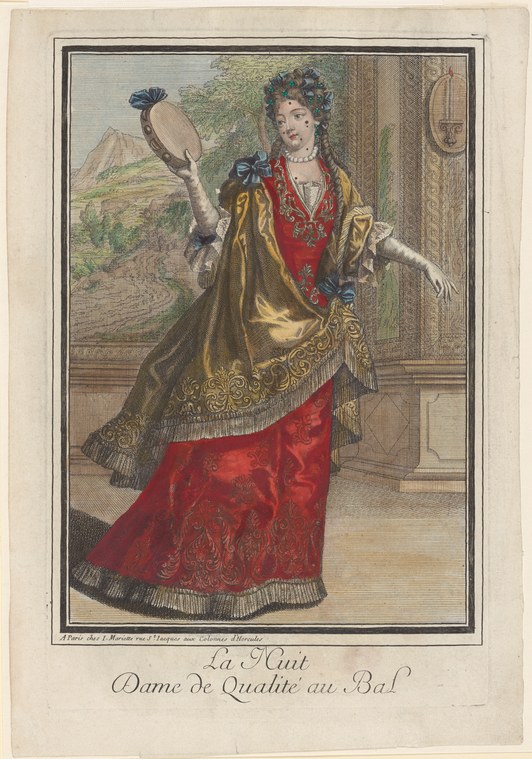
La nuit. Dame de qualité au bal
Unknown artist
- Collection:
- Prints depicting dance
- Source:
- New York Public Library
- Rights:
- Public domain — free to use, share and adapt.
- Recorded as:
- Public Domain
For historians of dance, this work illustrates the crucial distinction between the dance itself and the aristocratic *mise-en-scène* within which it took place—the costume, posture, and spatial conventions that framed 18th-century ballroom practice. It shows how women of quality were trained and expected to move, stand, and present themselves as objects of aesthetic appreciation, a preparation for the minuet and other formal dances that demanded comparable discipline and display.
What you are looking at
A woman of quality stands in an interior space before a landscape window, posed in the moment of donning or adjusting her evening dress. She wears a striking red silk gown with black fringe at the hem, overlaid with a yellow-gold cloak or robe trimmed in ornate embroidered designs and lined in blue silk. Her left arm is raised, holding a fan aloft in a gesture of elegant leisure; her right hand rests at her side. Her hair is dressed high and curled in the fashion of the late 18th century, adorned with ribbons. The setting is a classical interior with pilasters and drapery visible at right; through the window behind her, a mountainous landscape is visible. The whole composition speaks to aristocratic leisure and the studied display of fashionable dress before an evening's entertainment.
The dancing
A single standing figure, weight evenly distributed, body turned three-quarters to the viewer with her head turned further to engage the eye directly. The raised arm holding the fan is extended at roughly shoulder height; the elbow is bent softly. Her posture is upright and self-possessed, with no weight transfer or dynamic momentum—this is a pose of display rather than action. The body is stationary; no footwork or weight shift suggests movement.
The dance depicted
This is not a depiction of dance in motion, but rather a figure prepared for dancing or theatrical performance at a ball. The title *La nuit. Dame de qualité au bal* (Night. Woman of Quality at the Ball) places her in the context of aristocratic social dance—the 18th-century *bal* was the setting for minuet, contredanse, and other courtly forms. The figure's pose, dress, and setting mark her as a participant in or spectator of such entertainment, but she herself is stationary, posed for admiration rather than captured mid-movement. The image documents the costume and deportment expected of a noblewoman attending a formal evening assembly.
How it was made
This is a hand-colored engraving or aquatint, as evidenced by the fine linear work defining the architectural details, the figure's contours, and the clothing, combined with delicate watercolor or gouache wash establishing the colors. The technique allowed for relatively affordable reproduction and wide distribution among the French aristocracy and middle classes—this appears to be a fashion or social documentation print rather than a fine art object. The careful attention to the woman's dress and pose suggests it functioned as a record of current fashion and social codes, circulating in collections of similar prints documenting modes and manners.
About this work
This late 18th-century print documents aristocratic dress and social codes at the moment before or during a formal ball, when the display of wealth, taste, and refined deportment was as important as participation in dance itself. The woman's elaborate costume—the fashionable high coiffure, the costly layered silks, the elegant fan—marks her status and her knowledge of how to present herself in elite society. While she is not shown dancing, she is shown as a participant in the *bal*, the social and theatrical occasion where dance was the central activity. The print sits at the intersection of fashion documentation, social portraiture, and the visual record of courtly leisure.
How to look at it
The viewer should attend to the careful placement of the woman's body: her turn, her raised arm, the tilt of her head, and especially the fan—that essential accessory of 18th-century female sociability and communication. Notice how she is positioned neither frontally nor in profile, but at a three-quarter angle that shows off both the dress and the face; this is the angle at which the minuet or cotillion would have been most advantageous to her appearance. The landscape visible through the window is a convention of the period, situating her indoors at leisure, a sign of status. Her gaze toward the viewer suggests the reciprocal looking that was central to aristocratic social dance—to be seen, and to see.
The artist
The artist is not recorded in the catalogue. The style and subject matter are consistent with French fashion and social prints of the 1770s–1790s, a period of intensive documentation of aristocratic life and dress. Such prints were often engraved after drawings by specialist artists, hand-colored by workshop teams, and sold in series to aristocratic and bourgeois collectors. The print's inscription format and composition are typical of commercial fashion and social documentation of the period.
The period
In the late 18th century, the formal aristocratic *bal* was at its height as a social institution, even as the ancien régime itself approached collapse. The minuet, cotillion, and contredanse were the dominant courtly dances, all requiring elaborate dress, precise training, and the kind of studied deportment visible here. Simultaneously, prints documenting fashion, manners, and social life became increasingly popular among the wealthy classes, functioning as both art objects and instructional or aspirational documents. This print belongs to that tradition: it teaches by example the appearance and bearing a woman of quality should maintain.
Where it lives
The work is part of the New York Public Library's collection of prints depicting dance. Such prints were produced and circulated in France during the late 18th century as commercial objects, affordable to educated consumers but addressed to an audience of leisure and means.
Dance in this work
Questions about this work
What is a 'dame de qualité' and why would she be going to a ball?
A 'dame de qualité' (woman of quality) was a noblewoman or wealthy bourgeoise whose rank entitled her to move in aristocratic circles. The *bal* was the primary social event of the 18th-century court and high society—an evening of formal dancing, conversation, and display. Attendance demonstrated status; the ability to dance well, dress expensively, and conduct oneself gracefully were essential markers of elite identity.
Is she actually dancing in this picture?
No. She is posed stationary, as if dressed for the ball and pausing for observation. The title specifies she is 'at the ball' (*au bal*), meaning she is attending, but the image captures her in a moment of display rather than in the act of dancing. This distinction matters: the print documents social codes and fashion as much as dance itself.
What dance would she have danced at such a ball?
Likely the minuet, which was the prestige dance of formal 18th-century balls and required years of training to perform correctly. She might also have danced a cotillion or contredanse, which were more social and allowed for greater informality. All required careful deportment, precise steps, and the kind of trained, elegant bearing visible in her standing posture here.
What is the fan for?
In 18th-century aristocratic society, the fan was an essential accessory for women, serving practical, communicative, and aesthetic purposes. It could signal interest or disinterest, provide cooling at crowded events, and frame the hand and arm in movement. In formal dances like the minuet, the fan was often manipulated as part of the choreography.
More dance artwork





