49 works in this view — arrow keys or swipe to move between them.
Dance in Art
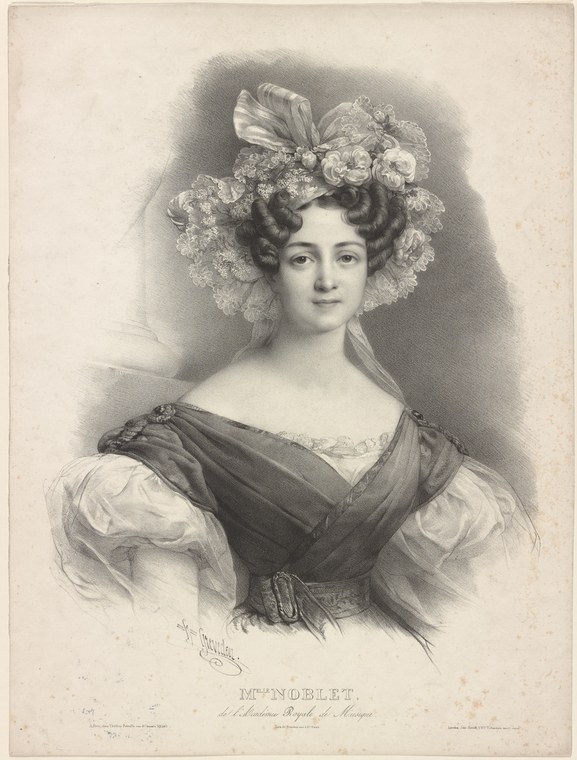
Melle Noblet de l'Académie royale de Musique
Unknown artist
- Collection:
- Prints depicting dance
- Source:
- New York Public Library
- Rights:
- Public domain — free to use, share and adapt.
- Recorded as:
- Public Domain
Named portraits of professional dancers from this period are relatively scarce and fragile; they offer rare documentary evidence of who danced, what they looked like, and how they were styled and marketed to their audience. Noblet's identity and her affiliation with the Académie Royale de Musique place her in the lineage of the dancers who performed in the canonical works of Romantic ballet—works that shaped the entire future of dance.
What you are looking at
A three-quarter-length portrait of a young woman, likely a professional dancer from the Académie Royale de Musique in Paris. She is shown against a dark, vignette background that emphasizes her figure. Her hair is styled in the fashion of the early 19th century, drawn up and elaborately decorated with a profusion of small white flowers and green foliage, crowned with a delicate white ribbon or bow. She wears a dark (possibly deep blue or black) off-shoulder dress with a draped bodice, beneath which a white chemise with puffed sleeves is visible. The dress sits low on her shoulders in the Romantic era fashion. Her posture is upright and dignified, her gaze directed slightly to the side with a serene, composed expression typical of formal portraiture of the period. The treatment is intimate despite the formal conventions—the focus is on her face and the carefully rendered details of her costume and coiffure.
The dancing
The subject is depicted in a static, frontal pose rather than captured in movement. Her shoulders are relaxed and turned slightly, her arms held naturally at her sides. There is no visible indication of dance position, weight distribution, or active footwork. The portrait mode emphasizes elegance and poise rather than the physical vocabulary of performance. The rendering prioritizes her identity and fashionable appearance over any kinetic quality.
The dance depicted
This is a portrait of a named dancer—Melle Noblet of the Académie Royale de Musique—rather than a representation of dance in action. The inscription identifies her professional status but provides no depiction of how she danced. Noblet was a performer in the Romantic ballet era, when the Académie (which controlled the Paris Opera) was the center of European dance. The costume elements—the pale flowers, the romantic off-shoulder dress, the refined coiffure—suggest she may have been known for roles in the Romantic ballet repertory, but the portrait itself does not show dance movement or technique.
How it was made
This is a lithographic or finely worked engraved print, likely hand-colored or produced in toned stone. The image shows the tonal subtlety and precision possible in early 19th-century reproductive printmaking—notice the delicate modeling of the face, the soft gradation of the background, and the careful rendering of textures (hair, fabric, flowers). The vignette effect (soft edges fading to white) is characteristic of lithography or fine engraving of this period. The technique allowed for relatively affordable circulation of portraits of celebrated performers, making this the kind of print that would have been sold to theater-goers and collectors of dance memorabilia.
About this work
This is a formal lithographic portrait of a named performer from the Paris Opera in the Romantic era. Melle Noblet is presented in fashionable dress of the 1820s–1830s, dignified and composed, with no attempt to represent her dancing. The print is a document of celebrity and fashion rather than a study of dance itself. It belongs in a dance gallery because it records a historical performer at a crucial moment in dance history—the height of Romantic ballet—and because such portraits were a major visual form through which dancers were known to the public.
How to look at it
This is not an action picture; attend instead to the choices made in stillness. Notice how the artist has positioned the sitter—the slight turn of the shoulders, the gentle tilt of the head, the placement of the eyes—to convey dignity and poise rather than spontaneity. The floral headdress and pale shoulders are carefully lit to stand out from the dark background, drawing the eye to the face and costume. The effect is one of controlled elegance, which was itself part of the Romantic dancer's public image. The print's precision and finish are meant to signal that this is a woman of refinement and professional standing, not a mere entertainer.
The period
This print dates to the height of Romantic ballet in France, approximately 1820–1840. During this period, the Paris Opera dominated European dance, and dancers—especially women—became celebrated public figures. Lithography was the cutting-edge technology for reproducing portraits and scenes for mass circulation; this print would have been sold in theater lobbies and through print shops as a souvenir of a celebrated performer. The fashion visible in the portrait—the off-shoulder Romantic dress, the flowers in the hair—reflects both stage costume and the broader romantic aesthetic of the era. Female dancers of the Académie occupied an ambiguous social position: acclaimed performers in a prestigious institution, yet often subject to gossip and speculation about their private lives. Such formal, dignified portraits served partly to elevate and legitimize the profession.
Where it lives
The print is held in the New York Public Library's collection of prints depicting dance. It is part of a broader archival tradition of theater and performance memorabilia accumulated from the 18th century onward.
Dance in this work
Questions about this work
Who was Melle Noblet?
The inscription identifies her as an 'Artiste Royale de Musique'—a performer at the Paris Opera. Beyond this portrait, little may be publicly known about her individual career. Many dancers of this era are documented primarily through such prints, playbills, and brief mentions in theater reviews. Research in the archives of the Académie Royale de Musique (now the Bibliothèque de l'Opéra) might yield more information about her roles and dates of performance.
Is this a costume portrait, or is she wearing street dress?
The off-shoulder chemise and draped bodice are consistent with both stage costume and fashionable day wear of the 1820s–1830s. Theater dress and fashionable dress of the Romantic period overlapped considerably, and Romantic ballet costumes were designed to reflect elite fashion. This portrait likely presents her in a romanticized ideal dress that blurs the line between stage and salon.
Why are there so many flowers in her hair?
The flowers are a signature of Romantic ballet aesthetics and of fashionable women's styling of the era. On stage, such garlands were used to suggest youth, beauty, and the ethereal quality prized in Romantic heroines. The careful arrangement and profusion here (rendered with considerable artistic skill) is meant to signal both her profession and her desirability as a public figure.
What can we learn about dance from a portrait that doesn't show movement?
Portraits like this document who danced, how performers were publicly presented, and what values the era invested in dancers—in this case, refinement, youth, and fashionable elegance. They also testify to the celebrity status of dancers in the Romantic era and the market for their images. To understand Romantic ballet itself, we need to look at prints showing movement, but this one is valuable evidence of dancer identity and public persona.
More dance artwork





