49 works in this view — arrow keys or swipe to move between them.
Dance in Art
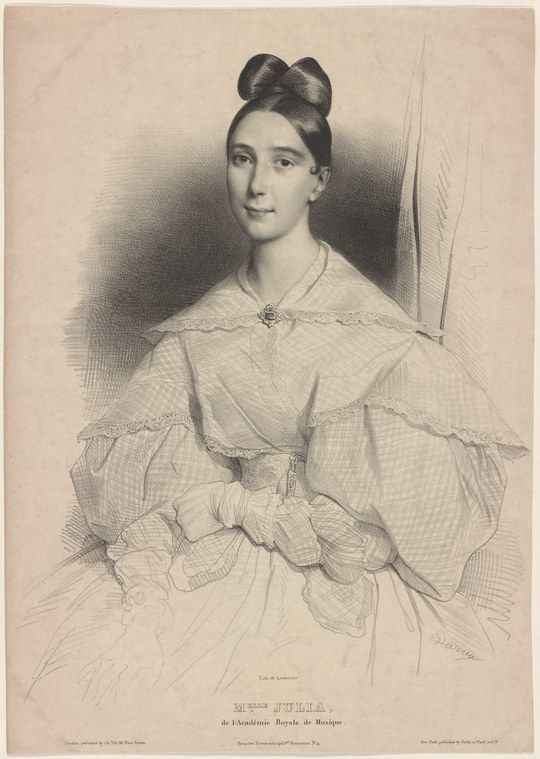
M'elle Julia, de l'Académie Royale de Musique
Unknown artist
- Collection:
- Prints depicting dance
- Source:
- New York Public Library
- Rights:
- Public domain — free to use, share and adapt.
- Recorded as:
- Public Domain
This image reveals how nineteenth-century ballet dancers were marketed and commemorated: not as action but as idealized feminine figures whose status and training were expressed through costume, posture, and beauty. It is a rare direct record of what a professional Paris Opera dancer looked like and how she was expected to present herself to public view outside the theater.
What you are looking at
A young woman in an elegant white cotton or linen dress stands in three-quarter view against a plain background, her body angled slightly to the left. She wears a voluminous off-shoulder gown with deep, gathered sleeves and a fitted bodice, its skirt billowing outward in soft folds that suggest movement or the weight of fine fabric. Her dark hair is styled high on her head in a fashionable knot or chignon, and she holds her arms at her sides with relaxed grace. The drawing captures her from roughly the waist up, positioning her as a portrait subject rather than in active dance motion, though the fabric's flow and her poised bearing convey an impression of cultivated movement and refinement. The sketch is rendered in fine linear technique with subtle cross-hatching to model form and fabric texture.
The dancing
A single standing figure in a formal, stationary pose. Her weight appears evenly distributed, her spine upright, her shoulders relaxed and open. Her arms fall naturally at her sides, hands not engaged in any specific gesture. The overall frame is one of composed elegance: the body is held with the controlled posture expected of an accomplished dancer, but there is no dynamic movement captured, no partnership, no turn or leap. The figure's training is suggested through her bearing rather than through action.
The dance depicted
This is not a scene of dance in progress but a portrait of a dancer. The subject is identified as "M'elle Julia" of the Académie Royale de Musique—the Paris Opera—suggesting she was a professional dancer of some standing. The image presents her as a cultivated performer of the period, but it does not depict a specific dance style or movement. Rather, it commemorates her as a person of status within the institution, using her elegant dress and refined posture as markers of her profession and accomplishment. Without active movement captured, the dance style cannot be identified from the image alone.
How it was made
This is a lithographic print, as evidenced by the fine linear quality, the controlled tonality created through regular parallel hatching, and the printing marks visible at the lower edge. The technique allowed for wide circulation of the image—lithography was the dominant reproductive medium of the nineteenth century and far more economical than engraving. This print would have been produced in multiple copies, distributed as a souvenir or promotional image of a celebrated performer. The clarity of line and the careful modeling of the fabric demonstrate a skilled artist working from a careful study.
About this work
This is a commemorative portrait print of a professional ballet dancer associated with the Paris Opera during the early-to-mid nineteenth century. The image presents her not in the moment of performance but as a respectable, cultivated woman whose dress and bearing identify her as a trained artist of the Académie Royale de Musique. The lithographic format signals a work intended for circulation among the opera-going public or within theatrical circles—a souvenir or advertisement of a notable performer. The work belongs in a dance gallery as documentation of how dancers were presented to the public and how their professional identity was constructed through portraiture and dress.
How to look at it
Focus on the dress: the off-shoulder neckline, the deep gathered sleeves, and the billowing skirt reveal the fashionable silhouette of the era and hint at the kind of roles this dancer would have performed. The pose is deliberate—formal enough to convey respectability, yet graceful enough to suggest the training that separated professional dancers from ordinary women. Notice how the artist has used fine parallel lines to suggest the weight and movement of the fabric, creating an illusion of elegant repose. The portrait freezes a moment of social presentation rather than choreographic action.
The artist
The artist is not recorded in the catalogue. The quality of execution suggests a professional lithographer working in mid-nineteenth-century Paris, likely someone who specialized in theatrical portraiture. The print bears the publication mark of a Parisian print house, confirming that the work was produced for commercial circulation.
The period
This portrait dates to an era when lithography had made celebrity portraiture and theatrical imagery accessible to a broad public. The Romantic ballet had reached its height in the 1830s–1840s, with dancers such as Marie Taglioni achieving international fame. Dancers were among the most celebrated women in European culture, and their portraits were widely collected. The Paris Opera (Académie Royale de Musique) was the institution that trained and employed the most prestigious dancers of the era. Portraiture of performers had become a standard form of theatrical marketing and public engagement.
Where it lives
This print is held in the New York Public Library's collection of prints depicting dance. The lithographic publication marks visible at the base indicate it was produced by a Parisian publisher during the nineteenth century, though the precise date and printer remain unrecorded.
Dance in this work
Questions about this work
Who was Julia and what did she dance?
The catalogue identifies her only as a performer at the Académie Royale de Musique (the Paris Opera). Without additional sources, her specific roles and career cannot be established from this image alone. The Académie was the premier institution for classical ballet in the nineteenth century, so she would have danced in the repertory of Romantic and classical ballets of the era.
Why is she not dancing?
This is a commemorative portrait, not a scene from performance. The convention of theatrical portraiture in this period was to present the dancer as a cultivated woman, often in costume, but in a composed pose that allowed the sitter's face, bearing, and dress to be clearly seen. Active poses were rarer and typically reserved for action scenes rather than celebrity portraiture.
What can we learn about ballet from what she's wearing?
The off-shoulder neckline and deep sleeves are characteristic of Romantic-era ballet costume—a style that emphasized ethereal, otherworldly femininity. The fitted bodice and full skirt would have allowed the dancer freedom of movement while creating the vertical line and lightness that defined the ideal Romantic ballet silhouette. This costume type was standard for classical and Romantic roles in mid-nineteenth-century ballet.
More dance artwork





