49 works in this view — arrow keys or swipe to move between them.
Dance in Art
Paris exposition
Unknown artist
- Collection:
- Prints depicting dance
- Source:
- New York Public Library
- Rights:
- Public domain — free to use, share and adapt.
- Recorded as:
- Public Domain
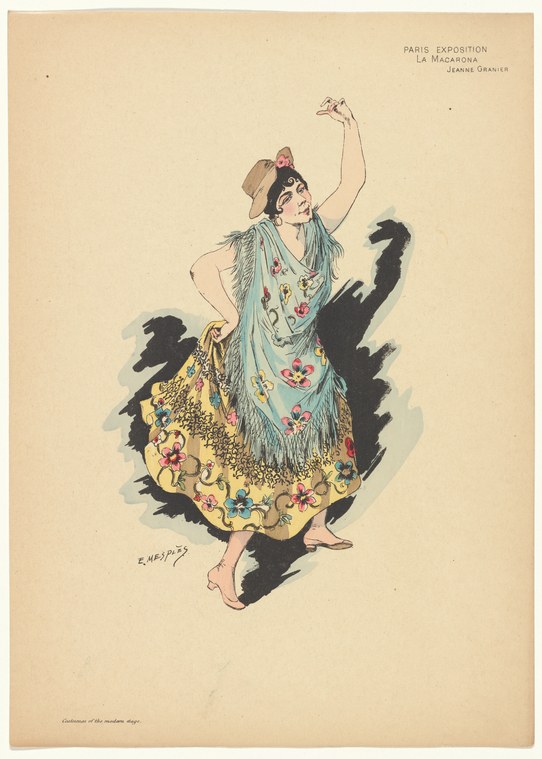
This image documents the fusion of visual art and dance design at a moment when both were animated by fascination with the exotic and the fantastical. It shows how theatrical bodies were composed, clothed, and framed for public spectacle, and preserves the aesthetic language of early 20th-century popular dance theatre.
What you are looking at
A woman in theatrical costume strikes a dynamic, elevated pose against a cream background. She wears a pale blue-green draped garment with ornate embroidered trim and long fringe, paired with a decorative gold-patterned skirt. A small hat or headpiece sits atop her head. Her right arm extends upward in an arabesque-like line; her left arm curves gracefully across her body. Her body weight is concentrated and her posture suggests a moment of suspension or exultation. She stands en demi-pointe or with feet close together. Behind her, rendered in bold black strokes, are silhouetted figures of what appear to be exotic birds or feathered shapes—possibly ostriches or peacocks—that echo and amplify the dynamism of her pose. The composition is economical and theatrical: the figure floats in the upper register of the page, and the stark black shadows below create depth and movement. The style is a coloured sketch or wash drawing, naturalistic in rendering the figure but graphically abstract in the background.
The dancing
The dancer stands in a moment of peak extension, with her supporting leg straight or nearly so, her working leg raised or held in alignment. Her upper body is open and lifted; the raised arm extends fully, creating a long line from hip through fingertips. The other arm is held in a softer, inward curve, balancing the composition. Her torso is not twisted or contracted—it faces forward with classical alignment. The silhouetted shapes behind her are not dancers but animate props or design elements that intensify the sense of swirl and elevation. Her weight and carriage suggest classical training and a moment of display or apotheosis.
The dance depicted
This appears to be a costume design or character study for a theatrical dance production, likely from the early 20th century. The exoticism of the dress—the Near Eastern or Central Asian styling, the ornate embroidery, the emphasis on rich fabrics and feathered or exotic elements—suggests a part in a ballet or musical theatre production set in an imagined Orient. The pose itself is not specific to any one technique, but rather a moment of theatrical triumph or seduction common to early 20th-century theatrical dance. The figure may represent a dancer in a harem scene, an exotic character, or a fantastical being. Without more information about the Paris exposition mentioned in the title, or the artist's identity, the specific choreography cannot be determined; but the image documents how the human body in dance was costumed and positioned in popular theatrical entertainments of the era.
How it was made
This is a watercolour or hand-tinted drawing on paper, rendered with considerable refinement. The figure is rendered in naturalistic colour—skin tones, textile detail, and embroidery are carefully observed and tinted. The background silhouettes are executed in bold, graphic strokes of black ink or dark wash, creating a stark contrast that flattens the space and emphasises the performer. This technique—combining detailed naturalism in the figure with graphic abstraction in the setting—is characteristic of theatrical costume and character studies of the 1910s–1920s. The scale and finish suggest this was a finished design document intended for circulation among theatre professionals, not a preparatory sketch.
About this work
This is a theatrical costume study for a female dancer or performer, likely created for a Paris exposition or theatrical production in the early 20th century. The work captures a moment of dramatic elevation and display, rendered in a style that blends careful attention to fabric and ornament with a more abstract, graphic sensibility in the background. It is a document of how exoticism and orientalism were imagined and embodied on the theatrical stage during this period, and of the costumier's and designer's role in shaping the visual spectacle of dance. The work belongs in a dance archive as evidence of theatrical practice and the aesthetics of the body in motion during the Belle Époque and its aftermath.
How to look at it
Note the moment the artist has chosen: not a movement frozen in its passage, but an apex, a moment of display. The dancer is at full extension, stationary and exposed—a photographic instant rather than a fleeting gesture. The feathered shapes behind her are not naturalistic scenery but design elements that amplify and abstract her energy: they move as she moves, or rather, they move *with* her to create a unified image. Observe how the costume itself—the weight and drape of the fabrics, the glint of embroidery—is as much the subject as the body wearing it.
The artist
The signature on the work reads 'E. Malpied' or similar (script is not entirely clear). The artist appears to be a theatre designer or illustrator working in the early 20th century, possibly French or working in Paris. Without confirmation of the signature and artist's dates, no secure biographical information can be offered; the level of finish and the theatrical specificity suggest a professional designer rather than an amateur.
The period
The early 20th century saw a flowering of theatrical dance in Paris, centred on the Ballets Russes and the music halls and exposition theatres of the Belle Époque. Orientalism was a dominant aesthetic: designers, choreographers, and impresarios drew on fantasy visions of the Middle East, North Africa, and Central Asia to create spectacle and allure. The costume and pose in this drawing reflect that era's taste for richly decorated, exoticised bodies and for the arabesque as a marker of refinement and otherness. Simultaneously, the graphic stylisation of the background suggests awareness of modernist developments in art—the flattening of space, the use of bold contour.
Where it lives
Held in the New York Public Library's collection of prints depicting dance. The work is catalogued as associated with a Paris exposition, but specific exhibition or production details are not recorded. It is one of a significant group of early 20th-century theatrical design documents and prints in institutional holdings, most without named artists.
Dance in this work
Questions about this work
Is this a real person or a character?
It appears to be a costume design or character study—a rendering of a role or type rather than a portrait of a specific dancer. The idealised pose and the theatrical staging suggest this is a design document intended to show how a part should look when performed, not a record of an individual.
What is the connection to the Paris exposition?
The title references a Paris exposition, likely the Exposition Universelle of 1900 or later. These were major international exhibitions that featured extensive entertainment, theatrical performances, and displays of costume and design. The character and costume style are consistent with the exotic entertainment and design that flourished at these venues.
Why are there birds or feathers in the background?
The silhouetted shapes behind the dancer may represent ostriches, peacocks, or other exotic birds—motifs common to orientalist design of the period. They amplify the exotic, fantastical register of the image and create visual movement and depth without literally depicting scenery.
What technique or style of dance is this?
The pose and posture suggest classical training, but this is theatrical dance design rather than documentation of a specific technique. The elevated, extended line and the moment of display are consistent with early 20th-century theatrical ballet and music-hall spectacle, but the identity of the actual choreography cannot be determined from the image alone.
More dance artwork





