49 works in this view — arrow keys or swipe to move between them.
Dance in Art
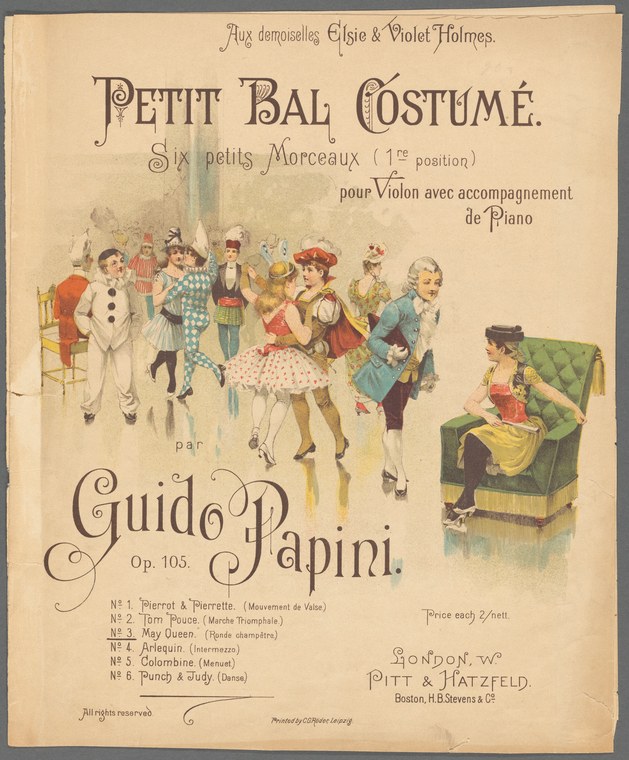
Petit bal costumé, six petits morceaux pour violon avec accompaniment de piano par Guido Papini
Unknown artist
- Collection:
- Prints depicting dance
- Source:
- New York Public Library
- Rights:
- Public domain — free to use, share and adapt.
- Recorded as:
- Public Domain
This object documents the crucial intersection of theatrical costume, music publishing, and social dance in the late 19th century. For historians of ballroom culture, it provides concrete evidence of how commedia dell'arte motifs were adapted into contemporary ballroom entertainment, and for music historians it shows how dance themes were marketed to amateur musicians through commercial publishing.
What you are looking at
This is the cover of a musical score for six short pieces for violin and piano, published by Pitt & Hattzfeld in London. The design features a lively costume ball scene populated by figures in theatrical dress: a clown in white with large buttons, a harlequin in checkered costume, a woman in a pink tulle skirt mid-spin, a figure in blue, a man in evening dress, and others in various carnival attire. The setting is a ballroom or salon with a green upholstered armchair visible at right where a seated woman in yellow watches the dancers. The figures occupy the middle ground against a cream background, arranged in a loose, animated cluster that suggests movement and social dancing. The illustration style is characteristic of late 19th-century commercial music publishing: a chromolithographic cover combining elegance with playful theatrical references. The title and composer's name are rendered in ornamental lettering, with the notation of the pieces (Pierrot & Pierrette, Tom Pouce, May Queen, Arlequin, Colombine, Punch & Judy) listed below.
The dancing
The dancers are shown in relaxed, social rather than formal ballroom positions. The woman in the pink skirt is caught mid-turn or curtsy, her skirt flared, suggesting the moment of a promenade or rotation common to 19th-century social dances. Most figures stand upright with arms held in classical ballroom frame or at rest. No closed holds or rigid partnerships are evident; instead the group has the informal, overlapping arrangement of a social gathering. The clown and harlequin suggest mime or theatrical gesture rather than technical footwork. The scale and spacing suggest this depicts a moment of socializing between dances rather than a unified ballroom movement.
The dance depicted
This is a costume ball or fancy dress dance (bal costumé) of the type popular in 19th-century European society, where dancers wore theatrical or allegorical costumes. The piece titles—Pierrot and Pierrette (traditional commedia dell'arte characters), Harlequin, Colombine, Punch and Judy, and others—indicate the commedia characters were the organizing conceit of the evening. These were dances in the quadrille or cotillion family, social formation dances that were the backbone of formal ballroom life in the 1880s–1890s, but adapted here for entertainment and theatricality rather than strict protocol. The music was likely played for these dances or for the entertainment between them.
How it was made
This is a chromolithographic cover for a published musical score. The technique allowed for the combination of colored illustration and printed text on a single sheet, making this an economical and widely circulating commercial product. The style and printing quality suggest production in London in the 1880s–1890s. Chromolithography made music scores visually attractive to amateur musicians and professional performers alike, and the theatrical imagery on this cover was designed to appeal to both the recreational musician and the fashionable ballroom attendee who might purchase the sheet music for performance or reference.
About this work
This is a commercial music publication—specifically a cover for a set of short violin and piano pieces—depicting the social world of the costume ball as it existed in late 19th-century European society. The work captures both the visual spectacle of theatrical costume dancing and the musical infrastructure that sustained it. It belongs in a dance history collection not as a record of a specific choreography, but as evidence of how costume, music, and social dance were integrated into entertainment culture. The commedia dell'arte characters were the theatrical vocabulary of the era, adapted into music and dance forms that were performed in ballrooms across Europe and America.
How to look at it
Attend to the range of costume and character types shown—the formality of evening dress mingles with theatrical masks and commedia figures, showing that the costume ball blended fashion, theater, and social ritual. The woman in pink caught mid-motion and the informal spatial arrangement of the figures reveal that costume balls were about social pleasure and theatrical play rather than the strict geometric precision of formal quadrille. The presence of the seated observer and the social grouping suggest this is capturing a moment of sociable mingling rather than a single unified dance step.
The artist
The composer Guido Papini (Op. 105) is not well documented in standard dance histories, but the publication by the London firm Pitt & Hattzfeld indicates he was working within the commercial music publishing network of the 1880s–1890s. The music was published for the amateur market—violin and piano was the standard amateur ensemble for domestic performance. The illustrator is not credited on the cover; the image is a commercial lithographic house production typical of Victorian-era sheet music design.
The period
The 1880s–1890s were the height of the ballroom costume ball tradition in European society. The quadrille and cotillion—social formation dances requiring music and often theatrical elaboration—were the primary ballroom dances of the era. Commedia dell'arte characters had been adapted into French quadrille themes since the early 19th century and remained a popular source of theatrical costume and character type. This publication sits within the commercial music trade that supplied amateur musicians with accessible, entertaining pieces based on fashionable social practices. Lithographic sheet music covers with theatrical imagery were a major form of visual culture and marketing in this period.
Where it lives
This object is held in the New York Public Library's collection of prints depicting dance. It is a commercial music publication produced for the London market and intended for amateur home performance.
Dance in this work
Questions about this work
What is a costume ball (bal costumé) and what dances were performed at one?
A costume ball was a formal social event where attendees wore theatrical or allegorical costumes, often based on characters from commedia dell'arte, mythology, or popular literature. The dances were typically quadrilles, cotillions, or other formation dances, with each piece or 'figure' of the evening themed to match the costume conceit. The dances themselves were the standard ballroom forms of the era, but the theatrical costume and thematic music made them entertainment rather than mere social protocol.
What are Pierrot, Harlequin, and Colombine?
These are stock characters from commedia dell'arte, the Italian improvisational theater tradition. Pierrot is the lovesick servant, Harlequin the clever trickster, and Colombine the maidservant or beloved. These characters remained popular in 19th-century European costume and theater long after commedia itself had declined, becoming a kind of theatrical shorthand for gaiety and play. Their adoption into costume ball themes made them a bridge between theater and ballroom social life.
Who would have bought this sheet music and performed it?
This would have been purchased by amateur musicians—the piano-playing middle and upper classes who performed for family entertainment and at social gatherings. The violin-and-piano combination was the standard amateur ensemble. A pianist and violinist in a household would perform these pieces for their own enjoyment or at small social gatherings, not necessarily in connection with an actual costume ball, though the music's titles and themes made them attractive to people interested in ballroom culture and theatrical performance.
More dance artwork





