49 works in this view — arrow keys or swipe to move between them.
Dance in Art
Fanny Elssler
Unknown artist
- Collection:
- Prints depicting dance
- Source:
- New York Public Library
- Rights:
- Public domain — free to use, share and adapt.
- Recorded as:
- Public Domain
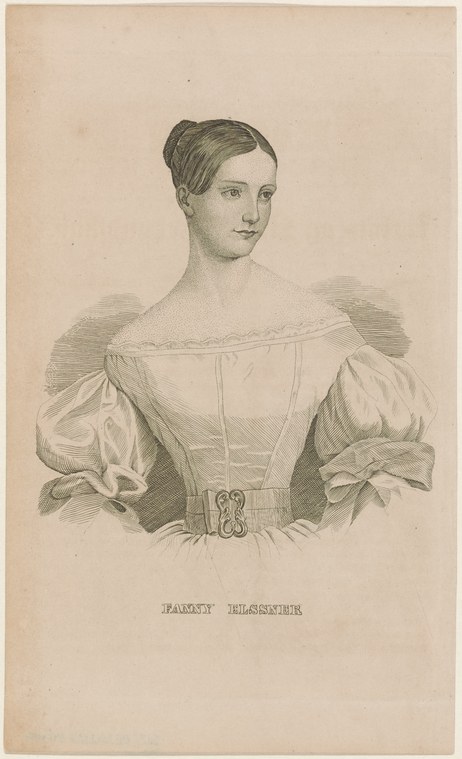
Fanny Elssler is central to understanding Romantic ballet and the emergence of the dancer as international celebrity. This engraving is direct evidence of how she was marketed and remembered—not in the supernatural roles she danced, but as a glamorous, accomplished woman in fashionable dress. For historians of dance and performance, such portraits are primary sources for understanding how dancers were perceived, packaged, and distributed to the public.
What you are looking at
A half-length portrait of a woman in early 19th-century dress, shown in three-quarter view against a plain background. She wears a white or cream off-shoulder dress with dramatically puffed sleeves gathered at the forearms, a style characteristic of the 1830s–1840s. A decorative belt or clasp sits at her waist. Her dark hair is drawn back simply, and her expression is calm and composed. The engraving is finely detailed, with careful attention to the fabric's texture and the play of light across her shoulders and chest. The name "FANNY ELSSLER" appears in capitals below the image.
The dancing
The figure is shown in a frontal, dignified pose with shoulders relaxed and slightly back. Her gaze is directed toward the viewer, steady and composed. There is no indication of active movement or dance position; this is a formal portrait presented for public circulation. The pose emphasizes grace and poise rather than any specific technical position.
The dance depicted
This is a portrait of Fanny Elssler, one of the most celebrated ballet dancers of the Romantic era, known internationally for her performances from the 1820s through the 1850s. The image captures her as a public figure and star rather than in performance. Elssler was renowned for her technical virtuosity and dramatic presence, particularly in roles that emphasized national character dances and folk idioms—a contrast to the ethereal, supernatural emphasis of her contemporary rival Marie Taglioni. The portrait's formal elegance reflects her status as a major theatrical celebrity.
How it was made
This is an engraving, likely a steel or copper-plate engraving given the fine detail and the date range suggested by the dress. The technique allows for precise rendering of fabric texture and facial features, and the delicate line-work produces subtle modeling of form. Such engravings were mass-produced and distributed widely through print shops and periodicals, making them the primary means by which theater audiences could own an image of their favorite performers. This widespread circulation explains why Elssler's image survives in multiple copies.
About this work
This engraved portrait presents Fanny Elssler, one of the Romantic era's greatest dancers, in the formal dress of her own time rather than in theatrical costume. It is a public document of celebrity—a souvenir and advertisement rolled into one. Elssler's prominence in European and American dance culture makes her image historically important; this engraving circulated widely and would have been recognized immediately by audiences of the 1830s–1840s who had seen her perform or read of her triumphs in the press. The portrait preserves not the dancer in action, but the woman as she presented herself to the world: composed, elegant, and unmistakably a figure of consequence.
How to look at it
Attend to the dress first: the puffed sleeves and the neckline are not theatrical costume, but fashionable street wear of the period, which tells you this is a public portrait, not a stage image. Notice the calm, direct gaze and the restful pose—there is no indication of the dramatic intensity or physical exertion of performance. The engraver has emphasized elegance and composure, qualities that made Elssler appealing to respectable audiences who might have been nervous about the moral status of actresses. The fine detail in the fabric and face, achieved through careful engraving technique, signals that this is a portrait of consequence, not a quick theatrical broadside.
The artist
The artist is not recorded in the catalogue. The engraving is competently executed and was likely produced by a professional print-shop engraver working from a drawing or painting; such portraits of celebrities were often adapted from multiple sources and reworked for different print editions. The work belongs to a standard tradition of theater portraiture.
The period
This engraving dates to the height of Romantic ballet, approximately the 1830s–1840s, when ballet was the dominant theatrical dance form in Europe and North America. Fanny Elssler and Marie Taglioni dominated the era, and their rivalry shaped the aesthetic of the period. Elssler distinguished herself through her emphasis on character and national dances (particularly the Spanish cachucha), while Taglioni represented the ethereal, weightless ideal. The fashion visible in this portrait—the puffed sleeves and off-shoulder neckline—is consistent with the 1830s–1840s silhouette. Theater portraiture was a major publishing business, and such engravings appeared in newspapers, magazines, and as standalone prints for sale to devoted fans.
Where it lives
The work is held in the New York Public Library's collection of prints depicting dance. It is catalogued by title alone, indicating it is one of many such portraits in the collection, part of a broader archive of theater ephemera and celebrity imagery from the 19th century.
Dance in this work
Questions about this work
Who was Fanny Elssler?
Fanny Elssler (1810–1884) was an Austrian ballet dancer who became an international star during the Romantic era. She was known for her technical brilliance and her emphasis on character dances and national idioms, which contrasted with the ethereal style of her rival Marie Taglioni. She performed throughout Europe and in the United States, and was one of the most celebrated performers of her time.
Is this a portrait from life or a copy?
This is an engraved portrait, likely produced for commercial distribution. It may have been based on a painting or drawing, but it is itself a mechanical reproduction designed for mass circulation through print shops and periodicals. Multiple versions and copies of such portraits exist, making it difficult to trace a single 'original' source.
What does the dress tell us?
The dress is fashionable street wear of the 1830s–1840s, not stage costume. The puffed sleeves and off-shoulder neckline follow the silhouette of the period. This formal, dignified presentation was common for celebrity portraits, positioning Elssler as a refined lady rather than emphasizing her role as a performer—an important distinction for a public figure in an era when actresses faced social suspicion.
What can we learn from the engraving technique?
The fine detail and careful line-work indicate this was produced by a skilled professional engraver. The quality and technical finish suggest it was intended for circulation among a relatively affluent audience—theater-goers and print collectors. Engravings were the primary means of reproducing images before photography, and they remained important for theatrical portraiture well into the photographic era.
More dance artwork





