49 works in this view — arrow keys or swipe to move between them.
Dance in Art
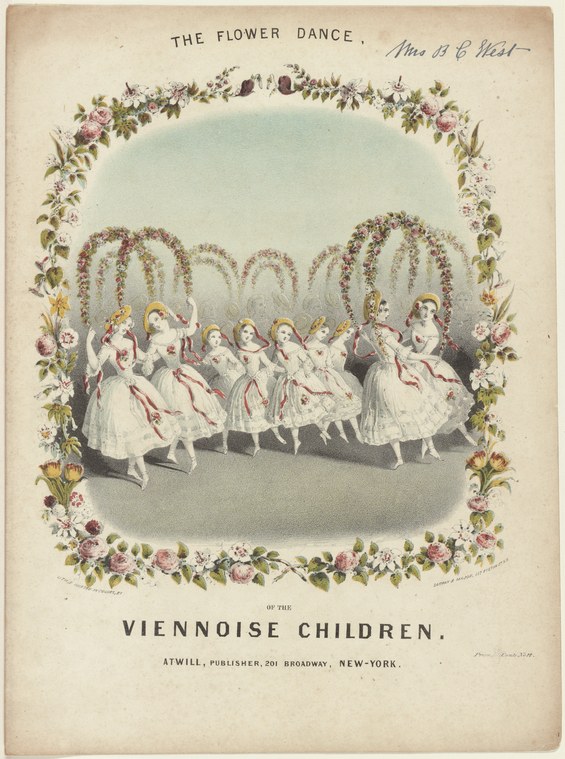
The Flower dance of the Viennoise children
Unknown artist
- Collection:
- Prints depicting dance
- Source:
- New York Public Library
- Rights:
- Public domain — free to use, share and adapt.
- Recorded as:
- Public Domain
This work is one of few surviving images that document how children were actually choreographed and presented in commercial theater during the Gilded Age. The symmetrical, unified formations and formal dress reveal pedagogical and aesthetic principles that shaped early theatrical training in America. For historians of dance, childhood, and theater, it is primary evidence of a now-vanished performance tradition.
What you are looking at
A chromolithographed title page presents a theatrical scene of children in white dresses performing a coordinated dance within an ornamental floral border. The frame itself is a wreath of pink roses, greenery, and flowering vines that encircles the entire composition. Within this frame, twelve young dancers in identical white muslin dresses with red sashes stand in two parallel arched lines, facing inward toward each other. The setting is a pale blue stage floor against a soft gray background. The children's poses suggest synchronized movement: their bodies are upright and formal, arms held at their sides or gently extended, creating a sense of balletic decorum. The composition is symmetrical and ceremonial, emphasizing the precision and conformity prized in Gilded Age children's performance. The border decoration and soft coloring suggest this is a printed souvenir or promotional image for a staged performance.
The dancing
The twelve dancers are arranged in two curving lines that echo the arch of the floral frame above them, creating a visual harmony between border and figures. Each child stands in an upright, formal posture with minimal visible flexion—the feet appear to be in a closed position, the bodies held square to the audience. The white dresses fall straight to mid-calf, unfluted and simple. The red sashes at the waist are the only color accent on the dancers themselves. The uniformity of dress and stance suggests children trained to execute synchronized movement in unison rather than individual interpretation, and the overall frame conveys a controlled, parlor-theatrical aesthetic rather than professional technique.
The dance depicted
This is a theatrical children's performance piece, most likely a 'flower dance' or tableau vivant popular in late nineteenth-century American parlor entertainment and school exhibitions. The work is titled *The Flower Dance of the Viennoise Children*, suggesting Viennese or Austrian origin or inspiration. The dance appears to be a choreographed ensemble piece designed for young performers, emphasizing symmetry, unity of dress, and formal deportment over technical virtuosity. The arched formations and synchronized poses are consistent with late Romantic or early Gilded Age children's spectacle—the kind of performance that might have been mounted in a drawing room, schoolhouse, or commercial theater by and for middle-class audiences. The floral title and decoration suggest the performance had aesthetic and allegorical pretensions, perhaps linking childhood innocence to natural beauty.
How it was made
This is a chromolithograph, a color printing process that allowed multiple stones or plates to be inked separately and layered to create a colored image. The technique is evident in the subtle gradations of the background sky, the fine detailing of the floral border, and the consistent pink and green palette. Chromolithography was the dominant commercial printing technology of the 1880s–1910s and was used extensively for theatrical playbills, sheet music covers, and promotional images. The presence of a handwritten inscription at top right ('Mrs D C West') suggests this may be a presentation copy. The process made it possible to produce inexpensive, colorful images for mass distribution, indicating this work was intended to circulate among theater patrons or as a souvenir.
About this work
This is a chromolithographed souvenir or promotional image for a children's theatrical performance called *The Flower Dance of the Viennoise Children*, published by Atwill of New York. The image documents both the performance itself—twelve young dancers in white dresses arranged in synchronized formations—and the aesthetic values of Gilded Age children's theater, which prized uniformity, decorum, formality, and floral or allegorical decoration. The work belongs to a substantial archive of popular theatrical imagery from the late nineteenth century, when color printing made such images widely accessible and commercially valuable.
The print sits at the intersection of theatrical history, printing technology, and childhood culture. It is neither high art nor documentary, but a designed object meant to advertise, commemorate, and idealize a commercial performance. It shows us what a middle-class American audience of the 1880s or 1890s valued in children's spectacle: formal training, visual harmony, and the poetic association of childhood with flowers and nature.
How to look at it
Look at the formal symmetry of the composition: the two curved lines of dancers mirror each other and echo the arched garland above, creating a visual harmony that would have been central to the appeal of such performances. Notice the uniformity of dress and pose—no dancer is individualized or caught in a moment of exertion; instead, all stand in a kind of ideal, timeless formation. The floral border is not merely decorative but integral to the image's meaning, linking the children to flowers and nature as an allegory of innocence. The chromolithographic technique itself—the soft colors, the carefully graded background—embodies the refinement and gentility the performance aimed to project.
The period
In the 1880s–1890s, children's theatrical performance was a established feature of American middle-class culture. Parlor entertainments and school exhibitions incorporated choreographed group dances, often with allegorical or floral themes. The influence of Romantic ballet—with its emphasis on line, symmetry, and ethereal costuming—is evident in the white dresses and arched formations shown here. At the same time, children's performance was understood as primarily pedagogical and moral: dancing taught posture, obedience, and grace. The production of chromolithographed images to promote and commemorate such performances was routine commercial practice by this period.
Austria and Vienna held a particular prestige in American culture as the home of classical music and courtly refinement. The attribution to 'Viennoise' (Viennese) children or a Viennese performance style may have been a marketing strategy to lend European sophistication to a local or American production, or it may document an actual Austrian troupe touring in America.
Where it lives
This is part of the NYPL's collection of prints depicting dance. The handwritten inscription 'Mrs D C West' at top right suggests this may have been a presentation copy, perhaps given to or by a performer or patron. Atwill was a major theatrical publisher based at 201 Broadway, New York, and issued numerous theatrical prints, playbills, and sheet music covers during the late nineteenth century.
Dance in this work
Questions about this work
Was this a real performance or an imagined one?
This appears to be a souvenir or promotional image for an actual performance, not a fanciful illustration. The specificity of the title (*The Flower Dance of the Viennoise Children*), the publisher's imprint, and the handwritten inscription all suggest it documented a real theatrical event. However, the image itself is idealized and stylized for promotional purposes, not a naturalistic record of the performance.
What does 'Viennoise' mean?
Viennoise means Viennese, or relating to Vienna. The title may indicate that the dance came from Vienna or was performed by Viennese children, or it may be a marketing device to suggest European sophistication and cultural prestige. By the 1880s–1890s, Viennese culture held high cultural status in America, particularly in music and dance.
How old were these dancers likely to be?
Based on the size and proportions shown in the image, the performers appear to range from roughly six to twelve years old. The uniformity of their dress and height suggests they may have been grouped or trained as an ensemble rather than selected for exact age matching, which was typical of theatrical companies of the period.
Is this a ballet?
It shares some characteristics with ballet—the white dresses, the formal posture, the symmetrical formations—but it is not classical ballet in the technical sense. It is closer to what would be called a parlor entertainment, school exhibition, or theatrical spectacle. The pose and uniformity suggest training in balletic deportment and movement, but not necessarily professional ballet technique.
More dance artwork





