49 works in this view — arrow keys or swipe to move between them.
Dance in Art
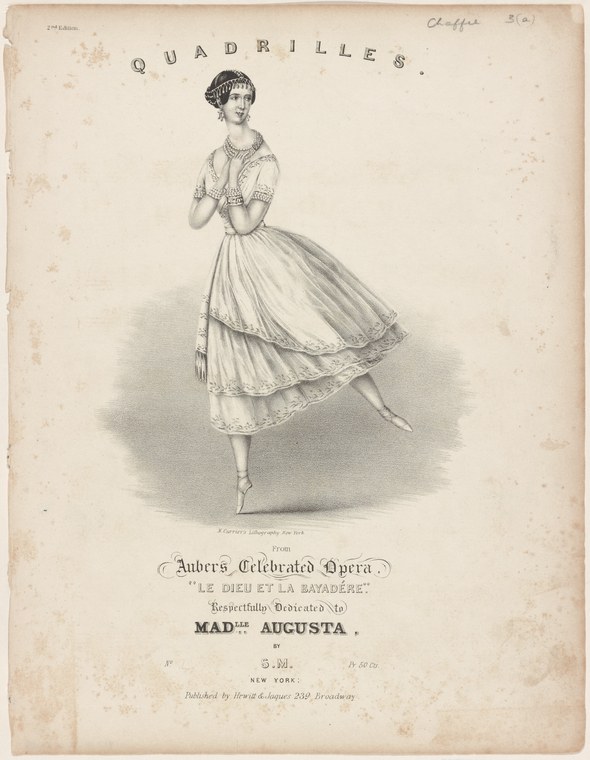
Quadrilles from Aubers celebrated opera, Le dieu et la bayadère, respectfully dedicated to Madlle. Augusta, by S. M.
Unknown artist
- Collection:
- Prints depicting dance
- Source:
- New York Public Library
- Rights:
- Public domain — free to use, share and adapt.
- Recorded as:
- Public Domain
This print preserves visual evidence of how a specific operatic quadrille was performed and presented in the early 1830s, and shows us the physique, costume, and deportment expected of a professional female dancer of that moment. For historians of dance and theatre, such prints are among the few reliable sources for the appearance of dancers and the styling of Romantic-era movement before photography; they were created for circulation and sale, making them more likely to capture actual practice than later reminiscences or idealized paintings.
What you are looking at
A single female dancer in a flowing white dress stands in a graceful pose against a plain background, her body angled three-quarters to the viewer. She wears a short-sleeved white tunic-style bodice with decorative trim, and a full skirt with multiple layers of ruffled underskirts that fall to mid-calf, allowing a glimpse of her feet en pointe or demi-pointe. Her dark hair is styled in an upswept arrangement typical of the 1830s–40s. Her arms are held in a soft, rounded position—the right arm raised with elbow bent, the left hanging naturally—and her posture is upright and elegant. The lithographic print captures a single, suspended moment of stillness rather than action, presenting the dancer as an idealized figure. The work is inscribed at the top with the title "Quadrilles" and at the bottom credits Auber's opera *Le dieu et la bayadère* and dedicates the print to "Madlle. Augusta."
The dancing
The dancer's frame is vertical and composed, with a clear upright carriage and only gentle arm movement—neither arm is extended fully, and both hands appear relaxed. Her weight appears to be centered over her legs, with her right foot slightly advanced. The pose suggests a moment of pause or transition rather than active stepping, typical of how individual dancers were portrayed in early 19th-century theatrical prints. There is only one figure, isolated against the void, which emphasizes the dancer's technical accomplishment and the appeal of her form rather than the dynamics of interaction or group work.
The dance depicted
The title indicates this work depicts or commemorates a quadrille—a structured, couples-based French ballroom dance typically performed by four pairs in a square formation. The dedicatee "Madlle. Augusta" was likely a professional dancer performing this music in a theatrical version of Auber's 1830 opéra comique. However, the image shows only a single dancer posed as if from a theatrical or concert performance, not the formation or partnering that characterizes actual quadrille practice. This appears to be a portrait of the dancer rather than a documentation of the dance itself, suggesting it served as a souvenir or promotional print for a specific performer and opera production.
How it was made
This is a lithographic print, identifiable by its tonal range, the crispness of the lettered title, and the characteristic soft gradations of shading in the skirt and bodice. Lithography allowed for relatively rapid production and affordable distribution to a theatre-going public, making such prints common merchandise in early 19th-century Paris and London. The technique's ability to capture fine detail in fabric and the human form made it ideal for theatrical souvenirs and fashion plates. The print's inscription in French and English, combined with the NYPL attribution, suggests it was distributed in or for an English-speaking market, likely New York.
About this work
This is a lithographic souvenir or portrait print commemorating a performance of a quadrille choreographed to or derived from Auber's 1830 opéra comique *Le dieu et la bayadère*. Rather than showing the four-couple formation characteristic of the actual dance, it isolates and celebrates the technical accomplishment and visual appeal of a single performer, "Madlle. Augusta." The work sits at the intersection of theatrical promotion, dance documentation, and early 19th-century fashion representation—it is at once a portrait of the dancer, a record of a moment in operatic dance, and a commodity meant for purchase by members of the theatre audience. Its survival in a major public collection reflects the prolific production of such prints and their value as witnesses to the training, style, and celebrity of Romantic-era dancers.
How to look at it
Observe the dancer's posture and the silhouette created by her skirt: the extreme fullness and the layering of ruffles are not incidental decoration but evidence of the construction required to present the female form in early 19th-century theatrical dance. Notice the precision of her foot placement and the careful balance implied by her upright stance—this is a trained body held in a moment of repose. The artist has chosen to show her in a moment of stillness and self-presentation rather than mid-movement, which was the convention for such promotional prints: the dancer is on display, not dancing. The soft tonal rendering of the skirt and the careful attention to the bodice's trim reflect the lithographer's skill and the print's value as a faithful record of theatrical costume.
The artist
The artist of this lithograph is not recorded in the catalogue. The print was published by Hirsch & Samouelle in New York, but the lithographic artist or any European source work is not identified. The style of the figure and the technique are consistent with the commercial theatrical print production of Paris and London in the 1830s, where such works were frequently unsigned or credited only to the publisher.
The period
The quadrille emerged in Paris in the 1810s and became the dominant couple dance in European ballrooms and theatres by the 1830s. Auber's *Le dieu et la bayadère* (1830) was a major operatic success, and quadrilles derived from operatic tunes were a standard form of theatrical and social dance. In this period, female dancers in European theatres were trained in a rigorous technique that blended elements of classical ballet with the social graces demanded by the Romantic movement—upright carriage, fluid arm movement, and a presentation of effortless elegance. The 1830s saw an explosion of lithographic theatrical prints, which served as affordable souvenirs and as fashion and dance references for the theatre-going public.
Where it lives
This lithograph is held by the New York Public Library in its collection of prints depicting dance. It was published in New York by Hirsch & Samouelle and is dated to an unknown year, though the reference to Auber's 1830 opera and the style of the print suggest a date in the 1830s or early 1840s. Such prints were mass-produced and sold at theatres or through print dealers.
Dance in this work
Questions about this work
Who was Madlle. Augusta?
The catalogue does not identify her beyond the print's dedication. She was likely a professional dancer performing in theatres in New York or another English-speaking city, and the quadrille shown here was probably a number in a theatrical production of or inspired by Auber's opera. Without further research, her identity and career remain unclear.
Why does the print show only one dancer if the quadrille is a couples dance?
This is a theatrical souvenir or portrait print, not a documentation of an actual dance performance. Such prints isolated a single performer for celebration and promotion, presenting the dancer as an artist and a fashionable figure. The quadrille would have been performed by multiple couples, but the print focuses on the individual dancer's technique and appeal.
How do we know this is a lithograph?
The tonal gradations, the fineness of the line work, and the characteristic soft shading in areas like the skirt are typical of lithographic printing. The lettered title and publication information also match the style of theatrical prints of the 1830s–40s. The record does not specify the medium, but the visual evidence supports a lithographic attribution.
More dance artwork





