49 works in this view — arrow keys or swipe to move between them.
Dance in Art
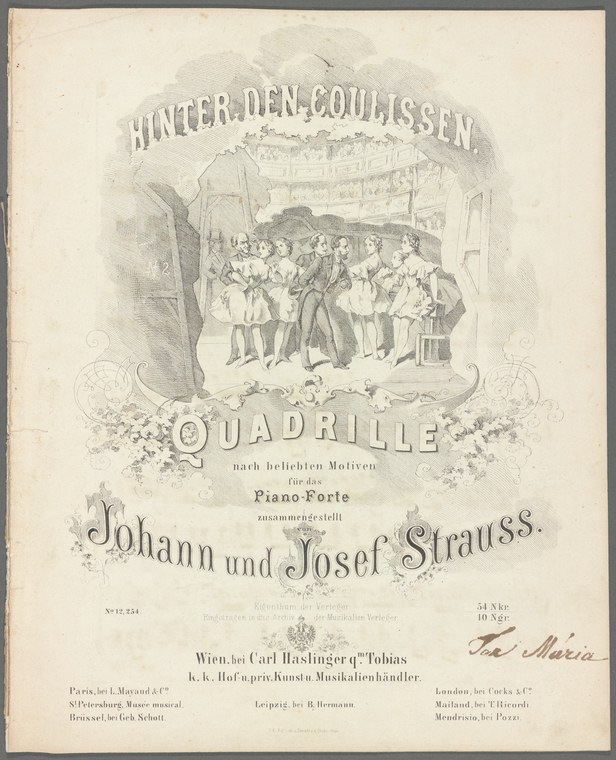
Hinter den Coulissen: Quadrille nach beliebten Motiven für das Piano-forte
Unknown artist
- Collection:
- Prints depicting dance
- Source:
- New York Public Library
- Rights:
- Public domain — free to use, share and adapt.
- Recorded as:
- Public Domain
This work shows the quadrille at the height of its cultural dominance—not as historical curiosity but as vital popular entertainment, arranged by the leading dance composers of the era. For anyone studying 19th-century social dance, theatre design, or the role of printed media in circulating dance, this image is both primary evidence and artifact of a vast commercial world of dance music now largely forgotten.
What you are looking at
This is a music-hall or theatrical engraving depicting a lively quadrille in progress. The composition is framed by an ornate decorative arch inscribed "HINTER DEN COULISSEN" (Behind the Curtains), establishing a backstage or green-room setting. The central scene shows approximately twelve figures in mid-19th-century formal dress arranged in two facing lines typical of quadrille formation. The dancers wear dark tailcoats and light-colored trousers, with women in full skirts; some figures are captured mid-gesture with raised arms and animated posture. The setting suggests theatrical gaiety—this is dance as entertainment observed from within the theatre itself rather than in a ballroom. The engraving technique has rendered the crowd with fine parallel hatching to create volume and shadow, and the architectural framing with scrollwork and ornamental flourishes typical of sheet-music covers conveys both the musical context and the commercial theatrical milieu.
The dancing
The dancers are shown in pairs and lines characteristic of quadrille formation, with several figures caught in animated mid-step positions. Arms are raised and extended, indicating the lively arm movements of the quadrille. The men stand in formal closed posture; the women's full skirts are rendered to show volume and movement. The figures are densely composed, creating a sense of crowded, energetic social dancing rather than ballroom precision. The artist has captured the social vitality of the form—these are performers or theatre-goers dancing together in confined space.
The dance depicted
The title explicitly identifies this as a quadrille, described as "nach beliebten Motiven" (based on popular melodies), which was a standard commercial formula for mid-19th-century dance music. The quadrille was the dominant social and theatrical dance of the period, performed both in fashionable ballrooms and in theatrical entertainments. This particular print commemorates the piece arranged by Johann and Josef Strauss, the famous Viennese dance composers. The scene captures the quadrille in its theatrical context—not as austere court dance but as lively, popular entertainment. The backstage setting suggests this may represent a quadrille performed by theatre performers or as a feature within a theatrical programme.
How it was made
This is a steel or copper engraving, characteristic of mid-19th-century sheet-music publication. The fine parallel lines (hatching and cross-hatching) are typical of intaglio work, and the ornamental framing with cartouches and scrollwork is the standard commercial design for printed musical scores intended for middle-class domestic and theatrical distribution. The technique allowed precise, repeatable imagery that could be circulated widely as both a cover design and advertisement. The engraving's clarity and finish indicate professional publication, likely by the Viennese or German publishing houses listed at the bottom of the print.
About this work
This is a mid-19th-century engraved sheet-music cover for a quadrille by the Strauss brothers, one of dozens of such pieces that dominated European dance culture after 1830. The image captures the quadrille not as a historical relic but as living, theatrical entertainment—dancers in formal dress performing backstage or in a social space connected to theatre. It is simultaneously a document of dance practice (showing formation and dress), a record of commercial musical publishing, and evidence of the enormous popularity of the quadrille across social classes. The Strauss family arranged and performed countless quadrilles based on popular melodies from operas and other sources, and this print advertises one such composition to customers who would perform it at home or witness it on stage.
How to look at it
Observe the precise formation—two facing lines, the architectural clarity of quadrille geometry despite the lively gesture. Notice how the engraver has captured the arm movements and raised skirts that characterize the lively tempo of the form. The backstage framing is significant: this is not a cold geometric diagram but a living, crowded social event witnessed as entertainment. The ornamental framing and commercial typography at the bottom (the publishing information) remind us that this is a printed commodity, a product made for sale to amateurs and professionals alike.
The artist
The print does not identify the engraver. The composition was arranged by Johann Strauss (1804–1849) and his son Josef Strauss (1827–1870), collectively known as the Strauss family, who dominated Viennese dance music throughout the mid-19th century. They composed hundreds of quadrilles, waltzes, and polkas, many based on themes from popular operas and ballets. This particular piece was published by Carl Haslinger in Vienna, a major music publisher of the period. The engraved cover art was a standard commercial product, likely designed by a house engraver whose name was not recorded.
The period
The quadrille was the defining social dance of the 1830s through 1870s, a figure dance for four couples or eight dancers in square formation, performed to lively music in duple or mixed meter. It originated in France in the early 19th century and spread rapidly across Europe and America, becoming the standard opening dance at balls and a staple of theatrical entertainment. By the 1850s, when this print was likely made, the quadrille had become so popular that composers published endless variations based on operatic melodies and folk themes—a commercial model of which this Strauss arrangement is an example. The simultaneous rise of the waltz in the 1830s-40s did not displace the quadrille but rather coexisted with it. Theatre and ballroom were not separated worlds; quadrilles were performed both socially and on stage, often by the same people.
Where it lives
This sheet-music cover is held by the New York Public Library as part of their collection of prints depicting dance. It is a published commercial product, produced by Carl Haslinger in Vienna, with distribution noted to Paris and London, indicating wide European circulation.
Dance in this work
Questions about this work
What is a quadrille?
A quadrille is a figure dance for four couples (eight dancers) arranged in a square, performed to lively music. Each couple takes a position on one side of the square, and the dance proceeds through a series of set figures performed by all couples or by pairs of couples in turn. It was the most popular ballroom dance of the 19th century and is the ancestor of modern square dancing.
Who were the Strauss family?
Johann Strauss (1804–1849) and his sons, including Josef (1827–1870) and the younger Johann Strauss (1825–1899), were Viennese composers and musicians who dominated dance music in the 19th century. They wrote hundreds of waltzes, quadrilles, and polkas and were celebrated as performers and bandleaders. Their quadrilles, like the one shown here, were often based on themes from successful operas.
What does 'Hinter den Coulissen' mean?
The title translates as "Behind the Curtains," referring to the backstage area of a theatre. This framing suggests the quadrille is being performed by theatre performers or in a theatrical social space, rather than in a formal ballroom. It may also be a playful reference to the theatrical or performative nature of social dance itself.
Was this actually performed?
Almost certainly yes. The Strauss family were celebrated performers as well as composers, and their quadrilles were played at balls, in theatres, and at concerts throughout Europe. Sheet-music covers like this one were advertisements for pieces that people could buy to perform at home or that professional musicians and theatre orchestras would perform publicly.
More dance artwork





