49 works in this view — arrow keys or swipe to move between them.
Dance in Art
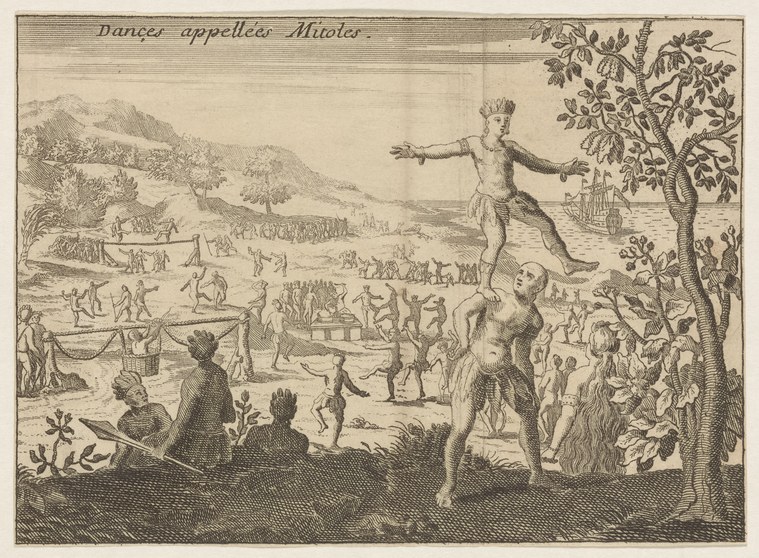
Dances appellées mitotes
Unknown artist
- Collection:
- Prints depicting dance
- Source:
- New York Public Library
- Rights:
- Public domain — free to use, share and adapt.
- Recorded as:
- Public Domain
The mitote represents an entire category of indigenous American dance practice that was largely suppressed and then forgotten after the colonial period, known now mainly through fragmentary written accounts and images like this one. This engraving is one of the few visual documents of how Mesoamerican dance was represented in the European imagination during the age of contact—important precisely because it reveals both what was observed and what was invented or misunderstood. For dancers and historians, it documents a tradition that shaped the hybrid dance forms that emerged during and after colonization.
What you are looking at
A densely populated landscape engraving depicts a festive gathering of indigenous dancers and celebrants in a lush natural setting. In the foreground, nude or minimally clothed figures perform energetic movements, some with arms raised or extended, others in dynamic postures suggesting rapid motion. The middle ground shows throngs of spectators arranged in loose groups around the performers, while the background recedes toward mountains and distant settlements. Large earthenware vessels rest on the ground in the left foreground, and substantial trees frame both sides of the composition. The scene conveys simultaneity and abundance—multiple activities occur at once, with no single focal point, suggesting a communal celebration rather than a formal performance. The engraving technique renders the figures in fine parallel lines that describe musculature, movement, and the warm climate.
The dancing
Dancers throughout the scene display open, expansive body positions with arms frequently raised, extended, or in arcs overhead. The torsos are often twisted or bent, and legs are planted wide or in lunging stances, suggesting weight transfers and vigorous footwork. Several dancers appear in mid-leap or mid-spin. The figures are drawn with anatomical detail that emphasizes the musculature engaged in exertion. Dancers move singly and in loose clusters rather than in coupled formations or rigid lines. The overall impression is of uninhibited, energetic movement with the whole body engaged.
The dance depicted
The title 'Mitotes' names a form of indigenous Mesoamerican ceremonial dance documented by Spanish colonial writers from the 16th century onward. Mitotes were communal dances performed for celebration, ritual, and social cohesion, often involving large groups of participants moving simultaneously and sometimes lasting for hours. The image captures the communal scale and open-bodied style consistent with descriptions of mitote performance: many dancers, no formal partnering, vigorous use of the full body, and integration with a watching community. The setting appears to be an idealized or generalized indigenous landscape rather than a specific documented event, reflecting the European ethnographic tradition of representing non-European practices through composite or imaginative scenes.
How it was made
This is an engraving, a print technique that uses fine lines incised into a metal plate to build tone and form through parallel hatching and cross-hatching. The technique allowed for wide circulation of images to a reading public across Europe without access to original paintings or firsthand accounts. The fine linear detail visible in the rendering of muscle, drapery, and landscape suggests a skilled engraver working from a drawing or painting, possibly after the work of a sixteenth- or early seventeenth-century artist with knowledge of colonial accounts. The tonal range achieved through densely packed lines conveys atmosphere and recession. Such prints were common in collections of travel narratives and ethnographic compilations during the early modern period.
About this work
This engraving documents the mitote, a communal ceremonial dance of Mesoamerican indigenous peoples, as understood and depicted for a European audience sometime in the early modern period. The image records not the dance as it was performed but rather how European viewers imagined it: energetic, populous, embedded in landscape and community practice, and executed with an exuberance foreign to European formal dance conventions of the period. The work belongs to a larger tradition of ethnographic representation in print—a way of making distant practices visible and knowable to readers who would never witness them. It is valuable because it captures European understanding of non-European dance at a moment when such practices were being recorded, often only through the lens of colonial encounter and the conventions of European artistic tradition.
How to look at it
Study the composition: notice how the artist has scattered dancers across the entire field rather than arranging them in symmetrical or processional lines. Observe the body positions—weight is rarely evenly distributed, and limbs are frequently in mid-arc, suggesting the engraver was attempting to capture momentum and exuberance rather than balanced stasis. Compare the treatment of the crowd watching to the performers: the spectators are rendered with less anatomical detail and smaller scale, emphasizing that this is a participatory, communal event rather than a performance observed from a distance. The landscape elements—the mountains, the trees, the vessels—anchor the dance to a specific culture and setting, marking it as 'other' for the European viewer.
The period
This engraving was produced during or shortly after the era of intense European ethnographic documentation of the Americas, roughly the sixteenth and seventeenth centuries. European scholars and travelers were publishing accounts of indigenous practices in earnest, and prints—cheaper and more reproducible than paintings—became the primary means of circulating images of foreign peoples and customs. Mitotes were explicitly described in Spanish colonial chronicles and missionary accounts as communal dances central to indigenous religious and social life. By the time this print was made, mitote practice had been severely disrupted by colonization, forced conversion, and the suppression of indigenous ceremonies, so such images often represent a partly imagined or partly remembered past rather than living observation.
Where it lives
The work is held in the New York Public Library as part of its collection of prints depicting dance. The catalogue record indicates unknown artist, date, and medium, but the engraving technique and style are consistent with early modern ethnographic prints, likely from a bound volume of travel narratives or a miscellaneous collection of images of foreign peoples and customs.
Dance in this work
Questions about this work
What is a mitote?
A mitote was a communal ceremonial dance practiced by Mesoamerican indigenous peoples—particularly among Nahua and other groups in Mexico—for celebration, religious observance, and social bonding. Dances could involve dozens of participants moving together for extended periods. They were documented by Spanish missionaries and conquistadors in the sixteenth century but were suppressed as part of colonial efforts to convert indigenous populations to Christianity. By the time of this print, the tradition was already fragmenting.
Why does this look so different from European dances of the same period?
European formal dances of the Renaissance and Baroque periods were choreographed, often paired or in processional lines, and followed geometric patterns reflecting courtly order. The mitote, by contrast, was collective, unscripted, and energetic, with no formal partnering or predetermined formations. The engraver's loose, distributed composition reflects the actual structure of the dance—many people moving simultaneously without formal hierarchy.
Is this an accurate representation?
Probably partially. The artist was working from written descriptions and possibly oral accounts, and European artistic conventions shaped what was depicted—for instance, the idealized landscape and the anatomical rendering reflect European taste more than indigenous visual traditions. However, the core elements—multiple dancers, open body positions, communal participation—align with colonial-period descriptions of actual mitote practice.
How was this image distributed?
As an engraving, this image was printed from a metal plate and likely bound into a book of travel narratives, ethnographic compilations, or general curiosities about the New World. Such volumes circulated among educated European readers, making images of indigenous peoples and practices widely accessible and shaping European ideas about the Americas.
More dance artwork





