49 works in this view — arrow keys or swipe to move between them.
Dance in Art
Rope dancing
Unknown artist
- Collection:
- Prints depicting dance
- Source:
- New York Public Library
- Rights:
- Public domain — free to use, share and adapt.
- Recorded as:
- Public Domain
The bolero engraving documents the moment when Spanish dance entered European high fashion and became tied to ideas of passion, sensuality, and otherness—a pattern that would shape dance aesthetics for two centuries. It shows how dance was promoted and circulated as a visual form among the educated elite: through colored engravings, accompanied by poetry and description, aimed at collectors who wanted to see and read about fashionable movements before experiencing them in the salon or theater.
What you are looking at
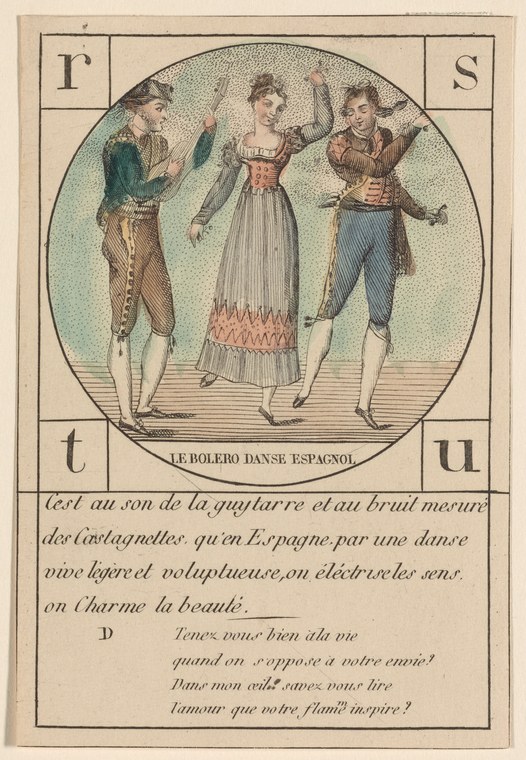
A hand-colored engraving depicts three figures in an energetic dance scene against a pale green background. At center stands a woman in a high-waisted neoclassical dress with short puffed sleeves, her arms raised in an expressive gesture. To her left, a man in fitted breeches and a dark jacket gestures toward her with both arms; to her right, another man in similar dress with his arms spread wide balances on the balls of his feet. The title beneath reads "LE BOLERO DANSE ESPAGNOL" (The Spanish Bolero Dance). Below the image, French text describes the dance as accompanied by guitar and castanets, performed with "lively and voluptuous" movement that "electrifies the senses" and "charms beauty." A poetic couplet follows, inviting the viewer to experience the dance's passionate appeal.
The dancing
The three figures occupy a shallow stage space with the woman centrally framed. Her posture is upright and contained despite her raised arms, which suggest a moment of turning or flourishing. The two men adopt asymmetrical stances—one leaning forward with invitation, the other balanced with arms extended as if in shadow play or accompaniment. All three are on the balls of their feet or in active stance, with weight distributed for mobility rather than stability. The composition suggests rhythmic counterplay rather than partnered contact.
The dance depicted
This is a representation of the Bolero, the Spanish dance that became fashionable in European salons and theaters in the late 18th century. The bolero was danced by one or more performers, often accompanied by guitar and castanets, and was celebrated for its passionate and sensual character. The engraving captures not a formal court dance but a theatrical or salon performance, where the dancer (the woman) is framed as the primary focus while the men seem to offer musical or dramatic accompaniment. The text emphasizes the dance's power to "electrify the senses," placing it squarely in the Romantic fascination with Spanish exoticism and sensuality.
How it was made
This is a hand-colored engraving, a technique that combined the precision of line engraving with watercolor or gouache tinting applied by hand or in workshop batches. The letters "r s t u" at the corners suggest it is part of a series or instructional sequence. Engraving allowed for reproducible images and wide circulation among educated audiences; the French text and neoclassical framing indicate a work aimed at European salons and collectors rather than a dance manual. The soft hand-coloring and delicate line work are characteristic of the late 18th-century taste for refined domestic entertainment.
About this work
This is a late 18th-century engraving celebrating the bolero, a Spanish dance that captivated European high society at the moment when Spain became a source of Romantic passion and exoticism. The image is not documentary but theatrical: it presents the dance as a performance to be admired, with the woman as the primary mover and the men as supporting figures. The accompanying text makes clear that this is not a technical treatise but a celebration of the dance's emotional and sensual power—the kind of promotional engraving that would have circulated among collectors and performers eager to participate in fashionable Continental taste. The work belongs in a gallery about dance because it captures a crucial moment when European audiences became fascinated by non-French, non-German dance forms, and when women's dancing bodies became subjects of intense theatrical and erotic interest.
How to look at it
Notice the woman's lifted, expressive arms and the way her body remains upright and contained—this is not the loose-limbed abandon that later images of "Spanish" dance would show, but a more controlled, theatrical presentation. Observe how the two men frame and balance her movement: the engraver has chosen a moment of pause or flourish rather than active partnering, emphasizing the woman's autonomy and the men's admiration. The soft palette and delicate line work invite the viewer to see the dance as elegant and refined, worthy of salon display—a far cry from the later 19th-century exoticization of Spanish dance. Read the French text alongside the image: it tells you this is a promotional object, designed to make the bolero sound irresistible to people who have never seen it performed.
The period
This engraving dates to the late 18th century, when the bolero was at the height of European fashion. The Spanish dance, which had circulated in Spanish court culture for decades, became fashionable in Paris and other Continental centers around the 1780s and 1790s. The neoclassical dress of the female figure—high waistline, minimal ornamentation, simplified silhouette—confirms a date in this period. Romanticism was rising: the emphasis on the dance's power to move the senses, the association with Spain and exoticism, and the focus on the emotional rather than technical character of the movement all reflect early Romantic values. At the same time, the formal engraving and refined hand-coloring belong to the culture of the ancien régime print, suggesting this may date to the 1780s-90s or even be a retrospective work from the early 19th century.
Where it lives
The work is held in the New York Public Library's prints collection. The letters at the corners (r, s, t, u) suggest it is one of a series, possibly part of a larger instructional or entertainment portfolio on fashionable dances. The presence of French text and the refined engraving style indicate publication or circulation in Continental Europe, most likely France.
Dance in this work
Questions about this work
What is a bolero, and who danced it?
The bolero was a Spanish dance that became fashionable in European salons and theaters in the late 18th century. It was danced solo or in small groups, accompanied by guitar and castanets, and was celebrated for its passionate, sensual character. The dance appealed to Romantic tastes because it was associated with Spain and exoticism, and because it emphasized emotional expression over formal technique.
Why are there three dancers, and are they dancing together?
The engraver has chosen to show the woman as the primary performer, with the two men as supporting figures—possibly representing musicians, companions, or audience members admiring her movement. They are not in closed or formal partner position; instead, their gestures suggest they are responding to or framing her movement. This composition emphasizes the woman's autonomy and the audience's fascination with her body.
What does the French text say?
The text translates roughly: 'It is to the sound of the guitar and the harsh noise of the castanets that in Spain a living, lively dance is performed—voluptuous and electrifying the senses without harming beauty.' A couplet invites the reader to experience the dance's power to inspire passion. This is promotional language, designed to make the dance sound irresistible and to justify its presence in European drawing rooms.
How does this image differ from later depictions of Spanish dance?
This engraving is relatively restrained and elegant. The woman's body is controlled, her dress is neoclassical and refined, and the composition emphasizes artistry over exoticism. Later 19th-century images of Spanish dance—especially flamenco—would emphasize loose hair, more exposed bodies, more dramatic postures, and a visual language coded as more explicitly sensual and 'primitive.' This earlier image shows the bolero at the moment it entered refined European taste, before the full load of Romantic and Orientalist exoticism had attached to it.
More dance artwork





