49 works in this view — arrow keys or swipe to move between them.
Dance in Art
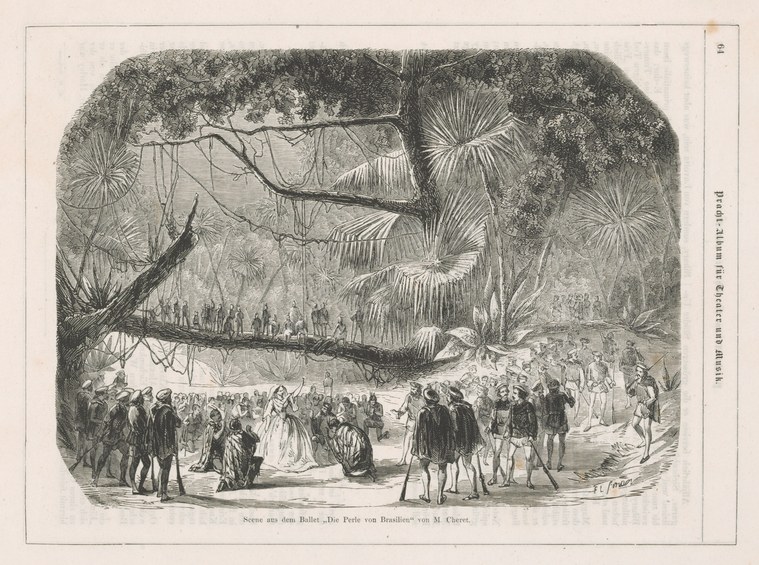
Scene aus dem Ballet Die Perle von Brasilien von M. Cheret
Unknown artist
- Collection:
- Prints depicting dance
- Source:
- New York Public Library
- Rights:
- Public domain — free to use, share and adapt.
- Recorded as:
- Public Domain
This engraving documents the relationship between dance and theatrical spectacle in the 1860s, showing how ballet performance existed within larger frameworks of exotic scenery and social pageantry. It provides visual evidence of how nineteenth-century dance was consumed and understood by the public through printed reproductions rather than live performance alone.
What you are looking at
A grand outdoor theatrical scene set in a tropical landscape. Massive palm trees frame the composition, their fronds creating a canopy above a gathering of elegantly dressed figures. The scene is crowded with spectators and performers arranged across the stage space—some standing in formal posture, others in animated conversation or gesture. The lighting suggests an evening or twilight setting, with dramatic illumination picking out the central figures against darker foliage. The composition uses deep recession into space, with figures receding toward the back of the stage where more activity suggests a theatrical event in progress. The engraving's fine cross-hatching creates rich tonal gradations, particularly in rendering the massive tree trunks and the play of light and shadow across the gathered crowd.
The dancing
The figures are dressed in mid-nineteenth-century formal wear—men in dark tailcoats and women in full-skirted gowns characteristic of the 1860s. The poses are primarily static or gently animated rather than demonstrating vigorous dance movement; most figures stand, walk, or converse rather than execute ballet steps. Several women are positioned with arms at rest or gesturing socially. The overall frame suggests a theatrical audience or promenade scene rather than a focused depiction of specific dancing bodies—no pointe work, no evident ballet positions, no clear pairing or hold between dancers.
The dance depicted
The title identifies this as a scene from Chéret's *La Perle de Brésil* (The Pearl of Brazil), a five-act opera-ballet that premiered at the Théâtre de l'Académie Royale de Musique in 1862. The scene appears to depict not a dance number itself but a theatrical tableau or gathering—possibly a ball, marketplace, or procession scene that was common in mid-century spectacular ballet. The ballet combined exotic Brazilian setting with the narrative and movement vocabulary of Romantic ballet, but this particular engraving emphasizes the scenic and social spectacle rather than dance technique. The image documents the theatrical context and audience appeal of the work rather than the choreography.
How it was made
This is an engraving, executed with fine cross-hatching and burr-work to create tonal variation and depth. The technique allows the artist to render complex spatial recession and atmospheric effects—the darkened foliage, the play of light on fabric and faces, the crowd's spatial arrangement. Engravings of this type were widely circulated as illustrations in periodicals and as individual prints, making theatrical scenes accessible to the public beyond those who could attend live performances. The high degree of finish and detail suggests this was a commercial publication, likely from a theatrical periodical or collected album of opera-ballet scenes.
About this work
This is a theatrical engraving documenting a scene from Chéret's 1862 opera-ballet *La Perle de Brésil*, depicting a social gathering in an exotic tropical setting. Rather than isolating a dance sequence, the print captures the spectacular stage picture and the fashionable audience context that defined mid-nineteenth-century Parisian ballet spectacle. The work belongs in a dance gallery as evidence of how ballet was framed and circulated through popular visual media, and what theatrical values—setting, costume, social gathering—accompanied dance performance in the period.
How to look at it
Attend to the composition's spatial depth and the way figures are scattered across the scene rather than unified in a single dance action. The artist has chosen to freeze a moment of theatrical gathering rather than a climactic dance movement—notice how few bodies are in positions of active dance gesture. The engraving's technique—the careful tonal gradation in the foliage, the attention to costume fabric and individual faces—prioritizes scenic splendor and social spectacle over the anatomy of dance. This framing reflects the 1860s ballet audience's interest in the total theatrical experience.
The artist
The catalogue record does not identify the engraver. The work is titled as a scene from an opera-ballet by M. Chéret (likely Michel Chéret), but does not credit the engraver's hand. The style and finish suggest a professional theatrical print workshop, possibly associated with periodical publication or theatrical documentation.
The period
This engraving dates to the era of Romantic ballet's peak in France, the 1860s, when the Paris Opéra produced large-scale spectacular ballets combining exotic narratives, elaborate scenery, and a mix of solo virtuosity and ensemble pageantry. The visual emphasis on setting and social context reflects the period's investment in *mise-en-scène*—the complete theatrical picture—as much as in dance technique itself. Mid-nineteenth-century theatrical engravings were mass-produced documents of ephemeral performance, circulated through journals, albums, and individual sales to audiences eager for visual souvenirs of famous productions.
Where it lives
The work is held in the New York Public Library's collection of prints depicting dance. It is a historical theatrical engraving, likely from mid-nineteenth-century French publication, and represents the documented visual record of a notable Paris Opéra production.
Dance in this work
Questions about this work
What is *La Perle de Brésil*?
*La Perle de Brésil* (The Pearl of Brazil) was a five-act opera-ballet choreographed by Michel Chéret and first performed at the Théâtre de l'Académie Royale de Musique (the Paris Opéra) in 1862. It combined Romantic ballet vocabulary with an exotic Brazilian narrative, exemplifying the mid-nineteenth-century taste for spectacular theatrical spectacle set in distant lands.
Why is this a scene rather than a dance?
This engraving documents a theatrical scene—a social gathering or procession within the ballet's narrative—rather than a focused dance sequence. Mid-nineteenth-century ballet productions alternated between solo and ensemble dance numbers and atmospheric scenic tableaux. The engraver has chosen to document the spectacular setting and the crowd, emphasizing the total theatrical experience.
How were theatrical engravings distributed?
Engravings of famous theatrical scenes were circulated widely through theatrical journals, collected albums, and individual print sales. They were accessible to the general public as visual souvenirs of performances, and allowed people who had not attended the theatre to experience famous productions through reproduced images.
More dance artwork





