49 works in this view — arrow keys or swipe to move between them.
Dance in Art
Masquerades and fancy-dress balls in prints
Unknown artist
- Collection:
- Prints depicting dance
- Source:
- New York Public Library
- Rights:
- Public domain — free to use, share and adapt.
- Recorded as:
- Public Domain
For dancers and historians, this print offers concrete visual evidence of how bodies moved and held themselves in Regency ballrooms, and how the architecture and decoration of the space contributed to the meaning of the dance. The precision of the engraving and the careful attention to costume and posture make this a reliable reference for historical reconstruction. It also reveals the relationship between ballroom dance and visual art: the ballroom itself became a subject worthy of professional documentation and circulation, indicating how central dancing was to the self-image of the era's elite.
What you are looking at
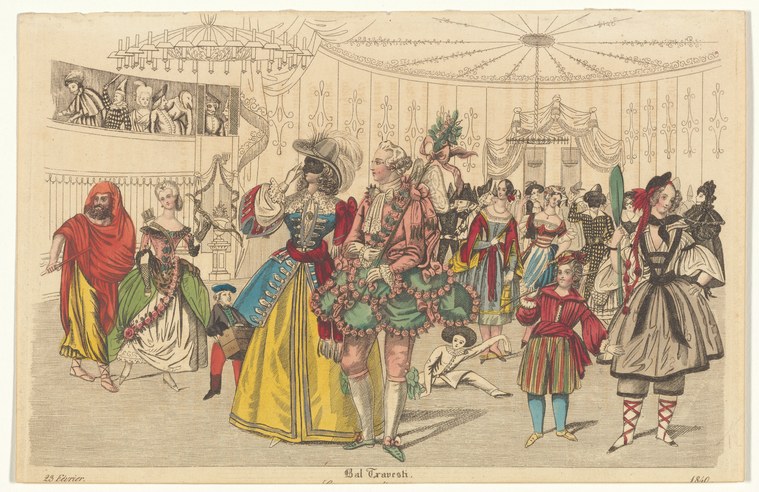
An ornate interior ballroom or assembly hall is filled with figures in elaborate early 19th-century dress engaged in social dance and promenade. The ceiling is a marvel of neoclassical design: a coffered dome punctuated by radiating lines and decorated with hanging garlands and swags. A musicians' gallery runs along the upper left. The floor is crowded with dancers in formal court dress—the women in high-waisted Empire silhouettes with long skirts, the men in tailcoats, breeches, and decorative hose. At the center, a couple stands highlighted, the woman in a blue skirt with yellow hem, the man in vibrant red coat with embroidered trim. Around them, other dancers in various attitudes of movement: some in closed holds, some promenading, some standing in conversation. The color hand-applied to the print is vivid—deep reds, bright yellows, blues, and greens against the pale paper ground. The entire composition suggests the height of Regency-era social formality, with guests arranged in the calculated informality of ballroom choreography.
The dancing
The central couple shows the closed ballroom hold characteristic of the period, with the woman slightly offset from the man's right side, both upright and composed. Other figures around them stand in small knots or pairs, some clearly mid-promenade with an easy, erect carriage. The women's arms are either held within the dance frame or at rest; the men stand in the propriety of formal evening dress. The spacing and grouping suggest simultaneous multiple dances or a grand march rather than a single cohesive set—a feature of Regency social protocol where different formations coexisted in the ballroom.
The dance depicted
This is a Regency-era ballroom scene, almost certainly depicting one or more of the formal dances of the 1810s–1830s: likely quadrilles, country dances, or a grand march. The dress, the neoclassical interior, and the formal arrangement of figures all point to the social dancing of the English Regency or European court equivalent. The image appears to be titled 'Bal Travesti' (Masked Ball), suggesting this may be a fancy-dress or masquerade variant, though no masks are clearly visible on the dancers themselves—only elaborate costume. The formality of posture and the geometric spacing indicates ballroom dances governed by fixed figures rather than improvisation.
How it was made
This is a hand-colored engraving or possibly lithograph, evidenced by the fine linear work visible in the architectural detail and clothing, with watercolor or gouache applied afterward to create the bright, saturated color. The date of the print appears to be 1846 based on a mark visible at lower right. The technique allowed for mass circulation of fashionable ballroom imagery to middle-class audiences; colored prints were more expensive than plain ones and thus indicated a relatively affluent or aspirational market. The precision of the engraving suggests a professional atelier, likely commercial production responding to appetite for images of high-society entertainment.
About this work
This is a Regency-era ballroom scene rendered as a hand-colored engraving, capturing the formal, hierarchical world of European court and high-society dancing in the early 19th century. The print documents not only the dances themselves—quadrilles, country dances, and grand marches—but the architecture, dress codes, and spatial protocols that governed them. It belongs in a gallery of dance imagery because it freezes a moment of social choreography and reveals the systems of class, gender, and etiquette embedded in the ballroom. The image is a historical document of how dancing functioned as a performing art of social order.
How to look at it
Attend first to the geometric spacing and posture of the figures: notice how upright and controlled the bodies are, and how the room is divided into small, distinct groups rather than a single flowing ensemble. The central couple at their moment of close contact shows the ballroom hold at its most formal. Look at the rendering of the women's skirts—the high waistline and length characteristic of Empire dress—and observe how the engraver has rendered the texture of silk and lace through fine hatching. The architectural detail of the ceiling is not incidental: the rational, orderly neoclassical design mirrors the orderly choreography below.
The artist
The artist is not recorded on the catalogue. The style, technique, and commercial execution suggest a mid-19th-century European print workshop, possibly German or Austro-Hungarian given the title 'Bal Travesti' and the ornamental style of the interior. The work belongs to a large tradition of ballroom-scene engravings produced for social consumption, often appearing in fashion and society periodicals.
The period
The Regency era (1811–1820 in Britain; the broader period of Neoclassical design extending through the 1840s) saw the quadrille and the formal country dance as the dominant ballroom forms across Europe. The style of dress, the neoclassical interior, and the formal etiquette depicted here reflect a moment when ballroom dancing was conceived as an art form requiring instruction, refinement, and strict adherence to figure and protocol. By 1846 (the date on the print), Romantic-era music and waltz culture were beginning to challenge the older formality, yet the quadrille remained dominant in formal settings. The hand-colored engraving itself reflects the technology of its moment: a mass medium for documenting and circulating images of fashionable life.
Where it lives
The print is held in the New York Public Library's collection titled 'Prints depicting dance.' It is catalogued as a colored engraving or hand-colored print from 1846, labeled 'Bal Travesti' (Masked Ball), artist unknown. The collection contains similar ballroom scenes and offers comparative material for understanding the circulation of dance imagery in the 19th century.
Dance in this work
Questions about this work
What dances are being shown here?
The formal ballroom dances of the Regency era, most likely quadrilles and country dances, possibly also a grand march. These were the dominant social dances of the 1810s–1840s and were highly formalized, with fixed figures and established protocols. The 'Travesti' (fancy dress or masquerade) title suggests this may be a variant occasion, though the dancing itself would have followed the same rules.
Why are the women's dresses so high-waisted?
The high waistline—placed just under the bust—is characteristic of Empire dress, the dominant silhouette of the Regency era and named after the Napoleonic Empire style. This cut allowed greater freedom of movement in the lower body compared to earlier styles, and it remained fashionable through the 1840s. The elongated line also suited the upright, formal posture required in ballroom dancing.
How do I know this is Regency or early 19th-century ballroom dancing?
Multiple visual cues converge: the Empire silhouettes, the men's tailcoats and breeches (rather than later Victorian fashion), the neoclassical interior design, and most importantly, the formal posture and spacing of the dancers themselves. The upright carriage, the restrained movement, and the division of the room into small, controlled groups are all characteristic of regulated ballroom protocol from this era.
Is this a real ballroom or an idealized scene?
This is almost certainly a real or realistic composite drawing: the architecture is carefully rendered and follows actual neoclassical design conventions of luxury ballrooms. However, as a commercial print intended to circulate as fashionable imagery, it emphasizes the grandeur and order of the occasion, presenting an idealized version of ballroom life rather than a candid record.
More dance artwork





