49 works in this view — arrow keys or swipe to move between them.
Dance in Art
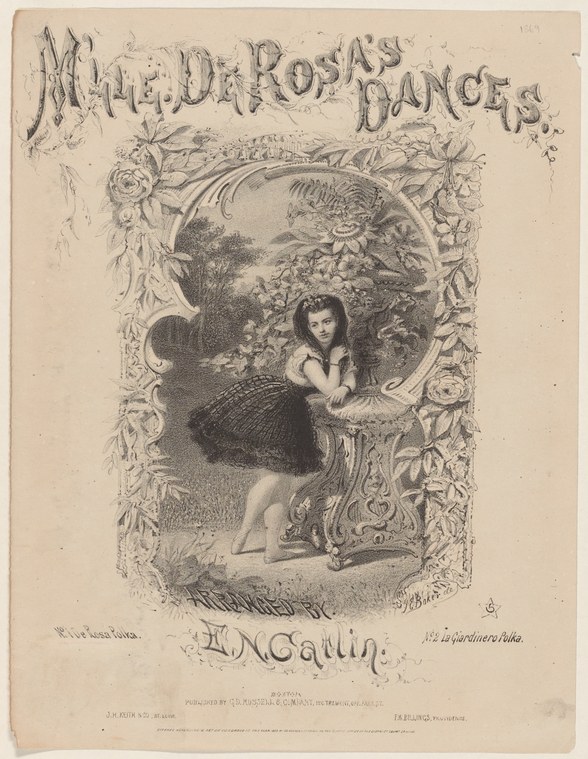
M'lle. DeRosa's dances
Unknown artist
- Collection:
- Prints depicting dance
- Source:
- New York Public Library
- Rights:
- Public domain — free to use, share and adapt.
- Recorded as:
- Public Domain
This image documents the individual celebrity of a named female dancer at a moment when dance was becoming a vehicle for female stardom and public visibility. It demonstrates how mid-nineteenth-century theatrical marketing worked—through affordable printed portraits distributed to fan bases—and how dancers' images were shaped by the romantic aesthetics of the period.
What you are looking at
A young woman in a dark, patterned dress sits gracefully in a lush garden or woodland setting, her pose both demure and theatrical. She is positioned within an elaborate decorative border of roses, vines, and scrollwork that frames the entire composition. The ornamental border itself suggests a printed theatrical programme or advertisement. The woman's dress appears to be of mid-nineteenth-century fashion, with a fitted bodice and full skirt, and she wears what looks like a bonnet or head covering. The garden setting behind her is rendered in soft, atmospheric tones with flowering plants and foliage. The overall effect is one of romantic theatrical elegance—this is a portrait presented as a stage property rather than a naturalistic figure study.
The dancing
The woman is seated rather than dancing, her posture upright but relaxed, with one arm resting gracefully. Her seated position suggests a moment of repose rather than active dance movement. The pose is consciously composed and flattering, with attention to the fall of the drapery and the elegant line of her silhouette. There is no visible partner or ensemble; she occupies the frame alone, presented to the viewer in a formal, frontal orientation typical of theatrical portraiture.
The dance depicted
This is not a representation of active dance but rather a theatrical portrait of a performer, likely Mademoiselle DeRosa, a dancer of the mid-nineteenth century. The title indicates this is a publicity image for 'M'lle. DeRosa's dances,' and the seated pose in an idealized garden setting was conventional for theatrical portraits of the period. The woman is presented not in the act of dancing but in a moment of elegant repose, which was the standard way to market performers to audiences. The romantic garden setting and careful costume detail suggest this was a named performer with enough prominence to warrant individual promotional imagery.
How it was made
This is a steel or copper engraving, a printing technique that allowed for fine detail and wide circulation of theatrical portraits. The delicate linework in the background foliage, the precise rendering of the decorative border, and the tonal gradations all suggest engraving rather than lithography. The technique enabled mass production, making this an economical way to promote a performer to theatre-goers. Engravings of this type were the standard medium for theatrical publicity imagery in the mid-nineteenth century, pasted into playbills, sold as souvenirs, or distributed to admirers.
About this work
This is a mid-nineteenth-century engraved theatrical portrait of Mademoiselle DeRosa, a named dancer whose individual prominence warranted promotional imagery. Rather than depicting her in performance, the print presents her as a fashionable woman of her era, seated in an idealized romantic setting framed by ornamental typography and decoration. It belongs to the gallery as evidence of how dancers were marketed to audiences, how individual performers achieved celebrity, and how the visual conventions of theatrical portraiture shaped the public image of dance artists. The work shows the complex relationship between dance performance and visual representation: a dancer advertised through her portrait rather than through a depiction of her dancing.
How to look at it
Notice how the artist has chosen a moment of stillness and repose rather than movement: the dancer is seated, posed, presented rather than captured mid-gesture. This is the key convention of the period—dancers were marketed through glamour and beauty, not through depictions of virtuosity or difficult technique. Observe the ornamental frame as part of the theatrical apparatus: it is not a window onto a real garden but a designed advertisement that frames the performer as an object of visual consumption. The woman's direct, calm gaze toward the viewer, combined with the romantic landscape, creates an intimate yet formal relationship with the audience.
The artist
The artist is not recorded. The work carries the marks of a professional theatrical print shop, likely French or English, producing publicity material for the stage. The style and execution suggest a commercial engraver rather than a named artist; such portrait work was often unsigned or attributed to the publishing house rather than the individual engraver.
The period
This print dates to the period of Romantic ballet in Europe, roughly the 1840s–1860s, when ballet was dominated by female stars and when individual dancers began to achieve lasting fame. The aesthetic of the image—the romantic garden, the idealized beauty, the emphasis on grace and refinement—reflects the Romantic movement's influence on dance, music, and visual culture. Theatrical portraiture was a booming commercial enterprise in this period, with photographic technologies beginning to compete with engraving by the 1850s. The elaborate decorative border and typography suggest this image was designed to serve multiple functions: as a playbill insert, a souvenir print for sale, and possibly as an advertisement.
Where it lives
The work is held in the New York Public Library's Prints collection, which documents theatrical imagery and popular visual culture of the nineteenth century. It is identified as a print depicting dance within the library's curatorial taxonomy, though minimal bibliographic information is recorded.
Dance in this work
Questions about this work
Was Mademoiselle DeRosa a famous dancer?
The name suggests she was prominent enough to warrant individual theatrical portraits, which indicates some degree of fame or at least steady employment in mid-nineteenth-century theatre. However, detailed records of her career do not appear in readily available sources. The fact that her portrait was mass-produced and distributed suggests she had an established reputation and fan base.
Why is she sitting down if this is a portrait of a dancer?
Theatrical portraits of the period rarely showed performers actually dancing. Instead, they presented them as fashionable, beautiful women in idealized settings. This convention made the portraits more widely appealing and easier to display; it also allowed for more elaborate composition and better control of the image. The seated pose was elegant, non-threatening, and emphasized the performer's beauty and refinement.
What is the ornamental frame made of?
The frame is printed as part of the engraving—it is made of the same technique as the rest of the image, not a separate physical object. The decorative roses, vines, and scrollwork are engraved lines that create the illusion of ornament. This integrated frame was typical of theatrical and commercial prints of the period, making the image more visually rich and framing the performer as a work of art.
When was this print made?
The style of dress, the aesthetic conventions, and the engraving technique all suggest a date in the mid-nineteenth century, likely between 1840 and 1870. The exact date is not recorded in the catalogue. Photography and lithography were competing technologies by the 1860s, making engravings of this type less common after that point.
More dance artwork





