49 works in this view — arrow keys or swipe to move between them.
Dance in Art
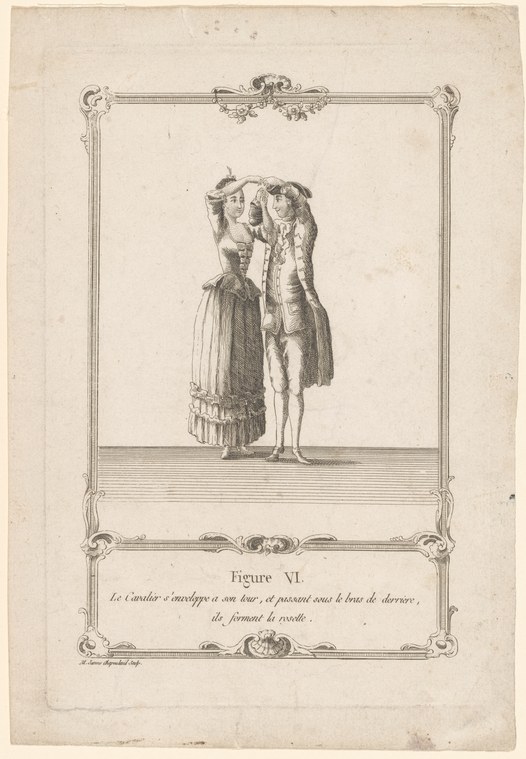
Figure VI. Le Cavalier s'enveloppe a son tour, et passant sous les bras de derriere, ils forment la rosette
Unknown artist
- Collection:
- Prints depicting dance
- Source:
- New York Public Library
- Rights:
- Public domain — free to use, share and adapt.
- Recorded as:
- Public Domain
This image is a direct record of how 18th-century aristocrats were taught to dance: the specific movements, the precise body alignments, and the gender dynamics of partner work are all encoded in a single frozen moment. For historians and dancers, it is primary evidence of technique, aesthetics, and the importance of symmetry and formal geometry to the period; for students of visual culture, it shows how dance was circulated as high-status instructional content in print.
What you are looking at
Two figures in 18th-century dress stand facing each other in an interior space defined by a decorative rectangular frame. The figure on the left wears a long pleated skirt or gown with fitted bodice and what appears to be a ribbon or sash; the figure on the right is in breeches, coat, and formal attire typical of a male courtier. Both are shown mid-gesture, their arms raised and extended as if in the moment of executing a choreographed movement. The positioning suggests a partner interaction or exchange, with the bodies angled to suggest rotation or turning. The engraving is finely detailed in the manner of 18th-century French instructional prints, with clean hatching and careful rendering of fabric and form against a plain background.
The dancing
Both figures stand upright with raised arms creating a symmetrical or mirrored compositional relationship. The woman's arms are drawn upward and inward; the man's arms are raised in a corresponding gesture. Their positioning suggests they are turning or rotating around a shared axis—the title's reference to the man wrapping around and passing under the woman's rear arms indicates a rotational exchange or enveloping movement characteristic of partner choreography. The formality of the pose and the precise alignment of their bodies speak to codified technique rather than improvisation.
The dance depicted
This is a figure from a French dance instruction manual, most likely dating to the mid-18th century based on the style and the formal figure-labeling convention. The title—'Le Cavalier s'enveloppe à son tour, et passant sous les bras de derrière, ils forment la rosette' (The Cavalier wraps around in turn, and passing under the rear arms, they form the rosette)—describes a specific partner movement in which the male dancer rotates beneath the woman's raised arms in a symmetric turning figure. This is characteristic of minuet choreography or the transitional court dances of the period, where such geometric 'rosette' formations and turns were prized elements. The movement emphasizes the formal interplay between partners and the creation of symmetrical patterns in space.
How it was made
This is an engraving, identifiable from the fine parallel line-work (hatching) used to render shadow and form, the precise black-and-white tonal range, and the decorative frame border typical of 18th-century French dance notation prints. The technique allowed for high-contrast, reproducible imagery suitable for instructional circulation among dance masters and students of the aristocracy. The care lavished on the costume details and the clarity of the poses indicates this was part of a high-status publication for a literate, educated audience—likely a compiled manual of choreographed figures with accompanying notation or written explanation.
About this work
This is one page from what was almost certainly a French dance instruction manual of the mid-18th century, showing a named figure or 'movement phrase' in the courtly dance vocabulary of that era. The minuet and its variants dominated European aristocratic dance in this period, and such manuals—often containing dozens of numbered or named figures—served as the primary way choreography was recorded, taught, and transmitted before the standardization of dance notation. The 'rosette' formation (circular turning pattern created by two dancers in symmetric relation) was a celebrated element of court dance technique, and this engraving documents both the geometric ideal of that movement and the elaborate dress in which it was performed.
How to look at it
Watch how the artist has positioned the two bodies: they are not in a static pose but frozen in the middle of a rotational movement, with the raised arms creating a dynamic pathway for one partner to pass beneath the other. The symmetry of the composition—the way the bodies mirror each other—was itself part of the aesthetic ideal: court dance was about creating pleasing geometric patterns visible to observers. The precision of the line-work in the engraving reinforces the idea of movement as something measurable, teachable, and repeatable according to rule.
The period
The mid-18th century was the golden age of the minuet and its variants in European court culture. Dance was a required accomplishment for the aristocracy, and instruction books—increasingly illustrated with engravings—became a major literary and commercial form. French dancing masters dominated the profession and the publication of manuals, and their emphasis on codified figures, geometric patterns, and the visual symmetry of partner relationships shaped how European courtly dance was understood and taught. The rise of printed instruction coincided with the gradual recording of actual choreography in symbolic notation, moving away from the purely verbal transmission that had dominated earlier centuries.
Where it lives
This engraving is held in the New York Public Library's collection of prints depicting dance. It is part of a larger archival category rather than a catalogued individual work with acquisition history; its status as a page from a larger manual is inferred from its form and the figure-labeling convention.
Dance in this work
Questions about this work
What is a 'rosette' in 18th-century dance?
A rosette was a circular or symmetric turning pattern created by two dancers in carefully aligned geometric relation to each other. The pattern was valued for its visual elegance when viewed from above or from the side, and it was a standard element in minuet variations and other courtly dances. The term reflected the period's love of ornament and formal symmetry.
How were dances taught and recorded before video?
Primarily through written and printed instruction, supplemented by live demonstration from a dancing master. Manuals like this one broke choreography into named figures and positions, which were illustrated and sometimes accompanied by written notation or choreographic symbols. Dancers learned by studying the images and practicing with a teacher or partner.
Was this a real dance people performed, or just an exercise?
Both. These named figures were the building blocks of actual minuets and other courtly dances performed at social events and entertainments. A dancing master would teach a nobleman or noblewoman to string together a sequence of such figures to create a complete choreography tailored to the occasion and the dancers' skill level.
More dance artwork





