49 works in this view — arrow keys or swipe to move between them.
Dance in Art
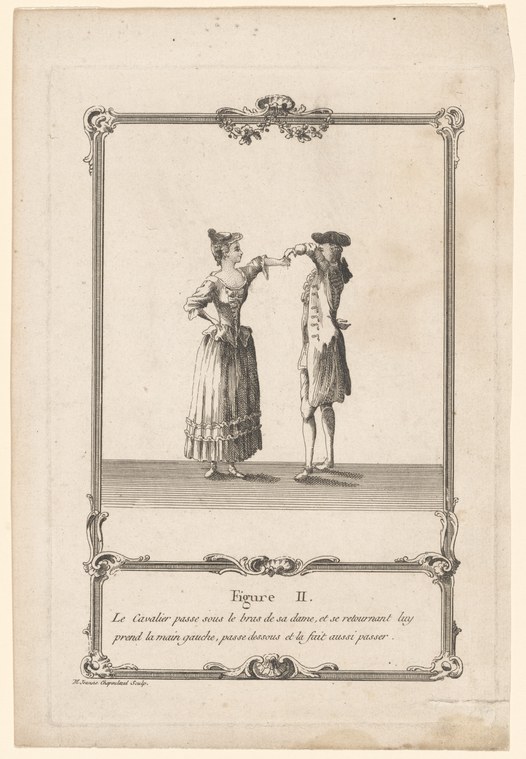
Figure II. Le Cavalier passe sous les bras de sa dame, et se retournant luy [sic] prend la main gauche, passe dessous et la fait aussi passer
Unknown artist
- Collection:
- Prints depicting dance
- Source:
- New York Public Library
- Rights:
- Public domain — free to use, share and adapt.
- Recorded as:
- Public Domain
This is primary source evidence for how 18th-century dance instruction worked: not through general description but through precise notation of moment-by-moment partnering and positioning. It shows what dancers were expected to learn and how dance masters communicated that knowledge, making visible the technical grammar of a dance form that shaped social life across Europe and the Americas for nearly a century.
What you are looking at
A man and woman stand facing each other in the center of a bare stage or dance floor, framed by an ornamental rococo border. The woman wears an elaborate gown with a fitted bodice, full skirt with deep flounced hem, and her hair is dressed high in the fashion of the mid-18th century. The man wears a coat, breeches, and a tricorn hat; he is leaning slightly toward the woman. Their arms are raised and positioned in the act of hand-joining or hand-passing—specifically, the moment captured appears to show the man's arm passing under the woman's arm, as the caption indicates. The engraving is rendered in fine line work with careful attention to the folds of fabric and the posture of both figures. The setting is minimal and formal, with a simple baseline suggesting a performance or instruction space rather than a narrative scene.
The dancing
Both figures stand upright with good posture and engaged upper bodies. The woman holds her left arm extended while the man reaches his arm beneath hers in a precise, controlled gesture. Their relative heights are proportioned naturally, and their positioning suggests a formal partnering sequence rather than a flowing turn. The hand-work is delicate and purposeful, demonstrating the careful arm and hand placement valued in formal couple-dancing of the period. Neither figure shows weight shift or obvious foot articulation, which is consistent with the instructional purpose of such images.
The dance depicted
This is a step or figure from a contredanse or quadrille, the dominant couple-dances of the mid-to-late 18th century. The caption specifies that the cavalier passes beneath his partner's arm while turning, then takes her left hand and passes under it again—a symmetrical arm-exchange figure common in courtly dances of this era. The image documents a specific technical moment in the vocabulary of these dances, showing how partners managed relative positions and maintained hand contact through spatial changes. This was likely part of an instructional series or dance manual rather than performance documentation.
How it was made
This is an engraving, rendered in fine black line on cream paper with no hand coloring. The ornamental rococo border with cartouches at top and bottom indicates this is from a published instructional work or series of dance illustrations. The precision of the line work and the absence of atmospheric effects are consistent with 18th-century engraved dance instruction plates, which were designed to be reproduced and circulated widely among the dancing elite. The technique allowed for fine detail in costume and gesture while maintaining clear, readable forms—essential for an instructional image meant to be studied and replicated.
About this work
This engraving documents a specific figure or step from the couple-dances—likely contredanse or quadrille—that dominated European social dancing in the mid-to-late 18th century. It is neither a depiction of a dance as lived performance nor a narrative scene, but rather a technical diagram rendered as portraiture: two idealized dancers frozen mid-figure to teach the precise positioning and arm placement required for a specific sequence. The ornamental border and formal presentation mark it as part of a larger instructional series. Such images were essential pedagogical tools, allowing dance masters to communicate complex spatial relationships and partnering patterns to students who could not see a live demonstration. The image preserves technical knowledge about how these dances were actually taught and practiced in the period.
How to look at it
Notice the exact positioning of the arms and hands: the woman's left arm extended, the man's arm passing beneath it. This is not a moment of sweeping movement but of precise geometric placement—the arm-exchange or *pas de main* that structures many contredanse figures. The formal posture and the absence of any sense of momentum or weight transfer tell you this is instructional: the artist has frozen the dancers at the moment when the arm position is clearest and most teachable, not at a moment of dynamic action. The rococo border emphasizes the artificiality of the presentation—this is a diagram dressed as portraiture, designed to be studied rather than admired as a scene.
The period
The contredanse and quadrille dominated European social dancing from roughly 1750 onward, replacing older couple-dances like the minuet in many contexts. These were dances that required instruction in their figures and sequences—they could not be learned by watching alone. The mid-to-late 18th century saw a boom in published dance manuals, many illustrated with engraved figures showing specific moments in the choreography. Dance was a required accomplishment for the educated elite, and demand for clear, reproducible instructional images was high. This print belongs to that tradition of visual dance pedagogy, reflecting both the codification of dance vocabulary and the role of the printed image in standardizing and disseminating that vocabulary across Europe.
Where it lives
This print is part of the New York Public Library's collection of prints depicting dance, held in the Prints and Photographs Online Catalog (PPOC). The catalogue record provides no artist attribution, date, or publishing information; these details would need to be established through comparative study of 18th-century dance instruction prints.
Dance in this work
Questions about this work
What dance is this?
The figure shown is characteristic of the contredanse or quadrille, the most popular couple-dances of the 18th century. The specific moment—a hand-passing or arm-exchange beneath the partner's arm—appears in many contredanse sequences. Without more context, it is impossible to identify a specific dance or figure name, but the vocabulary and style are unmistakably contredanse.
How were people supposed to use this image?
This was a teaching tool. A dance master or an advanced student could study this image to understand exactly where the arms should go and how partners should position themselves during a particular figure. It was meant to supplement live instruction or to serve as a reference when rehearsing alone or with a partner.
Why does it have such an ornate border?
The decorative rococo border signals that this is from a published, formal instructional work—not a casual sketch. It elevates the image, lending it authority and elegance, and it indicates that this is part of a series of similar plates, all uniformly framed. The border also filled the space efficiently in multi-plate publications.
Could you dance from these images alone?
Not really. These images show key positions and moments, but they cannot convey timing, weight distribution, the quality of movement, or how to transition between figures. They were always used alongside written description and, most importantly, the live example and correction of a dance master. They are fragments of a teaching system, not a complete record.
More dance artwork





