49 works in this view — arrow keys or swipe to move between them.
Dance in Art
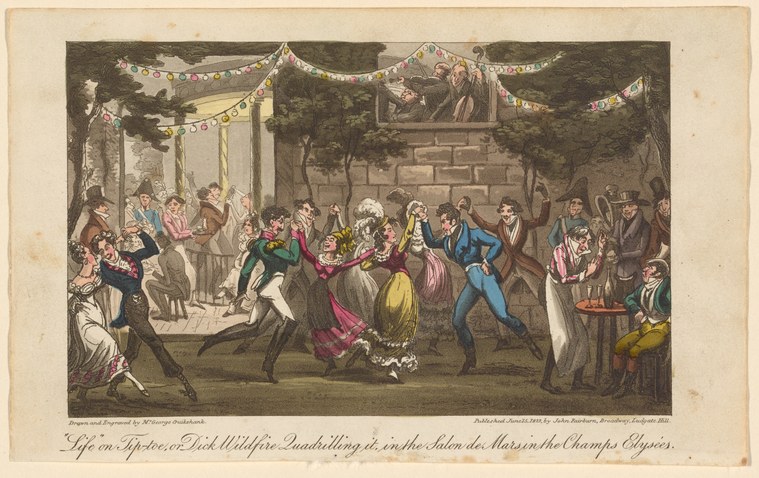
Life on tip toe, or Dick Wildfire quadrilling it in the Salon des Mars in the Champs-Elysées
Unknown artist
- Collection:
- Prints depicting dance
- Source:
- New York Public Library
- Rights:
- Public domain — free to use, share and adapt.
- Recorded as:
- Public Domain
The quadrille was the training ground for ballroom technique that would evolve into the modern competitive dances we know today; understanding how it looked when danced in its original context—with the posture, spacing, and social hierarchies visible here—is essential to understanding the development of ballroom dance itself. This image is also rare evidence of how such dances were actually performed in their own time, rather than only through written descriptions or choreographic notation.
What you are looking at
A lively ballroom gathering in what appears to be an elegant garden pavilion or outdoor salon, decorated with festive swags and garlands strung overhead. The scene captures a quadrille in full swing, with multiple couples arranged across the floor in the characteristic formations of the dance. The architecture suggests a fashionable Parisian venue—the Salon des Mars in the Champs-Élysées, as named in the title. Spectators line the edges of the space, some seated on benches at right, others standing and watching. The lighting is bright and even, suggesting either daylight or gaslight, and the entire composition conveys the pleasure and social energy of an evening entertainment. The figures are rendered in hand-colored engraving, with careful attention to the variety of dress—vivid silks in pink, yellow, and green for the women; dark suits and colored waistcoats for the men.
The dancing
The dancers move in the characteristic quadrille configuration: couples at intermediate depth are shown mid-movement, with women in full skirts captured at the moment of a turn or chassé, their bodies upright and arms raised or extended with balletic poise. The men face their partners in closed or semi-closed hold, their posture upright and controlled. The artist shows understanding of the controlled, geometric nature of quadrille footwork—no wild abandon, but rather the precise stepping and partnered movement of a formal ballroom dance. Visible are at least eight to ten dancers in active motion, with many more figures seated or observing around them.
The dance depicted
This is unmistakably a quadrille, the most fashionable ballroom dance of the nineteenth century, and specifically a French quadrille given the Parisian setting and the reference to 'Dick Wildfire quadrilling it.' The quadrille was danced by four couples arranged in a square formation, performing a series of fixed figures in strict time. The image captures the second or middle figures of the dance, when couples would execute chassés, turns, and promenades with precision and control. The title's mention of Dick Wildfire (likely a reference to a well-known dancer or a character from popular culture) suggests this is both a documentary record and possibly a humorous or satirical comment on fashionable society.
How it was made
This is a hand-colored engraving, identifiable by the fine linear hatching visible in the background, the crisp definition of figures, and the secondary application of watercolor or gouache to create the bright hues in the dancers' clothing. Engraving was the dominant medium for reproducing fashionable scenes of ballroom life in the nineteenth century; the technique allowed for wide distribution and rapid production, making such prints affordable to a middle-class audience interested in current social fashions. The hand-coloring indicates this was a relatively upmarket example, more costly than the plain engraved version. Such prints served both as documentation and as aspirational images of proper ballroom deportment.
About this work
This is a ballroom scene from the gilded age of European dance, depicting a quadrille—the most prestigious and widely practiced social dance of the nineteenth century. The quadrille combined elements of the earlier contredanse with French technique and courtly precision, and by the 1830s–1840s it had become the defining dance of fashionable society across Europe and America. The print documents not only the dance itself but also the architecture of pleasure, the dress codes, and the social rituals of the ballroom. It is a snapshot of a specific moment in dance history when ballroom dancing was a primary form of social participation for the urban gentry, and when the ability to execute the quadrille correctly was a marker of education and refinement.
How to look at it
Observe the geometric arrangement of the couples and how they maintain it even while in motion—this is the essence of the quadrille, which is a dance of precision and order. Notice the rigid posture of the women, with their arms held high and their spines straight, contrasting with the elaborate sweep of their skirts; this was the aesthetic ideal of the period. Look also at the framing of the scene: the spectators arranged around the dancers form a kind of theatrical proscenium, emphasizing that ballroom dancing was as much a performance for society's gaze as it was a dance. The title's reference to 'Dick Wildfire' suggests this may be a caricature or social satire—watch for any exaggeration or comic distortion in the figures that might indicate the artist's ironic intent.
The period
The quadrille reached its peak of popularity in Europe and America between approximately 1820 and 1870. It emerged from the contredanse, which had dominated the eighteenth century, but added a new emphasis on French elegance, precise footwork, and elaborate figures. By the 1830s, quadrille etiquette was codified in numerous published dance manuals, and the dance had become essential knowledge for anyone aspiring to social status. The Champs-Élysées, mentioned in the title, was one of the most fashionable promenade and entertainment venues in Paris during the nineteenth century. The reference to 'Dick Wildfire' and the humorous or satirical tone suggested by the title may indicate this print was part of a series of popular social commentary, perhaps parodying the pretensions or follies of ballroom society.
Where it lives
This print is held in the New York Public Library's collection of dance-related prints. It is a hand-colored engraving, likely produced in the 1830s–1850s in France or London, and is part of a broader corpus of ballroom scene prints that documented fashionable entertainment of the period. Such prints were often sold individually or in series and were widely distributed to a middle-class audience.
Dance in this work
Questions about this work
What is a quadrille and why was it so important?
The quadrille was a social ballroom dance performed by four couples in a square formation, executing a series of choreographed figures. It was the most prestigious ballroom dance of the nineteenth century and was essential knowledge for anyone of social standing. It combined French technique with the structure of the earlier contredanse, and required considerable training and precision to perform correctly.
Who is Dick Wildfire and why is he in the title?
Dick Wildfire is likely either a well-known dancer of the period, a character from popular entertainment, or a reference in a satirical print series. Without additional context or other prints from the same series, his exact identity is uncertain, but the title suggests the image may be humorous or satirical commentary on ballroom society rather than a straightforward documentary record.
What does the setting tell us about where this dance took place?
The Salon des Mars in the Champs-Élysées was one of the most fashionable entertainment venues in Paris during the nineteenth century. The decorated pavilion and elegant garden setting shown here indicate a prestigious public or semi-public ballroom where wealthy or socially aspiring people gathered for entertainment. The quadrille was danced in such formal settings, not in private homes.
How does this image show us the technique of the quadrille?
The engraving captures the upright posture, raised arms, and controlled footwork characteristic of the quadrille. The couples maintain a geometric formation even while turning and moving, and the women's bodies are held in the rigid, balletic alignment that was the aesthetic ideal of the period. The artist demonstrates understanding of the dance's precision and formality, showing it as a controlled, choreographed performance rather than improvisation.
More dance artwork





