49 works in this view — arrow keys or swipe to move between them.
Dance in Art
Wanda polka mazurka
Unknown artist
- Collection:
- Prints depicting dance
- Source:
- New York Public Library
- Rights:
- Public domain — free to use, share and adapt.
- Recorded as:
- Public Domain
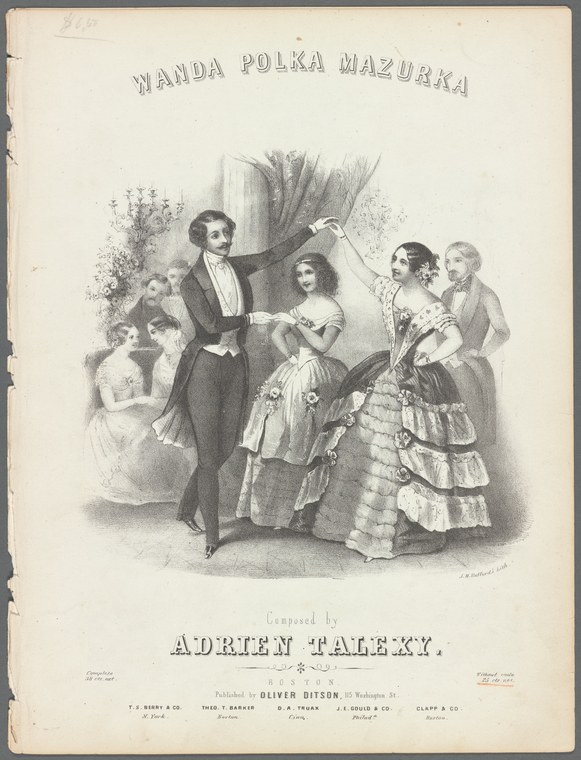
This print preserves evidence of how the polka mazurka was understood and marketed as a social experience in mid-nineteenth-century urban culture—not as a virtuoso spectacle but as a coded ritual of courtship and social performance. The image shows that dances of this era were consumed through multiple media: the musical score, the lithographed souvenir, the ballroom performance, and the theatrical commentary, all circulating simultaneously and shaping how people understood what it meant to dance.
What you are looking at
A lithographed title page for a polka mazurka with a theatrical social dance scene. A well-dressed man in dark evening clothes stands central, gesturing toward or presenting the dance to five women in elaborate mid-nineteenth-century ballroom dress—full skirts with multiple tiers of ruffles, fitted bodices, and off-shoulder necklines. The figures are arranged in an informal group rather than a strict dance formation. On the left, one woman sits at what appears to be a small table or settee; the others stand or move about the man. The composition suggests a moment of social courtship or flirtation rather than a formal dance step. The line work is fine and delicate, with careful attention to fabric texture and the play of light across the women's skirts and shoulders. The overall tone is one of Parisian salon society—elegant, intimate, and slightly comedic in its suggestion of male attention and female response.
The dancing
The central male figure stands upright in a pose of address or invitation, one arm gesturing outward. The women are not in closed hold or any recognizable ballroom frame; instead they are positioned as individuals responding to or attending to him. Their postures suggest movement or the imminence of it—weight is distributed unevenly, skirts catch light and shadow as if in motion or on the turn. The seated figure on the left creates asymmetry and narrative interest. None of the figures shows the rigid partnered stance of a formal waltz or polka; instead they convey the social negotiation of the ballroom before or between dances.
The dance depicted
The title identifies this as a polka mazurka, a nineteenth-century social dance hybrid combining elements of both forms. The polka was a Czech dance that took European ballrooms by storm in the 1840s–50s, known for its quick, bouncing character; the mazurka, a Polish court dance, was slower and more stately. This print appears to document the social context of such dances rather than a specific step or hold. The scene is theatrical and satirical in tone—the clustered women and the man's theatrical address suggest a comedic commentary on courtship ritual and dance-floor manners of the period. The composition prioritizes social interaction and flirtation over technical dance detail.
How it was made
This is a lithograph, a print process that allowed for wide circulation and reproduction. The medium is established from the fine, consistent line work and the characteristic crayon-like texture visible in the shading and in the delicate cross-hatching used to model form and fabric. Lithography was the dominant medium for popular theatrical and social prints of the mid-nineteenth century, allowing artists to reach a mass audience of music lovers, dancers, and society observers. The print shows signs of age and handling—slight foxing and wear—consistent with a work circulated as sheet-music cover art or a popular theatrical souvenir.
About this work
This is a lithographed title page for a musical work (a polka mazurka) by composer Adrien Taléry, published in London by Oliver Ditson and distributed internationally. It depicts not a technical instruction in dance movement but rather a scene of social ballroom life—the moment of courtship, invitation, and the negotiation of partners before or during a dance. The image sits at the intersection of social dance culture, theatrical comedy, and popular music publishing. As a document of mid-nineteenth-century ballroom manners, it tells us as much about gender roles, courtship conventions, and the social stakes of dancing as it does about the polka mazurka itself. The inscription credits Adrien Taléry as composer, indicating this was a recognized popular work, though the artist of the lithograph is not recorded.
How to look at it
Look first at the composition: the man is not partnered with any single woman but stands as the focal point of a loose group, suggesting the social negotiation that precedes dancing. Notice the women's postures—some leaning, some standing with weight on one leg, creating a sense of readiness or anticipation. The artist has frozen a moment of social performance rather than a step, inviting the viewer to read courtship and flirtation as a kind of choreography. The fine detail of the clothing—the layers of ruffles, the careful rendering of lace and silk—grounds the scene in the specific fashion of the 1840s–50s and suggests this is a document of contemporary manners, not a timeless ballroom scene.
The artist
The artist is not recorded. The print is credited to composer Adrien Taléry. The lithograph was published in London by Oliver Ditson, with additional distribution credits to publishers in Paris, Brussels, and New York, indicating the international reach of popular ballroom music and its visual culture in the mid-nineteenth century.
The period
The polka mazurka emerged in the 1840s–50s, during a period of intense enthusiasm for new social dances imported from continental Europe. The polka itself, which arrived from Prague, created a sensation in Paris (1840) and London (1844), spawning countless variations and hybrid forms. The mazurka, with its aristocratic Polish heritage, offered a more measured alternative, and composers combined the two to create works suited to different tempos and social contexts. Lithography was at its height as a medium for popular culture—music covers, theatrical scenes, and social commentary could be produced cheaply and distributed widely, creating a mass market for images of fashionable life. The tone of this print—satirical, observant of social manners—reflects the mid-century fascination with depicting urban leisure and the comedy of courtship rituals.
Where it lives
This is a lithographed title page held in the New York Public Library's collection of prints depicting dance. It is part of the Library's holdings of nineteenth-century popular music and theatrical prints. The inscription and publication credits indicate London publication with international distribution.
Dance in this work
Questions about this work
What is a polka mazurka?
A polka mazurka is a nineteenth-century hybrid social dance combining the quick, bouncy character of the Czech polka (popular from the 1840s) with the slower, more stately rhythm and style of the Polish mazurka. Composers created these hybrids to offer variety in the ballroom and to suit different musical and choreographic purposes. The form was especially popular in London and Paris in the mid-nineteenth century.
Why is this a scene of courtship rather than a dance lesson?
The composition and poses suggest a moment of social invitation and negotiation rather than a formal dance. The man's central position and gesturing attitude, the women's varied and informal positioning, and the overall tone of the scene all point to the social theater of the ballroom—the moment before or between dances when partners were invited and social hierarchies were navigated. This was a key subject of popular satirical art in the period.
Who was Adrien Taléry?
Adrien Taléry is credited as the composer of this polka mazurka. He was among the many composers of the mid-nineteenth century who produced popular dance music for the drawing room and ballroom. Little else is recorded about him here, but the international publication credits suggest his work had significant circulation.
How was this print used?
As a lithographed title page, this image would have appeared on the cover of the published musical score, allowing it to reach a wide audience of music lovers, piano players, and dancers. It served as both advertisement and cultural commentary, helping to shape how the polka mazurka was understood and consumed as a fashionable social practice.
More dance artwork





