49 works in this view — arrow keys or swipe to move between them.
Dance in Art
Acrobatic dancers in human pyramids
Unknown artist
- Collection:
- Prints depicting dance
- Source:
- New York Public Library
- Rights:
- Public domain — free to use, share and adapt.
- Recorded as:
- Public Domain
For dancers and historians, this is visual evidence of acrobatic ensemble work in a period before photography, showing how complex group balancing acts were performed and how they were communicated visually. The sheet also illuminates the history of circus and variety entertainment, and the overlap between acrobatics, court entertainment, and athletic display. Finally, it demonstrates how early modern printmaking served a role in documenting and circulating knowledge about performance techniques—a precursor to modern instructional and promotional imagery.
What you are looking at
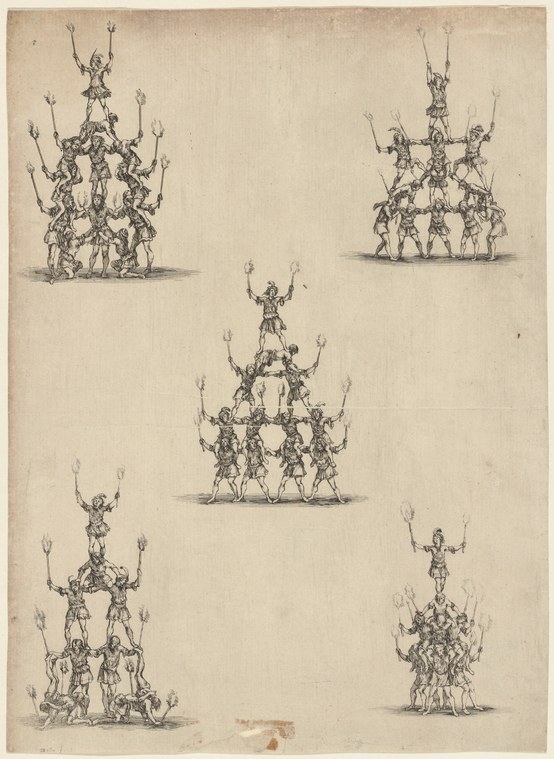
Five separate compositions present human pyramids formed by acrobatic performers, each stacked vertically in a dynamic tower. The figures are rendered in pen with fine hatching, appearing muscular and athletic. Each pyramid is topped by a single dancer with arms raised aloft, holding forked implements or poles that extend the height of the composition. The performers wear minimal, classical dress—fitted tunics or breeches—suggesting either ancient athletic costume or the stage dress of contemporary circus or variety entertainers. The pyramids vary in scale and complexity: some have three tiers of performers, others four or five, with the broadest bases formed by multiple figures in crouching or supporting positions. The figures' poses show careful anatomical study—the strain of weight-bearing is visible in tensed shoulders and planted feet, while those at the apex assume triumphant, open poses. The page itself shows age and damage; foxing spots and a wax seal suggest an old print or drawing, reproduced or circulated at some distance from its original production.
The dancing
The performers display precise understanding of balance and weight distribution. Lower tiers crouch with knees bent and feet planted wide, backs straight to bear the load; their hands grip the legs or shoulders of tier-mates. Middle performers stand more upright, feet apart, using their body mass to support the figures above. The apex dancer stands nearly vertical, arms raised in an open or celebratory gesture—the climax of the structure. The repeated forked poles or implements held at the top suggest either props used in the trick or a way of indicating height and completion. The proportions and musculature are consistent across the five variations, and the compositional choices show how the same basic feat was executed at different scales.
The dance depicted
This depicts acrobatic ensemble work, specifically human pyramid-stacking or tower-building. The feat appears to be a circus or performance acrobatics act rather than theatrical dance in the modern sense, though it would have been part of variety entertainment, carnival spectacles, or court performances historically. The multiple iterations suggest these are studies of variations—different configurations of the same fundamental trick—rather than a narrative sequence. Pyramids of this kind have ancient precedent (Roman acrobats, Greek performances) and were certainly performed in Renaissance and Baroque court entertainments, as well as in popular circus and fairground acts. Without inscription or date, the specific context cannot be determined, but the style of the study—multiple variations of a technical feat—is consistent with either historical documentation of performance technique or instructional material.
How it was made
The work is an engraving or fine pen drawing, likely reproduced as a print. The line is precise and consistent, with tonal variation achieved through hatching and parallel lines rather than wash or tone. The paper shows significant age and foxing, and the presence of a wax seal suggests this is an early document, possibly from a bound collection or archive. The technique allows fine anatomical detail and clear communication of spatial relationships—essential for a technical study of balance and positioning. The regularity and reproducibility of engraving made it the ideal medium for circulating knowledge about performance techniques and novelties before photography.
About this work
This sheet presents five variations of acrobatic human pyramids—a performance feat combining strength, balance, and ensemble coordination. The pyramids range from modest three-tier structures to taller five-tier towers, each topped by a figure with arms raised and holding implements that may serve both functional and aesthetic purposes. The drawings show careful anatomical knowledge and an interest in documenting the mechanics of the trick. Whether made as a historical record, an instructional diagram, or a published curiosity sheet celebrating an entertainment feat, the work captures a specific moment when acrobatic performance was valued as spectacle worthy of detailed visual study.
The five compositions suggest a systematic investigation: the artist or publisher presents variations in scale and configuration, inviting comparison and understanding of how the basic principle scales up. This approach—treating acrobatic performance as a subject for technical and compositional study—places the work at the intersection of performance documentation, anatomical study, and popular entertainment imagery.
How to look at it
Observe how the artist has frozen the moment at the apex of stability—the moment when the pyramid is fully formed and the dancers reach their climactic pose. Notice the variation across the five compositions: the artist is not repeating a single image but systematically showing how pyramids of different heights can be constructed from the same basic principles. Pay attention to the base in each case: the broader the pyramid, the wider and more firmly planted the base, and the more weight is distributed across multiple performers. The raised arms and implements at the top emphasize the triumph and completion of the feat—this is the moment of mastery and display.
The period
Human pyramid-stacking has deep historical roots in Mediterranean and Asian performance traditions. In Renaissance and Baroque Europe, acrobatic displays were valued entertainments at court and in public spectacles, often performed by traveling companies or as part of carnival celebrations. By the 17th and 18th centuries, such feats were regularly documented and published as curiosities, part of a broader appetite for images of unusual human achievement and physical prowess. The style and technique of this print suggest a date somewhere in the 16th–18th century, when engraved sheets of performance techniques and novelties were actively produced and circulated among educated audiences and performers.
Where it lives
The work is held by the New York Public Library as part of its collection of prints depicting dance and performance. The foxing, wax seal, and paper condition suggest the sheet is of considerable age and may have been part of a bound collection or portfolio.
Dance in this work
Questions about this work
Is this ancient or modern?
The artistic style and printing technique suggest a date between the 16th and 18th centuries—after the invention of engraving but before photography. Human pyramid-stacking itself is much older, practiced in ancient Rome and earlier, but this particular depiction is early modern.
Who performed acrobatics like this?
Traveling acrobatic companies, circus performers, court entertainers, and carnival performers all performed such feats. In Renaissance and Baroque courts, acrobats were valued entertainers. By the 17th–18th centuries, such acts were also a staple of fairgrounds and popular spectacles.
How was this printed?
The work is an engraving—a print technique in which a design is cut into a metal plate, inked, and pressed onto paper. This technique allowed fine detail and multiple impressions from a single plate, making it ideal for circulating images of performance techniques and novelties.
Why show five pyramids instead of one?
The five variations likely serve as a technical study or instructional sequence, showing how the same feat can be scaled to different heights and configurations. This approach helps viewers understand the underlying principles of balance and weight distribution.
More dance artwork





