49 works in this view — arrow keys or swipe to move between them.
Dance in Art
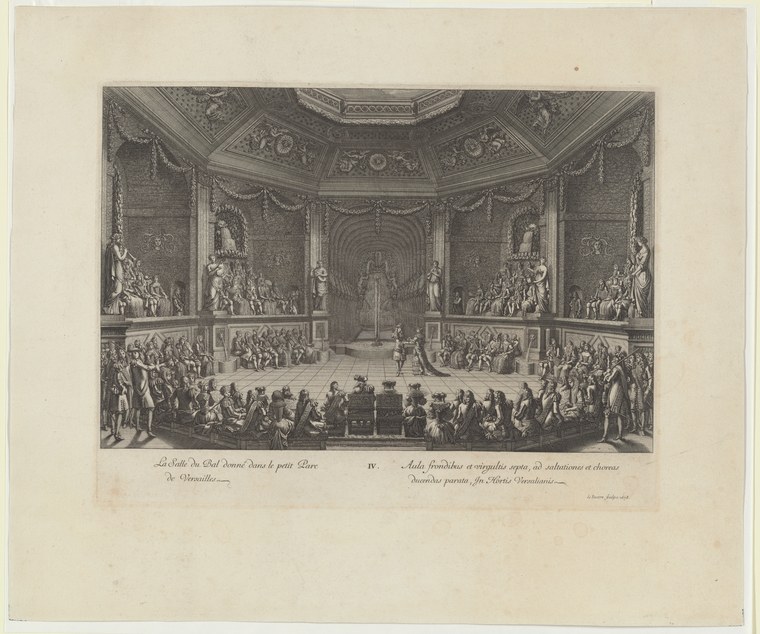
La salle du bal donné dans le petit parc de Versailles
Unknown artist
- Collection:
- Prints depicting dance
- Source:
- New York Public Library
- Rights:
- Public domain — free to use, share and adapt.
- Recorded as:
- Public Domain
This work is essential for understanding how 18th-century court dance was embedded in architecture and social ritual rather than experienced as a form of movement or expression. It shows that from the perspective of court documentation, the ball was primarily an occasion for the display of the built environment and the assembly of rank—and that dancers, while present, were secondary to the space and the crowd.
What you are looking at
This engraving depicts an elaborate ball held in the small park at Versailles, rendered in the theatrical architectural style of 18th-century court spectacle. The composition is structured around a vast octagonal or polygonal ballroom with an ornate coffered and decorated ceiling, its walls articulated by pilasters and framed by draped garlands in the baroque manner. The floor is crowded with hundreds of figures: courtiers in formal dress fill every level of the space—seated in the foreground, standing in clusters throughout the hall, and arranged in galleries along the walls at multiple levels. The light is even and classical, giving the scene the quality of architectural documentation as much as social record. At the center of the composition, a relatively clear space opens onto a distant passage, suggesting the space has been designed to frame a procession or formal viewing. The dress is uniformly court formal: men in coats and breeches, women in full panniers and gowns, all rendered in the minute detail characteristic of 18th-century engraving.
The dancing
The figures are distributed as a crowd rather than as active dancers; most are standing, walking, or seated in conversation, with bodies arranged in the stiff, upright posture of formal court dress. Few bodies show active motion—the gathering has the character of a formal assembly or promenade rather than a dance in progress. Those few figures who may be dancing appear in the open central space and are rendered too small in the composition to read their specific hold or frame. The overwhelming impression is of static social positioning rather than kinetic movement; bodies are adornment and status markers within the architectural spectacle.
The dance depicted
The image is titled as a ball (bal) given in the small park at Versailles, which places it within the French court tradition of the 18th century, when such events commonly featured structured dancing such as minuets, contredanses, and quadrilles. However, the engraving emphasizes the event as architecture and assembly rather than as a moment of dancing itself. No recognizable dance notation—no clear couples in closed hold, no visible footwork pattern, no framing that would identify a specific form—is readable in the composition. The work documents the theatrical and social apparatus of the ball rather than the dance practice within it.
How it was made
This is an engraving, executed with fine lines in black ink on paper in the classical manner of 18th-century court documentation. The technique allows the artist to render architectural detail with precision and to populate the composition with hundreds of distinct figures, each defined with clear contours. The tonal range is limited to line and the white of the paper, creating a graphic, almost diagrammatic quality that serves the work's apparent purpose: to record the spatial and social structure of a major court event rather than to capture the atmosphere or movement of the ball. The precision and the labor of engraving itself signal that this was a significant occasion and a work intended for distribution among the court and educated collectors.
About this work
This engraving documents a formal ball at Versailles in the 18th century, rendered as an architectural and social spectacle rather than as a dance event. The composition prioritizes the designed space—the ornate ballroom, the ordered arrangement of courtiers, the hierarchical use of galleries and floor—over the movement or technique of the dancers themselves. It is a record of court ceremony and display as much as a depiction of dance, and it illustrates how dance in the 18th-century French court was inseparable from the performance of rank, order, and architectural magnificence.
How to look at it
Attend to the composition's emphasis on architectural frame and crowd rather than on any single dancer or couple. The eye is drawn to the structure of the space, the placement of figures at different levels, and the distant focal point, rather than to any moment of movement. This is deliberate: the engraver is recording the event as a document of state ceremony, not as a scene of dancing in action. Look at the scale and distribution of the crowd and consider what the artist chose to emphasize—not the footwork or the beauty of a particular dancer, but the vastness and order of the space and the multitude of witnesses.
The artist
The artist is not recorded. The work is a professional court engraving, likely produced in France in the 18th century as a commemorative document. The style and subject matter suggest it was made by a specialist in architectural and ceremonial documentation, a common practice at Versailles and other major courts.
The period
This engraving dates to the period when Versailles was at the height of its power as a stage for royal display and when formal court balls were among the most elaborate entertainments staged in Europe. In the 18th century, such events were opportunities for the performance of courtly etiquette, the display of rank and alliance, and the demonstration of the crown's ability to command resources and space. The minuet, contredanse, and quadrille were the dominant forms of ballroom dance during this period, each governed by strict rules of progression, timing, and precedence. The engraving's emphasis on architecture and crowd rather than on movement reflects a court perspective in which the choreography of social order was as important as the choreography of the dance itself.
Where it lives
This engraving is held in the New York Public Library's collection of prints depicting dance. It is a commemorative and documentary print, typical of 18th-century court production, intended for distribution and collection among nobles and educated patrons.
Dance in this work
Questions about this work
Is anyone actually dancing in this engraving?
The engraving is titled as a ball, so dancing presumably took place, but the composition does not emphasize it. The focus is on the assembled crowd and the architectural frame rather than on any moment of active dance. A few small figures in the center space may be dancing, but they are dwarfed by the architecture and the crowd.
What dance forms would have been performed at a ball at Versailles?
In the 18th century, formal court balls at Versailles featured the minuet (a slow, processional dance for couples), the contredanse (a group dance with complex figures), and the quadrille (a structured square dance). Each had strict rules of precedence and timing. This engraving does not make clear which forms were danced at this particular event.
Why does this engraving look more like an architectural drawing than a picture of a dance?
Because it was designed as a commemorative document of a major court event, emphasizing the magnificence of the space and the assembly of the court rather than the movement of the dancers. The engraver's job was to record the event's grandeur and significance, not to capture the aesthetics of the dance itself.
More dance artwork





