49 works in this view — arrow keys or swipe to move between them.
Dance in Art
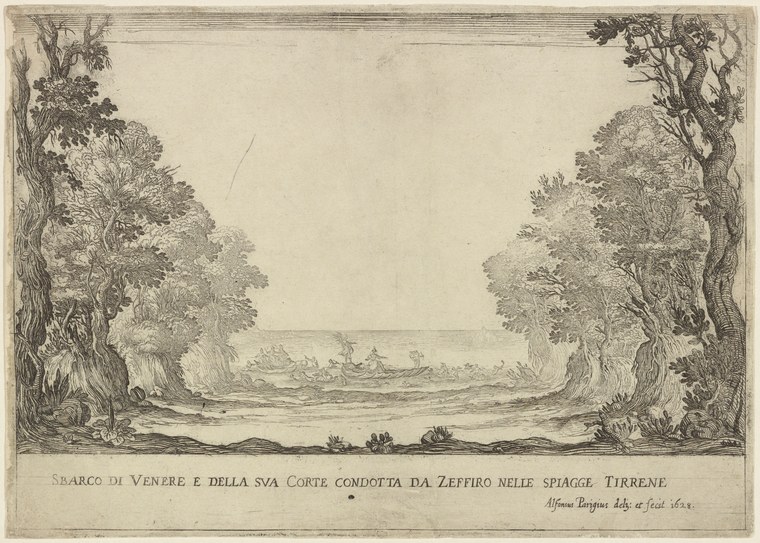
Sbarco di Venere e della sua Corte condotta da Zeffiro nelle spiagge Tirrene
Unknown artist
- Collection:
- Prints depicting dance
- Source:
- New York Public Library
- Rights:
- Public domain — free to use, share and adapt.
- Recorded as:
- Public Domain
This engraving shows how Renaissance and Baroque courts imagined classical mythology as living spectacle. It is evidence of the visual and narrative frameworks that shaped courtly dance and entertainment, even though no dancing is shown here. Understanding these preparatory and emblematic images helps explain why certain mythological subjects appear again and again in actual court masques and ballets.
What you are looking at
A shore scene framed by towering trees that form a natural archway opening onto a calm sea. In the distance, a fleet of vessels—galleys and sailing ships—approaches the beach, their sails and rigging finely rendered. The foreground is empty except for rocks and low vegetation at the water's edge, creating a moment of anticipation before arrival. The composition uses classical perspective to draw the eye through the tree tunnel toward the sea and the approaching cortège. The sky is rendered in subtle tones; the entire scene has the luminous quality of an engraving, with careful attention to the play of light on water and foliage. The Italian inscription below identifies this as the landing of Venus and her court, conducted by Zephyr (the west wind) on the Tyrrhenian shore.
The dancing
No dancers are visible in this work. The human presence is suggested only by the fleet in the distance—the approaching court is not yet depicted on shore. The composition is one of anticipation rather than action: the empty beach awaits the arrival that the title announces. This is a preparatory or emblematic moment, setting the stage for an arrival rather than depicting the arrival itself or any dance that might follow it.
The dance depicted
No dance is depicted. The title promises a mythological procession—Venus and her attendants arriving on shore under the guidance of Zephyr—but the image shows only the landscape and seascape before that arrival. This is characteristic of Renaissance and early modern allegorical prints, which often illustrated literary or courtly scenarios that might involve spectacle, procession, or dance without showing those acts explicitly. The work may be preparatory to a larger narrative or may represent a moment from a courtly entertainment or masque.
How it was made
This is an engraving, identified from the fine linear work, the tonal gradations achieved through parallel hatching and cross-hatching, and the high quality of the impression. The signature at lower right reads 'Alfeo Lanfriso delt. et fecit 1623' (Alfeo Lanfriso drew and made this, 1623). The technique allowed for wide distribution of such allegorical designs, which were often used as models for actual courtly entertainments, decorative schemes, or as prints for scholarly and aristocratic collections. The precision of the line work and the architectural clarity of the composition suggest this was intended for a cultivated audience familiar with classical mythology and court culture.
About this work
This engraving depicts not a dance but the mythological moment preceding one: the arrival of Venus and her court on the Tyrrhenian shore, guided by the wind god Zephyr. Made in 1623 by Alfeo Lanfriso, it illustrates a scenario from classical mythology that was a favourite subject of Renaissance and Baroque courtly spectacle. The work belongs in a dance collection because it documents the kind of allegorical narrative that courtly entertainments—which involved dance, music, and spectacle—were based upon. Such prints circulated among patrons planning masques and court ballets, making them crucial to understanding how mythological and allegorical subjects were visualized and performed in Early Modern Europe.
How to look at it
Attend to the way Lanfriso uses landscape to create narrative anticipation rather than action. The framing trees and the opening toward the sea structure the composition as a threshold—the viewer stands on the empty shore looking out at the approaching vessels. This is the moment just before spectacle begins. The emptiness of the foreground is not a lack but an intentional pause, inviting the viewer to imagine what will unfold. Notice how the careful perspective and the rendering of individual ships and rigging create a sense of real, imminent arrival rather than fantasy.
The artist
Alfeo Lanfriso is recorded as an engraver active in the early 17th century. The signature format 'delt. et fecit' (drew and made it) suggests he was responsible for both the design and the engraving. Little else is known of his practice, but the quality and style of this work suggest he was trained in the formal conventions of Renaissance printmaking and had access to courtly or literary circles. The work appears in the New York Public Library's collection of prints depicting dance and spectacle.
The period
This engraving was made in 1623, during the height of European court culture's engagement with elaborate theatrical entertainments. The early 17th century saw the development of the court masque in England and the court ballet in France, both of which drew heavily on classical and allegorical themes. The Tyrrhenian shore and the arrival of Venus were well-established subjects in courtly art—Venus arrivals featured in numerous masques and were painted, engraved, and sculpted across Europe. Lanfriso's print would have circulated among the educated elite and may have served as inspiration or reference for actual stage designs or choreographic schemes.
Where it lives
This print is held in the New York Public Library as part of its collection of prints depicting dance. It was sourced from that institution for inclusion in this research project.
Dance in this work
Questions about this work
Is this a painting or a print?
This is an engraving—a print made by incising lines into a metal plate and inking the plate for printing. The signature 'Alfeo Lanfriso delt. et fecit' (drew and made it) indicates Lanfriso created both the original design and the engraved plate. Engravings like this were mass-produced and circulated widely among collectors and patrons in the 17th century.
Why is there no dancing shown if this is supposed to be about Venus and her court?
The title announces the mythological scenario—the arrival—but the image shows the moment before arrival, when the shore is still empty. This was a common way of organizing allegorical narrative in Renaissance and Baroque prints: showing the key moment of anticipation rather than action. Such images often served as reference material for actual court entertainments where dancing would have occurred, rather than documenting a performance itself.
What is the Tyrrhenian shore?
The Tyrrhenian Sea is the body of water between mainland Italy and the islands of Sardinia and Corsica. In classical mythology, it was a site associated with Venus and maritime arrivals. Choosing this specific location grounds the allegorical narrative in a recognizable geographic and mythological setting.
Who was Alfeo Lanfriso?
Lanfriso was an engraver active in the early 17th century, but biographical details are sparse. The quality and formality of his work suggest professional training in Renaissance printmaking conventions and likely access to courtly or literary circles. This print, dated 1623, is among the documented works attributed to him.
More dance artwork





