49 works in this view — arrow keys or swipe to move between them.
Dance in Art
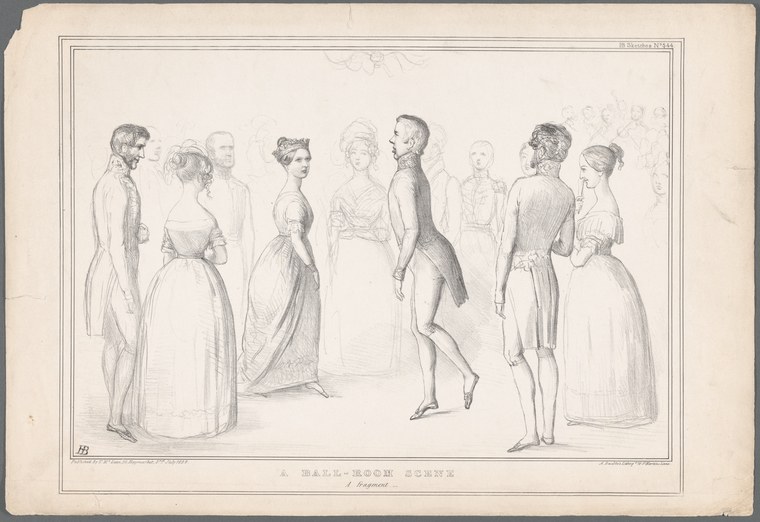
A ball-room scene: a fragment
Unknown artist
- Collection:
- Prints depicting dance
- Source:
- New York Public Library
- Rights:
- Public domain — free to use, share and adapt.
- Recorded as:
- Public Domain
The work captures an often-overlooked aspect of dance history: the social ballroom was a space structured by multiple simultaneous dances, each with its own rules and communities. Understanding what happened between dances—the standing, waiting, and repositioning—is as important to understanding regency dance culture as understanding the steps themselves. The print's commercial circulation suggests this was how middle-class and aspiring audiences learned to imagine themselves in ballrooms.
What you are looking at
A formal ballroom scene rendered in pen and ink, showing nine figures arranged in a social gathering. The composition is arranged loosely across the page, with figures distributed in small clusters and pairs rather than locked into a single formation. At left, two couples stand facing each other—a man and woman in conversation near a second pair. To the right, a solitary man in dark coat stands in profile, his posture casual but alert. A woman in an elaborate gown with a high waist stands centrally, her body angled in conversation. At far right, two more women in full skirts complete the group. The setting is a drawing room or salon with minimal background detail; the focus is entirely on the figures and their positioning relative to one another. The dress is consistent throughout: men in tailcoats and trousers, women in high-waisted regency-era gowns with minimal ornamentation. The line work is precise and controlled, with careful attention to the fall of fabric and the angle of shoulders and heads. No music, furniture, or architectural detail is indicated—the space is abstract and defined only by the arrangement of bodies.
The dancing
The figures are depicted in standing positions with varied stances that suggest social interaction rather than unified choreography. Weight appears distributed evenly on both feet; no feet are lifted or extended in active dance positions. Arms hang naturally at sides or are raised in gentle gestures of conversation. The nearest couple (lower left) stands in informal proximity but without a dance hold—their orientation is toward each other but the spacing suggests conversation rather than partnered movement. All figures maintain upright, dignified posture consistent with regency ballroom etiquette. The artist demonstrates understanding of period decorum: no exaggerated movements, no lifted legs or extended line.
The dance depicted
This is most likely a generic ballroom scene representing the social convention of the regency period (approximately 1811–1820) rather than a specific named dance. The gathering shows the intermission or promenade moment—the interval when dancers stood, conversed, and positioned themselves for the next set. The regency ballroom encompassed multiple dances: quadrilles, cotillions, country dances, and waltzes all occupied the same space and were organized into "sets" or "figures." The title's explicit use of the word "fragment" suggests this is a study or sketch, capturing a moment of social theatre rather than choreographic action. No footwork, arm frame, or positioning suggests any single dance style—the work documents the spectacle of the ballroom itself as a social space.
How it was made
This is a pen-and-ink line engraving or etching, executed with fine parallel hatching to suggest volume and shadow, particularly in the rendering of fabric folds and male silhouettes. The technique is light and controlled, favoring clarity of outline over dramatic tonal contrast. The page carries printed text at the bottom and a printed border frame, indicating this was a commercial print—likely from a periodical or portfolio rather than a unique drawing. The linear style and composition suggest this could be from Cruikshank or his circle, given the subject matter (English social satire or documentary) and period. The technique allowed for mass reproduction and circulation to a middle-class audience interested in contemporary social manners.
About this work
This is a study of the English regency ballroom as a social arena, captured in the moment between dances when couples and groups arrange themselves in conversation and observation. The work documents ballroom protocol—the decorum, the dress, the spatial relationships—rather than the mechanics of any single dance. It belongs in a gallery of dance in art because it shows the choreography of social space itself: the regency ballroom was not only a place where dances happened, but a stage for the performance of social rank, courtship, and propriety. The image preserves the visual culture of this institution at a specific historical moment.
How to look at it
The viewer should notice the absence of active dancing: no lifted legs, no rapid arm movements, no couples in closed hold. Instead, observe the carefully controlled postures—the slight angles of bodies toward conversational partners, the formal distance maintained between men and women, the way clusters of figures create a social network. The artist has chosen to freeze the ballroom in a moment of stasis, which tells us something important about how these dances worked: the regency ballroom was fundamentally about waiting and watching, not continuous motion. The title's reference to this as 'a fragment' invites us to read it as a specimen or study, as if the artist is documenting a social behavior.
The period
The regency period (1811–1820) saw a flourishing of ballroom culture across England and Europe. The social dances of this era—particularly the quadrille, cotillion, and country dance—were organized hierarchically, with sets of couples taking turns while others watched and waited. The waltz, still considered scandalous for its closed hold and rotational motion, was beginning to challenge these conventions. Prints and engravings of ballroom scenes were popular documentary and satirical subjects; they were circulated in periodicals and as standalone prints to a growing middle class eager to understand and emulate upper-class manners. Artists used such scenes to comment on social aspiration, courtship, and the tension between formal propriety and emerging modern behavior.
Where it lives
The work is held in the New York Public Library's collection of prints depicting dance. It is a commercial print—likely from a periodical or portfolio series—and represents the type of mass-produced social documentation that circulated to middle-class audiences in the early 19th century.
Dance in this work
Questions about this work
What dance is actually being shown here?
None in particular. This is a ballroom scene during an intermission or promenade—the moment between dances when couples and groups stood, conversed, and prepared for the next set. Regency ballrooms hosted multiple dances in succession: quadrilles, cotillions, country dances, and waltzes. This print documents the social space itself rather than the performance of any single dance.
Why is the engraving titled 'a fragment'?
The title suggests this is a sketch or study rather than a complete narrative scene. It may be a fragment of a larger composition, or it may use the word metaphorically to indicate that this is a moment or specimen extracted from the continuous social life of the ballroom.
What does the dress tell us about the date?
The women's high-waisted gowns with minimal ornamentation, the men's tailcoats, and the overall silhouette are consistent with English regency fashion, approximately 1811–1820. The absence of corsetry in the women's figures and the lightweight appearance of the fabrics are typical of this period's aesthetic.
Could this be satirical?
It is stylistically neutral—neither exaggerated nor caricatured. However, prints of ballroom scenes in this period often contained social commentary. Without additional context or a visible artist signature, it is impossible to determine whether this was intended as documentation or satire.
More dance artwork





