49 works in this view — arrow keys or swipe to move between them.
Dance in Art
Historical and ethnic costumes
Unknown artist
- Collection:
- Prints depicting dance
- Source:
- New York Public Library
- Rights:
- Public domain — free to use, share and adapt.
- Recorded as:
- Public Domain
For dance historians, the image documents the visual codes of court status and musicianship in a pre-colonial or early colonial context where dance and music were markers of elite culture. The instrument, costume, and gesture all encode a sophisticated performance tradition that was central to Mughal and post-Mughal court life, and this work preserves that visual memory in the form European collectors chose to understand it.
What you are looking at
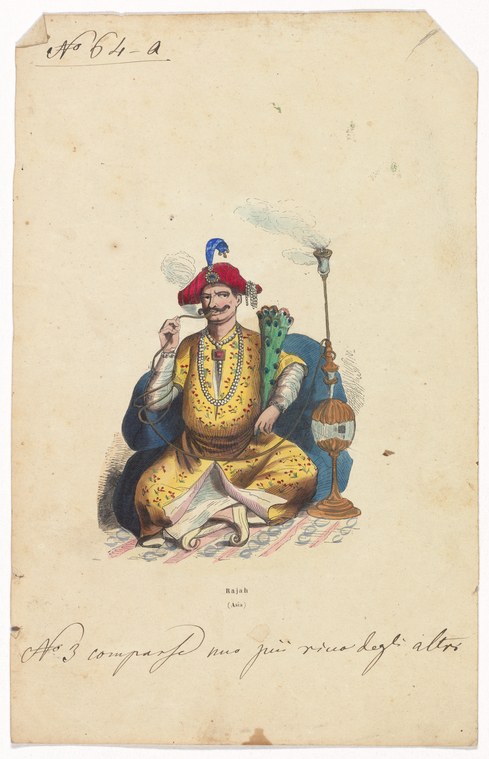
A single figure sits in a cross-legged pose against a plain cream background, wearing an ornate costume of South Asian origin. The figure has a mustache and wears a tall red hat with a blue plume, a yellow tunic embroidered with a dense pattern of flowers or jewels, and a dark blue garment draped over the shoulders like a shawl. The costume includes jewelry: what appears to be a beaded necklace. At his left side rests a stringed instrument resembling a sarangi or similar classical Indian instrument, and to the right, a decorated staff or ceremonial object with feathering. His right hand is raised to his face in a gesture suggesting contemplation or refined leisure. The figure's posture and regalia suggest high social status, perhaps a court musician or dancer of the Mughal period.
The dancing
A single seated figure in a fully cross-legged position, the weight settled into the hips. The right arm is raised with the hand near the face in a delicate, introspective gesture; the left arm rests across the body. The pose is static and meditative rather than active, suggesting a portrait of leisure or contemplation rather than a captured moment of movement. The upright carriage and dignified bearing convey authority and refinement.
The dance depicted
The image is labeled 'Rajah' and appears to depict a figure of high rank in a moment of repose rather than active dance. However, the presence of a stringed instrument and the ornate costume suggest a context in which music and dance were integral to court culture. The pose may reference the refined aesthetic codes of North Indian classical dance, where hand gestures (mudras) and composed stillness held as much significance as movement. The figure's status and adornment suggest the Mughal or late Mughal court world in which classical Indian dance was patronized.
How it was made
This is a hand-colored engraving or aquatint, characteristic of 19th-century European documentary illustration of ethnographic subjects. The fine hatching visible in the fabric patterns and shading suggests engraved or etched line-work, with watercolor or gouache applied afterward to establish local color. The technique allowed for wide circulation in illustrated books and periodicals aimed at European audiences curious about 'exotic' dress and customs. The craftsmanship is competent but the approach is observational and didactic rather than imaginative.
About this work
This is a 19th-century European ethnographic print depicting a figure identified as 'Rajah'—likely a court musician or dancer of South or Central Asian origin, shown in formal dress and contemplative repose. The work belongs to a tradition of costume documentation that flourished in the 19th century, when illustrated costume books and periodicals were standard vehicles for European knowledge of non-Western cultures. The figure's pose and adornment suggest a world in which music, dance, and courtly refinement were inseparable from rank and luxury. While the image does not depict active dance, it captures the aesthetic and material context in which classical Indian or South Asian dance would have been performed and valued.
How to look at it
Look first at the costume: the embroidered tunic, the jewelry, the hat and plume, the instrument. These are markers of status and musical learning in a pre-modern court. Notice the stillness of the pose—this is not a action photograph but a formal portrait, the equivalent of a Renaissance prince shown with his lute. The raised hand, delicate and refined, speaks to an aesthetic in which restraint and subtle gesture conveyed more than movement. The artist has chosen to show the figure in repose, adorned and at leisure, rather than in active dance or performance.
The artist
The artist is unrecorded, but the style and provenance suggest a work produced for a European publisher or collector in the mid-to-late 19th century. Such costume studies were often compiled by commercial print houses or illustrators working for ethnographic publishers, and were rarely attributed to individual artists. The hand-coloring may have been done by a separate specialist, making the 'author' of the final image a collective enterprise.
The period
This print was likely made in the 19th century, during the height of European ethnographic illustration and at a moment when colonial and orientalist interest in non-Western costume, dance, and music was reaching its commercial peak. It belongs to a genre of 'costume books' that served both as reference works for artists and as curiosities for educated European audiences. At the same time, in India itself, classical dance forms including Kathak, Bharatanatyam, and other court-affiliated traditions were undergoing transformation and suppression under colonial rule, even as European collectors and scholars were documenting them.
Where it lives
This hand-colored engraving or aquatint is held in the New York Public Library's collection of prints depicting dance and costume. The catalogue record identifies it only as 'Historical and ethnic costumes' and labels the figure as 'Rajah,' suggesting it was part of a larger series of costume documentation. The work likely originated as a commercial print, produced for sale or inclusion in a costume compendium aimed at 19th-century European collectors and artists seeking reference materials.
Dance in this work
Questions about this work
Is this a dancer?
The figure is shown at rest rather than in active movement, but the context—the instrument, the costume, the refined gesture—suggests involvement in music and dance patronage and performance. In court cultures where he appears to belong, these roles were closely linked.
What culture does this costume represent?
The dress and ornament suggest a figure from the Mughal court or its successors in South or Central Asia, most likely from North India. The tall hat, embroidered tunic, and stringed instrument are consistent with 16th–19th century court culture in that region, though the print is a European interpretation and may blend or stylize elements for a foreign audience.
Why is it in a dance collection if no one is dancing?
Classical dance in many cultures is not primarily about continuous movement; gesture, stillness, and the aesthetic codes of the body matter equally. This print documents the material and social context of dance—the costume, status, and courtly learning that sustained performance traditions. It also reminds us that European collections often defined 'dance' narrowly, and may have classified works about music, costume, and court life under dance by association.
More dance artwork





