49 works in this view — arrow keys or swipe to move between them.
Dance in Art
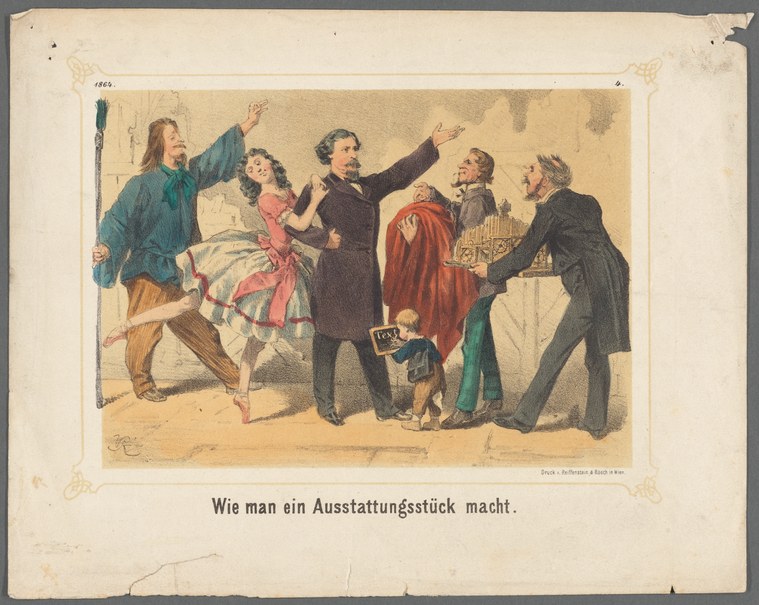
Wie man ein Ausstattungsstück macht
Unknown artist
- Collection:
- Prints depicting dance
- Source:
- New York Public Library
- Rights:
- Public domain — free to use, share and adapt.
- Recorded as:
- Public Domain
The print offers a rare satirical window into mid-19th-century theatrical production practice and the social dynamics between dancers and stage management. It also documents the "Ausstattungsstück" (costume spectacular), a now-obscure German theatrical genre that employed dance as part of elaborate visual and narrative production, and reveals contemporary anxieties about artifice, direction, and the construction of theatrical illusion.
What you are looking at
A German satirical print depicting the backstage chaos of theatrical production, titled "Wie man ein Ausstattungsstück macht" (How one makes a costume piece). Six figures occupy a studio or backstage space: a dancer in a pink skirt with arms raised in an exaggerated pose, surrounded by men in dark coats and formal dress who gesture, point, and confer. The central male figure extends his arm upward in direction or instruction, while others—a bearded man on the left, a gentleman in a red cape, and two others to the right—observe, discuss, or manage the scene. A small child crouches at floor level, adding to the sense of crowded disorder. The warm, sepia-toned lithographic palette and sketchy handling suggest mid-19th-century theatrical satire, capturing a moment of intense creative (or comic) activity around a single dancing figure.
The dancing
The dancer stands center-right in a theatrical pose: weight appears lifted, one leg extended or poised, arms held high and open—a classical or balletic line. The male figures around her adopt postures of management and judgment: pointing, gesturing, leaning in to observe. No formal partnering or ballroom hold is present; instead, the woman is the object of scrutiny and direction from multiple male observers. The composition emphasizes hierarchy and control rather than mutual dance engagement, typical of stage rehearsal or costume-fitting scenes.
The dance depicted
The work depicts theatrical dance production rather than a specific dance style being performed. The woman's raised arms and lifted carriage suggest classical theatrical dance training—possibly ballet or pantomime—but the satirical context suggests this is a commentary on how such pieces were constructed, staged, and directed, rather than a serious study of dance technique. The German title and mid-19th-century style indicate this critiques the conventions of German theatrical production, particularly the often absurd process of costume and spectacle creation in commercial theatre.
How it was made
This is a hand-colored lithograph, a technique that allowed for relatively rapid production and wide distribution of satirical social commentary. The colored ink was applied to a lithographic stone and printed, then hand-finished with watercolor or colored ink. The sketchy, expressive line work and loose handling of form are characteristic of satirical printmaking and suggest this was made for a popular or theatrical audience rather than fine-art collectors. The technique was ideal for theatrical and social satire, as it was affordable and suited to narrative, figure-heavy compositions.
About this work
This is a mid-19th-century German satirical lithograph documenting the theatrical backstage world—specifically the process by which a "costume piece" (Ausstattungsstück), a spectacular theatrical genre popular in German theatre, was constructed and rehearsed. Rather than depicting actual dance performance, it shows the apparatus of theatrical production: the dancer as a figure to be shaped, directed, and dressed by male impresarios, costume designers, and stage managers. The work captures a moment of intense creative negotiation and absurdity, using the body of the dancing woman as both the literal and comic center of theatrical labor. It belongs in a dance gallery as documentary evidence of how theatrical dance existed within and was subordinate to the machinery of commercial spectacle production.
How to look at it
Notice the dancer's isolation within a circle of male observers and directors: she is posed and watched rather than freely moving. The composition captures not a moment of dance itself but the moment just before, during, or around performance—the rehearsal, the fitting, the direction. Observe how the lithographer uses the contrast between her light costume and the dark suits of the men to emphasize her role as the visual object of the scene. The small child and the casual postures of the men suggest this is meant to be amusing—a satire on the gravity with which theatrical professionals approach costume and spectacle.
The period
This work dates to the mid-19th century, when German theatre was experiencing explosive growth in spectacle-based production. The "Ausstattungsstück" emerged as a major commercial form, competing with ballet and opera by combining elaborate costumes, scenery, music, and choreography into visually overwhelming entertainments. Satirical lithography was at its height as a medium for theatrical and social commentary; German print culture was highly engaged with ridiculing both the excesses of theatrical fashion and the hierarchies of theatrical production. The focus on costume and artifice in the title reflects contemporary debates about whether such theatre was art or mere commercial spectacle.
Where it lives
This work is held in the New York Public Library's collection of prints depicting dance, a broad archival category that includes theatrical, satirical, and documentary images related to dance and performance. As a lithograph in a public collection rather than a signed, framed work, it circulated as a popular print, likely sold individually or in series to theatre-goers and educated readers interested in theatrical gossip and satire.
Dance in this work
Questions about this work
What is an 'Ausstattungsstück'?
An Ausstattungsstück (costume piece or spectacular) was a popular form of theatrical entertainment in 19th-century German theatre, characterized by elaborate costumes, scenery, and visual effects. It combined elements of ballet, pantomime, comedy, and music, often with thin or fantastical plots, designed primarily to showcase expensive and impressive staging. The form was sometimes disparaged by critics as mere spectacle lacking artistic substance—which is likely why it became a subject for satirical prints like this one.
Is this a record of actual choreography?
No. This is a satirical print about theatrical production, not documentation of a specific dance or choreographic style. The dancer's pose may reference classical ballet conventions, but the work is focused on the process and people behind the scenes rather than the dance itself. It is more valuable as evidence of how dance existed within theatrical institutions than as a record of how dances were actually performed.
Who created this print?
The artist is not recorded in the catalogue. The style and subject matter suggest a professional satirical lithographer working in a German theatrical milieu in the mid-19th century, but without a signature or documented provenance, the creator cannot be identified from the image alone.
Why are there so many men around the dancer?
The composition satirizes the hierarchy of theatrical production: the dancer is the visual center but not the authority. The men surrounding her—likely a director, costumier, impresario, and stage manager—represent the layers of male control and decision-making that shaped what the audience saw. This reflects the actual social structure of 19th-century theatre, where dancers (often women) had limited agency over their own performance.
More dance artwork





