49 works in this view — arrow keys or swipe to move between them.
Dance in Art
Masquerades and fancy-dress balls in prints
Unknown artist
- Collection:
- Prints depicting dance
- Source:
- New York Public Library
- Rights:
- Public domain — free to use, share and adapt.
- Recorded as:
- Public Domain
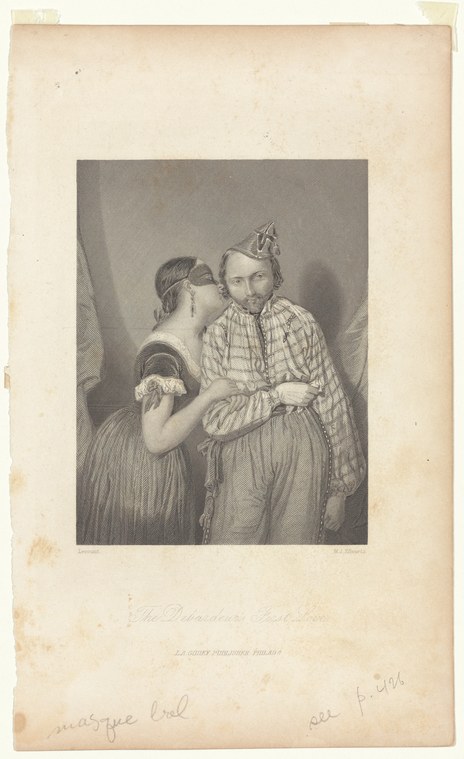
Masquerades were crucial sites of social dancing and romantic encounter in the Regency period, and they were documented extensively in prints to make the fashion, costume, and social conventions visible to a broad audience. This image shows us not the movement but the setting and comportment that surrounded dancing—what women wore, how they held themselves, what conversations might pass between dancers in a masquerade context.
What you are looking at
Two women in early 19th-century dress stand in close conversation or instruction, set against a plain background lit to suggest interior space. The woman on the left, viewed from behind, wears a high-waisted white or cream gown with vertical pleating and a bonnet tied under the chin. She holds her hands clasped before her in a formal posture. The woman on the right faces three-quarter view, wearing a similar high-waisted dress with checked or plaid patterning and a matching bonnet. Both figures stand upright with heads close together, their body language suggesting either intimate conversation or a demonstration. The composition is vertical and close-framed, focusing entirely on the interaction between the two figures with no setting details beyond drapery.
The dancing
Both women stand in an upright, formal posture typical of Regency-era deportment. The woman on the left maintains a demure position with hands clasped low, while the woman on the right inclines her head slightly toward her companion. Neither figure displays active footwork or a clear dance hold; instead, their positioning suggests stillness or the interval between movements. The spatial relationship—close but not in contact—and the attentiveness of both figures suggest instruction or intimate social exchange rather than active dancing.
The dance depicted
The image likely depicts a moment from a masquerade ball or fancy-dress gathering, as the title suggests, but it captures a pause in activity rather than dance in motion. The formal dress and bonnet-wearing indicate this is not active dancing but rather the social context surrounding such events: perhaps two women meeting, greeting, or one instructing the other on manner or costume. The Regency-era clothing places this in the early 19th century when masquerades were fashionable entertainments combining dance, courtship, and social intrigue. The moment chosen emphasizes social interaction and decorum over movement.
How it was made
This is a stippled or finely-worked engraving, likely steel-engraved or produced by tonal engraving techniques that allow subtle gradation of light and shadow. The technique is capable of rendering fine detail in the fabric patterns and facial features, and the careful modeling of the figures and background drapery suggests a skilled reproductive engraver working from a drawn or painted design. The high degree of finish and the formal mounting on a larger sheet with margins indicate this is a print of some circulation intended for a middle- or upper-class audience familiar with Regency social customs.
About this work
This engraving documents the visual culture of Regency-era masquerades and fancy-dress balls—public and semi-public entertainments that combined masked anonymity, theatrical costume, music, and social dancing. The work captures not the dancing itself but the social moment, the interaction between costumed guests, and the codes of feminine deportment and dress that governed such events. It belongs in a gallery of dance imagery because masquerades were fundamentally dance events, and this print preserves the costume, setting, and social rituals that framed that dancing even when it is not explicitly shown.
The title indicates this is part of a series documenting different types of masquerade costume and scenario, suggesting it was meant as one image among several showing the variety and social texture of the ball. Such prints circulated among people planning to attend or wanting to understand the fashion and etiquette of these events.
How to look at it
Notice the fine detail in the checked fabric of the right-hand figure's dress and the way the pleating on the left figure's gown indicates the high waistline and silhouette of Regency fashion. The bonnet-wearing and formal posture tell us this is not active dancing but a formal social moment. The artist has chosen to freeze a moment of social exchange—perhaps greeting, perhaps instruction in dance etiquette—rather than the dance itself, which suggests that masquerade culture was as much about the social interaction and costume as about the actual movement.
The period
Masquerades were at the height of fashion in England in the late 18th and early 19th centuries, reflecting both aristocratic and newly wealthy middle-class participation in elaborate social entertainments. They combined elements of carnival tradition, theatrical costume, anonymity, and formal dance in settings that were often scandalous or at least risqué by contemporary standards. Prints documenting masquerade fashion and scenarios circulated widely and served both as entertainment and as guides to etiquette and costume for those attending such events. The Regency period saw an explosion of such prints, particularly in the 1810s and 1820s.
Where it lives
This print is held in the NYPL's collection of prints depicting dance, likely as part of a series or portfolio of masquerade imagery. Such collections were often compiled thematically for reference, instruction, or entertainment in the 19th century.
Dance in this work
Questions about this work
What is a masquerade ball?
Masquerades were elaborate social entertainments, especially popular in the 18th and early 19th centuries, in which guests wore costumes and masks, attended formal dancing, and engaged in flirtation and social intrigue under the cover of anonymity. They were held in fashionable venues and attended by a mix of aristocracy, gentry, and wealthy commoners. They were often associated with romance, scandal, and transgression of normal social boundaries.
What does the dress tell us about the date of this image?
The high-waisted, simple silhouette with minimal ornamentation, the bonnet style, and the overall cut of the dresses are characteristic of Regency-era fashion, roughly 1811–1820. The absence of corsetry visible in the line of the dress, and the empire waistline, are hallmarks of this period in women's fashion.
Is this engraving documenting an actual event?
Most likely not. This is a generic or composite image showing the type of interaction and costume typical of a masquerade, probably designed to be one of a series showing various scenarios or costume types. It served both as a fashion guide and as a form of entertainment for people interested in masquerade culture.
Why are bonnet worn at a masquerade if the point is anonymity?
This image may depict a moment before the masquerade proper, or during a break, when women would not yet be masked or would have removed their masks. The bonnet was essential Regency outdoor and semi-public indoor wear, so it appears here as an artifact of the period rather than as a masquerade costume per se.
More dance artwork





