49 works in this view — arrow keys or swipe to move between them.
Dance in Art
John D'Auban, ballet master
Unknown artist
- Collection:
- Prints depicting dance
- Source:
- New York Public Library
- Rights:
- Public domain — free to use, share and adapt.
- Recorded as:
- Public Domain
D'Auban was a major choreographer and ballet master of the 1870s–1890s, responsible for staging ballets at the Gaiety Theatre and other London houses during a period when ballet in Britain was professionally under-resourced and culturally marginal. This caricature documents the personality and reach of a figure who kept balletic training and performance visible in London theatres at a time when serious ballet had largely migrated to continental Europe.
What you are looking at
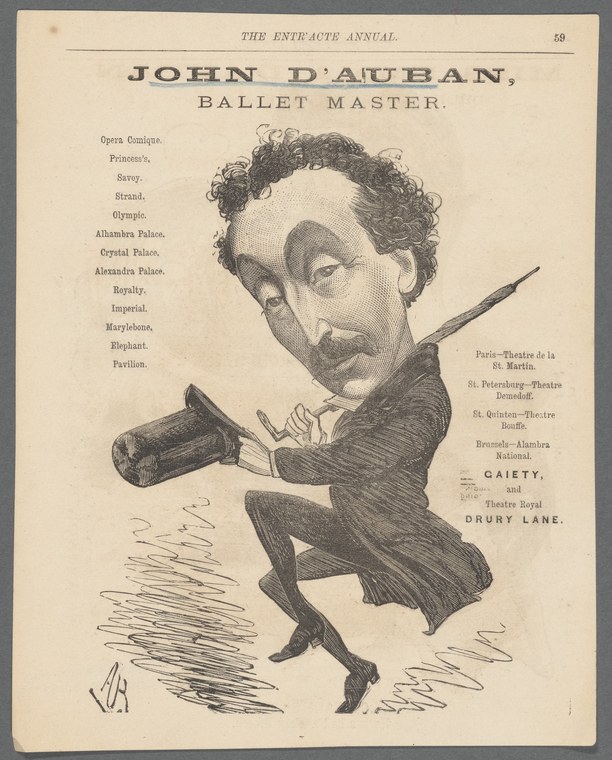
A caricature portrait of John D'Auban rendered in ink, showing a man's head and shoulders in three-quarter view against a cream background. The subject has a distinctive face with a prominent nose, dark curly hair, and facial hair; he gazes downward with an introspective expression. Below the neck, his body is rendered in a dynamic theatrical pose: he wears dark formal dress (coat and trousers) and is captured mid-movement in an exaggerated leap or jump, with one leg extended high and bent, the other leg extended behind, and arms spread wide. His posture suggests balletic elevation and control. The composition places the naturalistic head above an anatomically impossible, energetically distorted body—a characteristic device of theatrical caricature. At left, text lists London theatres where D'Auban worked: Opera Comique, Savoy, Strand, Gaiety, Alhambra Palace, Crystal Palace, Alexandra Palace, Royalty, Imperial, Marylebone, Elephant, Pavilion. At right, additional venues appear: Paris—Théâtre de la St Martin, St. Petersburg—Theatre Imeaddh, St. Gallen—Theatre Basle, Brussels—Alhambra National, and finally Gaiety and Theatre Royal Drury Lane. A signature or mark appears in the lower left corner.
The dancing
The figure shows a balletically trained body in a moment of dynamic elevation. The supporting leg is nearly vertical, carrying the weight upward; the free leg is bent and drawn up toward the torso in a position suggesting a développé or dégagé. The arms are spread wide in an open frame. The posture demonstrates control and the upward suspension characteristic of trained ballet technique. The exaggeration of the pose and the impossible angle of the head relative to the body mark this as caricature rather than naturalistic anatomy.
The dance depicted
This is a caricature of John D'Auban, a prominent late 19th-century ballet master and choreographer. The pose captures the essence of his professional identity—a dancer and master of balletic movement, frozen in an attitude of elevation and control. D'Auban was known for his work in both British and Continental European theatres, and the list of venues confirms his peripatetic career across London, Paris, Brussels, and St. Petersburg. The image celebrates his status as a theatre professional and dance pedagogue through the balletic virtuosity of his pose, even as caricature distorts the anatomical reality. The artist has chosen elevation as the defining gesture—the moment of weightlessness that ballet prizes.
How it was made
This is a pen-and-ink drawing or engraving, likely printed for theatrical and entertainment circles. The technique shows confident linear work, with hatching and cross-hatching used to model form and create tonal variation, particularly in the face and in the folds of cloth. The composition and the theatrical context suggest this is a theatrical caricature, a genre that flourished in the second half of the 19th century and circulated through periodicals, annuals, and theatrical programmes. The medium allowed for rapid, expressive rendering suitable to capturing likeness and character in a single iconic image.
About this work
This is a theatrical caricature of John D'Auban, a Gilded Age ballet master whose career spanned London, Paris, Brussels, and St. Petersburg. The work celebrates his identity as a dancer and choreographer through an exaggerated balletic pose—a suspended leap rendered in ink with the head rendered naturalistically but anatomically disconnected from the energetic body below. D'Auban's list of professional affiliations, printed around the margins, documents his high status and international reach in late 19th-century theatre. The piece belongs to the tradition of theatrical caricature, a popular form of celebrity portraiture that circulated among theatre professionals and enthusiasts.
How to look at it
Attend first to the split between head and body: the face is rendered with realistic portraiture in mind, while the body is pure balletic fantasy, a moment of impossible weightlessness and elevation. This split is the principle of caricature—to capture something true about the subject (D'Auban as a dancer; D'Auban as a theatrical personality) through exaggeration and distortion. The artist has chosen the moment of greatest elevation, when a dancer appears almost to defy gravity—the instant that best conveys balletic mastery. Notice the confidence in the draughtsmanship: the line is quick, the hatching decisive, the composition economical.
The artist
The artist is not identified in the catalogue record. The style and subject matter suggest a theatrical caricaturist working in London in the 1870s–1890s, during the heyday of theatrical caricature as a form of entertainment journalism. The signature or monogram in the lower left may identify the artist, but it is not clearly legible in reproduction.
The period
This work dates to the Gilded Age of British theatre, when the Gaiety Theatre and other playhouses were expanding their offerings and hiring continental-trained ballet masters to stage divertissements and full ballets. D'Auban's career reflects the professionalization of theatre production and the increasing prestige of dance—though still often subordinate to drama and music hall. In Europe, this was the era of Romantic and Classical ballet at the Imperial theatres; in London, ballet was more often a feature of musical theatre, pantomime, and variety entertainment. The caricature reflects contemporary fascination with theatre celebrities and the visual culture of theatrical publicity.
Where it lives
This print is held in the New York Public Library's collection of prints depicting dance. The work is from *The Entr'acte Annual*, a British theatrical periodical or annual publication that documented theatre personalities and performances of the era.
Dance in this work
Questions about this work
Who was John D'Auban?
John D'Auban (c. 1842–1904) was a British ballet master and choreographer who worked across Europe in the late 19th century. He was associated with London's major theatres—the Gaiety, Drury Lane, the Alhambra—and also worked in Paris, Brussels, and St. Petersburg. He was instrumental in keeping ballet visible in London theatres during a period when British ballet was underfunded and often marginal to dramatic and musical theatre.
What is a theatrical caricature and why did artists make them?
Theatrical caricatures were portrait prints, usually in ink or lithography, that exaggerated the features or celebrated the profession of theatre personalities. They circulated in theatrical annuals, programmes, and periodicals, and were popular souvenirs and promotional images. They allowed artists to capture likeness while also expressing something about the subject's professional identity or public persona—in this case, D'Auban's identity as a dancer of balletic refinement.
Why is D'Auban shown in a balletic pose?
The pose is his professional signature—it communicates that he was a dancer and ballet master. The moment of elevation (the suspended jump) was one of the most visually striking and technically demanding aspects of ballet, and the caricaturist has chosen it to epitomize D'Auban's skill and status. It is both a portrait and a tribute to his craft.
What do the theatre names tell us?
They document D'Auban's career across major European theatre centres. London theatres (Gaiety, Drury Lane, Alhambra) show his association with London's most prestigious playhouses; Paris, Brussels, and St. Petersburg confirm his international standing and mobility. This was a mark of success for a theatre professional of the era.
More dance artwork





