49 works in this view — arrow keys or swipe to move between them.
Dance in Art
Dancing girls
Unknown artist
- Collection:
- Prints depicting dance
- Source:
- New York Public Library
- Rights:
- Public domain — free to use, share and adapt.
- Recorded as:
- Public Domain
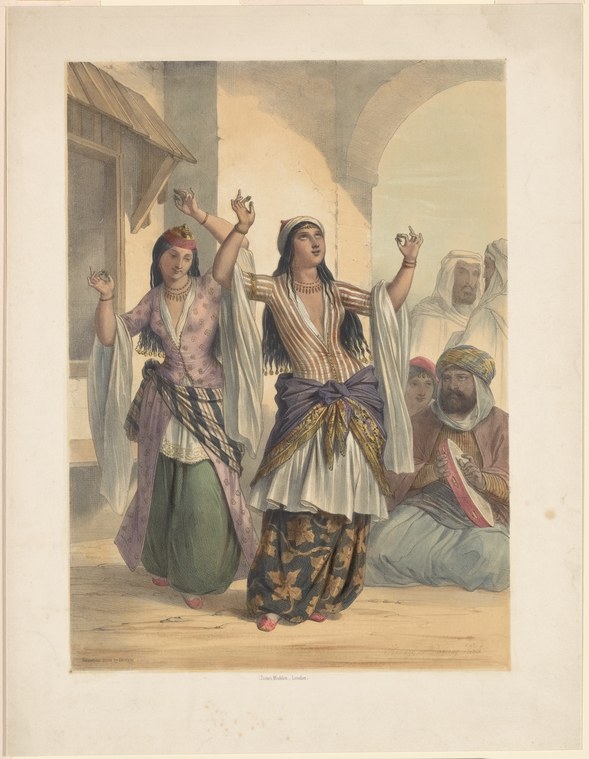
This print provides rare documentary evidence of how women's dance looked in the 19th-century Ottoman or North African world, from the perspective of an artist with direct access to the performance context. The artist has captured not a stylized or orientalist fantasy but a specific moment—the peak of an arm gesture, the radiance of celebration—which tells us how the dancers themselves understood the beauty and meaning of the movement. For historians and dancers working to recover the roots of Raqs Sharqi and related traditions, this image is a primary source.
What you are looking at
Two women in elaborate Middle Eastern or North African dress dance with arms raised in a columned interior space. The figure on the right wears a white linen wrapper over a dark patterned skirt and gold jewelry; the figure on the left is dressed in pink and green fabrics with similar adornment. Both have their arms lifted to shoulder height or above, palms open and fingers extended in a gesture of joy or invocation. A third woman in white stands behind them, partially obscured. To the right, three seated male figures in turbans and robes watch the performance—one in red and gold, two in earth tones—their posture suggesting they are an audience. The setting is an austere interior with tall columns and arched openings that suggest a palace or wealthy household. The light is cool and even, falling from the left, with strong shadows defining the architectural forms. This is a hand-colored print; the technique has allowed the artist to render the fabrics and jewelry with jewel-like intensity, and the composition has the formal framing of a published work meant to document an observed social custom.
The dancing
The two central dancers stand nearly upright with weight evenly distributed, their torsos facing forward. Both have raised their arms to approximately shoulder height or slightly higher, with elbows bent and palms open—a gesture of celebration, blessing, or rhythmic emphasis rather than partnered hold. The arms are relaxed but purposeful, not rigid. Their feet are not clearly visible due to the long skirts, so footwork cannot be assessed. The third figure in white appears to be either participating or attending. The male observers sit at ground level, creating a clear spatial and social distinction between the performers and the audience.
The dance depicted
This appears to document Raqs Sharqi (belly dance) or a related form of women's social dance from the Ottoman or North African world, most likely from the 19th century. The raised arms, open palms, and upright posture are consistent with documented forms of women's celebratory dance from this region and period. The domestic or palace setting, the presence of a female audience, and the segregation of male observers suggest this is a social or household performance rather than a formal theatrical event. The artist has chosen to freeze a moment of joyous celebration—the peak of an arm movement, the radiance of the gesture—rather than attempting to capture a specific step or sequence.
How it was made
This is a hand-colored print, most likely a lithograph or color-printed engraving from the mid-19th century. The technique allowed the artist to achieve the luminous, jewel-like quality of the fabrics and jewelry, and the precision of the architectural detail. The formal framing and careful composition suggest this was a commercial publication, probably issued as a single sheet or as part of a series documenting non-European customs and dress for a European audience. The print has been mounted on card stock and housed in an institutional collection, indicating it was valued as a documentary artifact.
About this work
This is a hand-colored print documenting a scene of women's social dance in a Middle Eastern or North African household, most likely from the 19th century. The two central figures perform with raised arms and open palms, a gesture characteristic of Raqs Sharqi and related forms of celebratory women's dance. The domestic setting, the presence of female attendants, and the formal segregation of male observers all point to a household or palace performance rather than a public theatrical event. The work belongs in a gallery about dance because it is a valuable visual record of how this dance was performed and understood in its original cultural context—not as exotic spectacle for a distant audience, but as a joyous social practice among women.
How to look at it
Pay attention to the moment the artist chose: the peak of the arm gesture, when both dancers have their arms raised and open, as if in unison. This freeze-frame tells us that the arm movement was central to the dance and to its beauty—not incidental, but the primary visual statement. Note also the formal symmetry of the composition: the two dancers are nearly mirror images, posed in a way that emphasizes their synchronization and the deliberateness of their gesture. The male observers are placed at the margin, almost as an afterthought, which suggests that the dance itself—the movement and the joy of the women—is the true subject.
The artist
The artist is unknown, but the work bears the hallmarks of 19th-century European commercial printmaking—specifically the hand-colored lithographs and engravings that documented non-European cultures for European audiences. The style and technique place it in the tradition of Orientalist travel documentation, though the quality of observation and the formal, dignified framing of the dancers suggest the artist had more than passing familiarity with the subject.
The period
This print was made during the heyday of 19th-century Orientalism, when European artists and publishers were producing illustrated accounts of travel, ethnography, and 'exotic' customs. At the same time, Raqs Sharqi was undergoing significant transformation in the Ottoman and North African world—from a household and celebratory practice to an increasingly professionalized and commercialized theatrical form. This image captures a moment between these worlds: a domestic performance, but documented and circulated in the formal language of European scientific and ethnographic illustration. The print belongs to a larger body of work that both preserved and exoticized Middle Eastern culture for European consumption.
Where it lives
This work is held in the New York Public Library's collection of prints depicting dance. It is one of many such prints in institutional collections that document non-Western dance traditions as seen through 19th-century European eyes.
Dance in this work
Questions about this work
Is this Belly Dance?
This appears to depict Raqs Sharqi (belly dance) or a closely related form of women's social dance from the Ottoman or North African world. The raised arms, open palms, and upright posture are consistent with documented forms of this dance. However, the footwork—which is central to belly dance technique—is not visible in this image because of the long skirts.
Who were the dancers?
We do not know. The print does not identify them. Based on the setting and audience, these were likely women performing for other women in a household or palace context, not professional performers in a public theater. Social dance of this kind was practiced by women of many classes.
When was this made?
The catalogue record does not provide a date. Based on the style of the print, the fashion, and the artistic technique, it was most likely made in the mid-19th century, during the height of European Orientalism. More precise dating would require further research.
Why are the men sitting down and watching?
This reflects the gender segregation of social space in the Ottoman and North African contexts from which this image comes. Women danced for and with other women; men observed from a formal distance. This spatial and social arrangement was part of the meaning of the performance.
More dance artwork





