49 works in this view — arrow keys or swipe to move between them.
Dance in Art
The dancing master
Unknown artist
- Collection:
- Prints depicting dance
- Source:
- New York Public Library
- Rights:
- Public domain — free to use, share and adapt.
- Recorded as:
- Public Domain
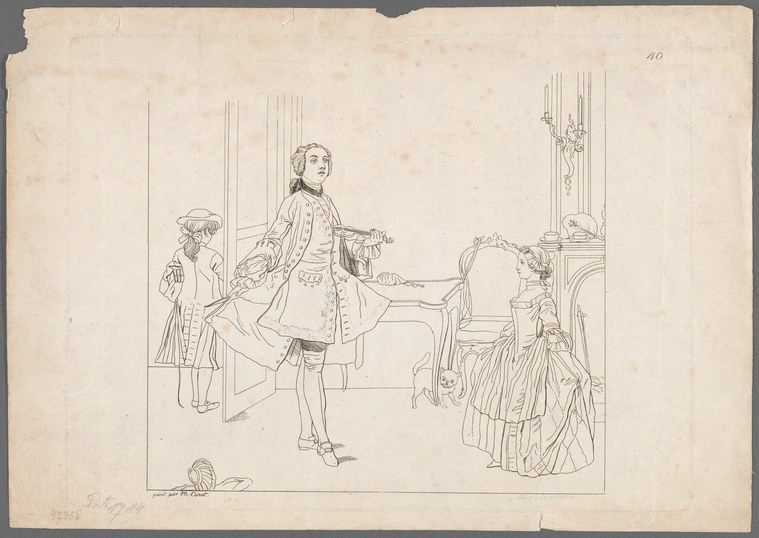
This image is rare documentary evidence of 18th-century dance pedagogy in action. It shows the actual method of instruction—the master's demonstration, the student's attentive posture—and preserves the look of the body in a formal dance step at a moment when such dancing was a marker of social class and cultivation.
What you are looking at
This is a drawing of an 18th-century dancing master conducting a lesson in a formal interior. The master stands at center, dressed in a coat with ornate embroidery and breeches, one leg extended in demonstration of a step or position. He gestures with both arms—his right hand raised expressively—addressing the scene before him. To his left stands a young boy in similar formal dress, watching intently. To the right, a young woman in a full skirt sits in an elegant chair, observing the instruction. In the background, another small figure in light dress stands near the draped window, completing the domestic scene. The setting is defined by tall curtained windows with ornamental details, suggesting a room in a house of some means. The line work is delicate and precise, with careful attention to the fall of fabric and the posture of each figure.
The dancing
The dancing master's body is the focal point: his weight appears to be on his left leg while his right leg extends forward in what looks like a démonstration of a balletic position or court dance step. His upper body turns toward his pupils, arms in an open, instructive posture—the right arm raised to shoulder height or above, the left arm extended more horizontally. The young male student stands at ease, watching. The seated woman maintains an upright posture appropriate to the period. None of the figures are in active dance themselves; the action is the master's demonstration and the students' attentive observation.
The dance depicted
This depicts a dance lesson in the 18th-century style of instruction, almost certainly a minuet or another court dance of the period, given the formal setting, the costumes, and the teacher's authoritative stance. The master appears to be demonstrating correct placement and carriage—the extended leg and open arm position are hallmarks of baroque and early neoclassical dance technique. The drawing captures the pedagogical moment rather than social dancing: a private lesson for young people of good family, instruction that was part of their education in gentility and proper deportment.
How it was made
This is a pen or ink drawing on paper, likely created as a preparatory study or finished illustration. The line work is controlled and economical, with hatching used sparingly to suggest shadow and volume. The technique allows for precise delineation of costume detail and spatial relationship, and suggests this may be an illustration for a book or manual on dance instruction—a genre that was popular in the 18th century. The informal verso marks and wear visible on the original support the idea that this was a working drawing.
About this work
This drawing documents the formal instruction of dance in an 18th-century domestic setting, showing a master teaching two young students. It captures not a performance or social dance, but the pedagogical practice of dance education among the gentry—the transmission of bodily discipline, grace, and social propriety through demonstration and observation. The work is an invaluable record of how court dances were taught and what the master-student relationship looked like in practice.
How to look at it
Look at the master's extended leg and the angle of his body: he is frozen mid-demonstration, his leg showing the ideal extension and placement for the step. His arms are arranged to instruct—not in a natural position of repose, but in the formal frame required by court dance. Notice how his pupils position themselves to observe: the boy stands close and faces him; the woman, seated, maintains the upright posture demanded by fashion and propriety. The setting—the formal room, the furniture, the window treatment—establishes this as a house of quality where such instruction would have taken place.
The period
In the 18th century, dancing was an essential accomplishment for anyone of genteel birth. Dance instruction was formalized; masters traveled between houses, teaching minuets, cotillions, and other fashionable dances to young men and women. The minutiae of position, carriage, and gesture were recorded in printed manuals with descriptive text and sometimes illustrations. This drawing likely dates to a period when such instruction was at its height in Europe—the earlier to middle 18th century—before Romantic ballet began to reshape attitudes to the body and movement.
Where it lives
The drawing is part of the New York Public Library's collection of prints depicting dance. It is catalogued as a historical document with minimal metadata, reflecting the gaps in archival records for such working drawings.
Dance in this work
Questions about this work
What dance is being taught here?
The image does not specify, but the formal setting, the master's posture, and the 18th-century dress suggest a court dance such as the minuet or cotillion. These were the dances taught to people of good family as part of their education in proper deportment.
Why is the woman sitting down?
In 18th-century dance instruction, women were often taught while seated to begin with, learning the upper body and arm positions before standing to execute steps. Alternatively, she may be observing while waiting her turn, or the artist chose to show different moments of the lesson.
Who drew this and when?
The artist and date are unknown. The style and subject matter suggest the drawing dates to the 18th century, probably the first or second quarter. It may have been created as an illustration for a book on dance instruction or as a record of a lesson.
How do we know this is a lesson and not a performance?
The domestic interior, the informal grouping, the fact that the master is demonstrating to a small group of students, and the attention to teaching posture rather than spectacle all point to instruction rather than performance. The woman's seated position is also typical of how students were positioned during lessons.
More dance artwork





