49 works in this view — arrow keys or swipe to move between them.
Dance in Art
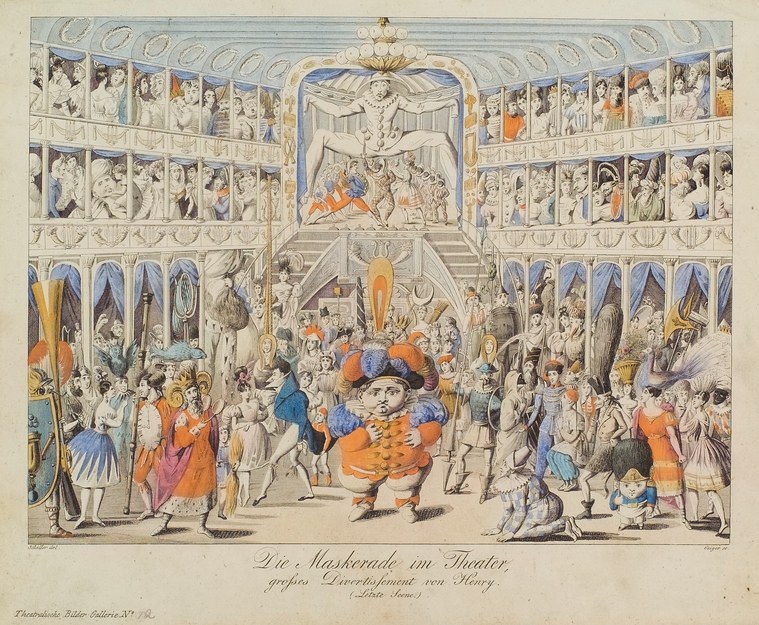
Die Maskerade im Theater, grosses Divertissement von Henry (letzte Scene)
Unknown artist
- Collection:
- Prints depicting dance
- Source:
- New York Public Library
- Rights:
- Public domain — free to use, share and adapt.
- Recorded as:
- Public Domain
This work provides rare visual documentation of how baroque court dance was integrated into large-scale theatrical spectacle: not as performance in isolation but as part of an allegorical, architectural, and ceremonial whole. The engraving shows choreography in context—which dancers where, what scale of formation, how the eye was directed through visual hierarchy—information that survives in few other sources. For historians of baroque dance, court culture, and theatrical design, this piece shows the actual staging conventions and spatial relationships that contemporary written descriptions of divertissements only suggest.
What you are looking at
A crowded indoor theatrical space, rendered in hand-colored engraving, depicts the climactic masquerade scene from a theatrical divertissement. The composition is vertically organized around a central crucifixion figure suspended above the stage floor, flanked by elaborate architectural elements—towering columns, arched niches filled with spectators, and ornamental plasterwork. The stage itself teems with figures in elaborate costume: men in bright orange and blue silks, plumed hats, and jeweled dress; women in pale gowns and elaborate headdresses; attendants and supernumeraries filling every plane. The upper galleries are packed with onlookers in period dress observing from boxes. The foreground shows a large central figure in an extravagant orange coat, arms raised in theatrical gesture, surrounded by a whirling constellation of dancers in various states of movement—some frozen mid-turn, others bowing or gesturing toward the crucifixion. The lighting is even and pale, typical of hand-colored print work, with warm ochres, blues, and flesh tones applied to a finely detailed line engraving.
The dancing
The dancers occupy a range of positions from formal court posture to energetic theatrical movement. Most visible are men and women in closed or open holds typical of baroque court dance, with upright frames and extended arms. The central male figure strikes an emphatic pose with both arms raised outward in a gesture of presentation or astonishment. Bodies are rendered with attention to the volume of silk and satin garments—women's skirts billow, men's coats stand away from the torso. The crowd effect is achieved through layering of figures, some in sharp focus, others dimmed by the density of the composition. Footwork is not clearly distinguishable at this print scale, but the overall carriage is aristocratic and controlled, even in moments of apparent excitement.
The dance depicted
The work depicts a theatrical divertissement, a staged entertainment combining music, dance, spectacle, and allegorical imagery typical of European court theater in the 17th and early 18th centuries. The title identifies it as the final scene of Henry's masquerade entertainment. The crucifixion motif—unusual in a secular masquerade—suggests this may be a historical or biblical narrative frame. The dances visible are consistent with baroque court dance forms: formal processional movement, coupled dances with arm gestures, and the kind of theatrical grouping seen in French court ballets. The prominence of the masquerade costume and the indoor theater setting indicate this is a professional or courtly production rather than a private ball, and the scale of the spectacle suggests state-sponsored theatrical patronage.
How it was made
This is a hand-colored engraving, identifiable from the fine parallel line work visible in the architectural detail and the figures' drapery, with translucent color washes applied afterward—a standard reproductive and commercial print technique of the 18th century. Engravings of this complexity and theatrical subject matter typically reached a wide educated audience across Europe, circulating among collectors, court officials, and theater enthusiasts. The detail suggests it was made from a drawing by a theater specialist or scene painter, then engraved for publication—a common practice for documenting important court entertainments. The technique allowed the artist to capture both the intricacy of the architectural space and the individual expressions of dozens of costumed figures.
About this work
This is a hand-colored engraving documenting the final scene of a major theatrical divertissement titled 'Die Maskerade im Theater'—likely a German court entertainment, given the title language. It shows a masquerade ball or masked entertainment staged within an elaborate interior space, with the stage itself framed by boxes of spectators and dominated by a crucifixion figure. The work combines documentary precision about 18th-century theatrical production design with careful attention to the choreography of court dance: the formal groupings, the costume vocabulary, the gestural language of baroque ensemble movement. It belongs to the tradition of theatrical event documentation that was common among court and aristocratic circles, where engravings of important spectacles served as records of courtly power and cultural investment.
How to look at it
Begin with the architectural frame and the central crucifixion figure—these establish the allegorical or narrative anchor of the entertainment. Then trace the movement of figures outward from that center: where are dancers clustered, where sparse? Notice how costume and position create a hierarchy of importance and focus. Look closely at the foreground figures, particularly the central male dancer and the women nearest him, to read the actual vocabulary of movement: the arm positions, the body facing, the spacing between partners. The print technique allows fine detail even in crowded scenes—attend to individual gestures and expressions rather than reading only the mass. The presence of spectators in the upper galleries reminds us that this was a formal performance, not a private dance, and the architectural elaboration suggests that the space itself—not just the dancers—was part of the spectacle.
The period
The divertissement was a dominant form of court entertainment across European aristocracies in the 17th and 18th centuries, particularly in France and the German principalities. These events combined spectacular scenery, allegorical narrative, professional and courtly dancers, and music into unified productions that could last hours. Theatrical masquerades—where courtiers wore exotic or mythological costume and participated in scripted and improvised entertainment—were a marker of courtly sophistication and political power. The engraving technique for documenting these events became increasingly refined during the 18th century; prints circulated as records of magnificence and as models for other courts' productions. By the time this work was made, such spectacles were becoming more professionalized, with professional dancers and choreographers supplementing courtly amateurs.
Where it lives
This engraving is held in the New York Public Library's collection of prints depicting dance. It is catalogued as part of a group of theatrical and masquerade documentation prints, likely German in origin and dating to the 18th century, though the precise date of creation and publication are not recorded in the available catalogue information.
Dance in this work
Questions about this work
What was a divertissement?
A divertissement was a staged entertainment combining dance, music, spectacle, and narrative, popular at European courts from the 17th through 19th centuries. Typically performed as part of a larger court celebration or as an independent event, divertissements could last several hours and involved both professional performers and courtiers. They allowed courts to display wealth, artistic patronage, and political power through elaborate scenery, costumes, and choreography.
Was this a performance or a court dance?
This was a theatrical performance, not a social ballroom dance. The elaborate setting, the prominent crucifixion figure as an allegorical center, the mix of professional and courtly performers, and the documentation via expensive engraving all indicate this was a formal state-sponsored entertainment. Courtiers may have participated, but the event was produced and directed as theater.
Why is there a crucifixion at a masquerade?
The presence of a religious or allegorical central image in a masquerade suggests this entertainment had a narrative or moral frame. Baroque court entertainments frequently combined secular dance and costume with religious or classical themes. Without the original program or libretto, the exact meaning of this particular crucifixion cannot be determined, but it likely served as an allegorical focal point around which the masquerade action revolved.
How does this image show us how baroque dance actually worked?
The engraving documents spatial relationships and formations that written dance descriptions rarely capture: the distance between partners, the way couples were arrayed on stage, how individuals used arm gestures and body orientation to create visual focus, and the integration of dance with spectacle and architecture. The print preserves information about scale, costume weight, and the visual grammar of baroque movement that would otherwise survive only in notation or written account.
More dance artwork





