49 works in this view — arrow keys or swipe to move between them.
Dance in Art
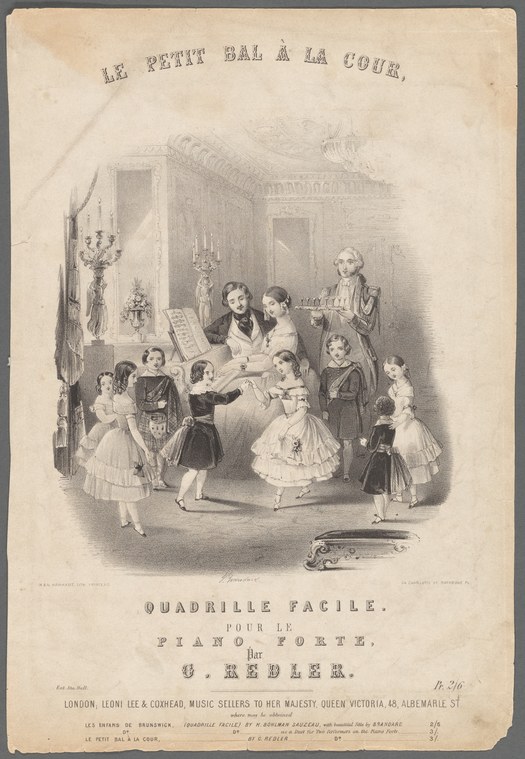
Le petit bal a la cour, quadrille facile pour le piano forte, par G. Redler
Unknown artist
- Collection:
- Prints depicting dance
- Source:
- New York Public Library
- Rights:
- Public domain — free to use, share and adapt.
- Recorded as:
- Public Domain
This print is a direct link between published dance instruction and lived practice. It shows not only what a quadrille looked like, but how it was taught—through music notation and visual model, side by side. For dance historians, it documents the quadrille's place as a rite of passage in Victorian society and reveals the precise aesthetic of mid-19th-century ballroom deportment: upright, controlled, and formal.
What you are looking at
A formal court or ballroom setting, depicted in the restrained style of a mid-19th-century engraving. A group of elegantly dressed figures—children and young people in dark jackets, white gloves, and full skirts—are arranged in the geometric formation typical of a quadrille. The figures occupy a classical interior with panelled walls, tall candlesticks, and minimal architectural detail rendered in fine parallel lines. The composition is symmetrical and staged, with figures distributed across the shallow space as though frozen in a formal moment of the dance. The engraver has used careful cross-hatching to suggest volume and fabric texture, particularly in the layered skirts and the formal dress coats. The overall effect is one of decorum and instruction—this is a dance lesson or demonstration, not spontaneous movement.
The dancing
The dancers are arranged in the closed, upright posture required by quadrille protocol. Most stand in pairs or small groups facing each other or the viewer. The women wear full skirts that suggest weight and structure; the men and boys stand stiffly in dark formal dress. Arms are held at the side or in the modest positions of mid-Victorian propriety. The nearest figures show no dramatic extension or elevation; bodies are vertical and controlled. The composition emphasizes formation over individual virtuosity—the geometry of the set matters more than the expression of the body.
The dance depicted
This is a quadrille, the dominant social dance of the mid-19th century in Britain and Europe. The title *Le petit bal à la cour* (The little court ball) and the subtitle *quadrille facile pour le piano forte* (easy quadrille for piano) identify this as an instructional or amateur version—a simplified quadrille arranged for domestic performance on the piano. The quadrille was danced in sets of four couples in a square formation, moving through prescribed figures that combined elements of the cotillion, country dance, and French court tradition. This print appears to be the cover or interior illustration from a published score, intended to show performers and teachers what the formation should look like. The elegance of dress and the formal interior suggest a respectable domestic or private academy setting.
How it was made
This is a wood engraving or steel engraving, recognizable from the fine parallel lines (hatching and cross-hatching) used to create tone and the crisp, high-contrast black-and-white image characteristic of 19th-century reproductive printmaking. The technique allowed for fine detail and wide circulation—this was a commercial print, likely bound into a published music score and distributed to middle-class households and music teachers. The publisher information at the foot (Leone Lee & Coanead, London) confirms this was a commercial music publication. The restraint of the engraving style, with its careful parallel lines and formal composition, was the standard for instructional and fashionable prints of this period and suited the solemn decorum of the subject matter.
About this work
This is a mid-19th-century engraved illustration of a quadrille, the most fashionable ballroom dance of the era, reproduced as the cover or interior plate of a published piano score for amateur performers. The print documents both the dance itself—the precise geometric formation, the formal dress, the ballroom setting—and the means by which such dances were taught and disseminated: through published music with instructional illustrations. The quadrille was the social dance of respectable society, taught to children and young people of the middle and upper classes, and this print represents that institutional role. It belongs in a gallery of dance imagery as evidence of how dance was formally codified, transmitted, and consumed in the 19th century.
How to look at it
Look at the precise geometry of the formation—the four couples in a square, the symmetrical spacing, the way each figure's position relates to the whole. This is the defining feature of the quadrille and what the artist has taken pains to illustrate. Notice too the formality of the dress and the stillness of the moment: this is not a captured movement but a posed diagram, a moment in which the formation is complete and visible. The engraver has chosen a moment of stasis, not action, because the instructional purpose requires clarity of formation over the impression of motion. The formal ballroom interior and the careful rendering of fabrics and posture also convey something of the social status and decorum associated with this dance.
The artist
The print is credited to G. Redler as composer; the engraver is not named. Redler appears to have been a minor composer of salon music and instructional pieces for piano in mid-19th-century London. Such figures were prolific and often anonymous contributors to the vast market for domestic music and dance instruction. The print itself was produced commercially by Leone Lee & Coanead, a London music publisher, as part of their line of instructional and fashionable dance music.
The period
The quadrille dominated European and British ballroom culture from roughly 1820 to 1900. It was the successor to the cotillion and a more formal alternative to the waltz (which was still considered daring in respectable circles). The mid-19th century saw an enormous market for published dance music, instructional prints, and etiquette guides aimed at the rising middle class. Learning to dance well was essential to social advancement, and published scores with visual instruction were a primary tool. This print reflects that moment when print culture, commercial music publishing, and dance instruction converged to standardize and democratize the teaching of fashionable dances.
Where it lives
This print is held by the New York Public Library as part of their collection of prints depicting dance. It originated as the cover or interior page of a published music score, one of hundreds of such instructional prints produced by London music publishers in the mid-19th century.
Dance in this work
Questions about this work
What is a quadrille?
A quadrille is a formal ballroom dance performed by four couples arranged in a square. It consists of a series of prescribed figures—combinations of steps, turns, and formations—danced in sequence. Popular from the 1820s onward, it was the standard dance of respectable society and was taught to children and young people as part of their social education. This print shows the basic formation from which the various figures would be danced.
Why would a dance be published with music and an illustration?
In the 19th century, published dance instruction was a major commercial enterprise. A music teacher or a family wanting to learn the latest fashionable dances would purchase a score that included the melody, harmony, and often an illustration showing the formation or the proper dress and posture. This print is part of that system: it shows performers and teachers what the quadrille should look like, while the music (not visible here) provided the tempo and structure for the dance.
How formal was the quadrille?
Very formal. Unlike the waltz or the polka, the quadrille required precision, etiquette, and above all the correct formation and figures. There was little room for improvisation or personal expression. The dance was codified in instructional manuals and taught by professionals. This engraving captures that formality: every figure is upright, controlled, and placed according to rule.
Who danced the quadrille?
The middle and upper classes in Britain, Europe, and America. It was taught to children and young people as a sign of refinement and good breeding. It was danced at balls, private parties, and social occasions where respectability mattered. The formal dress shown in this print—the dark coats and full skirts—indicates a respectable domestic or academy setting, not a public theatre or pleasure garden.
More dance artwork





