49 works in this view — arrow keys or swipe to move between them.
Dance in Art
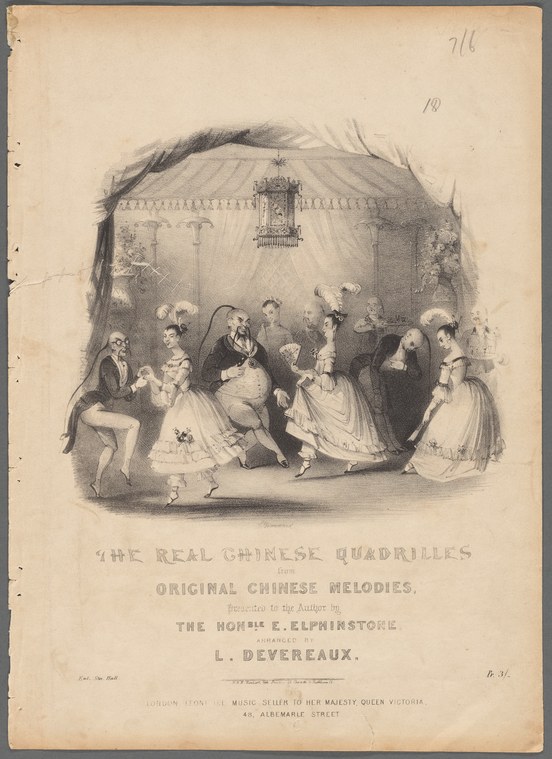
The real Chinese quadrilles from Original Chinese melodies, presented to the author by the Honble. E. Elphinstone, arranged by L. Devereaux
Unknown artist
- Collection:
- Prints depicting dance
- Source:
- New York Public Library
- Rights:
- Public domain — free to use, share and adapt.
- Recorded as:
- Public Domain
The quadrille was the engine of 19th-century ballroom social life, and this image captures its performed reality rather than its theoretical structure. The title's reference to 'original Chinese melodies' documents the period's appetite for Orientalism in dance music and offers a specific example of how European composers adapted and marketed non-European material to ballroom audiences.
What you are looking at
A interior ballroom scene rendered in soft grayscale tones, viewed through an ornamental archway draped with swags and tassels. The space is warm and enclosed, lit by a hanging chandelier, with decorated walls visible in the background. A group of approximately twelve figures in formal Victorian dress occupies the floor: men in dark coats and women in full white gowns with bell skirts characteristic of the 1860s–70s. The figures are arranged in a scattered formation typical of ballroom social dancing rather than a rigid line or set. Several couples are engaged in active motion—one woman's skirt is captured mid-swirl, and bodies are angled to suggest turning and stepping. The overall mood is festive and social, with figures at various distances from the viewer, creating depth within the framed space. The composition emphasizes the gaiety of an evening assembly rather than formal demonstration.
The dancing
The dancers display the characteristic posture and spacing of mid-Victorian ballroom dancing: upright frames, women's full skirts creating prominent silhouettes, and couples maintaining what appears to be closed or semi-closed hold. Several bodies are caught mid-rotation or weight transfer, with skirts flaring outward as evidence of turning motion. The grouping is social and informal rather than geometrically precise—figures overlap and intermingle rather than holding strict positions. One prominent woman in the center-left has her skirt dramatically swirled, suggesting active stepping and rotation. The men's posture is formal and upright, typical of the period's ballroom etiquette.
The dance depicted
The title explicitly identifies this as 'The Real Chinese Quadrilles,' indicating it is a quadrille—a four-couple formation dance that was central to European ballroom social life in the 19th century. The image depicts the social, recreational version of the quadrille as danced at balls and assemblies, not a formal pedagogical demonstration. The composition captures the lively moment of execution rather than a posed chart. The quadrille was danced to 'original Chinese melodies' according to the title, suggesting this was an exoticized or novelty version incorporating non-European musical material—a common practice among European composers and choreographers seeking to capitalize on Victorian fascination with the East. The actual figures and formations are not clearly legible from the perspective chosen, which suggests the artist prioritized capturing the social atmosphere and movement quality over documentary precision.
How it was made
This is a lithograph or engraved print, rendered with careful tonal gradation and cross-hatching to create depth and light effects. The soft, diffused quality and the ability to render complex interior detail and facial expression suggest a skilled reproductive print, likely produced for a music publication or dance instruction manual. The technique allows for wide circulation—this is clearly a commercial product intended for an educated middle-class audience with access to sheet music and dance instruction. The archway framing device is a compositional convention of the period that both encloses the scene and draws the viewer into the ballroom space. The print quality suggests professional publication rather than manuscript or unique artwork.
About this work
This is a lithographic illustration accompanying sheet music for 'The Real Chinese Quadrilles,' a novelty ballroom dance of the Victorian era. The image shows the social context in which the quadrille was performed: an evening assembly of fashionably dressed couples in a well-appointed interior, captured at the moment of active dancing. The work documents both the dance form itself and the Orientalist taste that shaped Victorian ballroom entertainment. As part of a music publication presented to the Hon. E. Elphinstone and arranged by L. Devereaux, it functioned as promotional material and instructional aid—allowing purchasers to visualize the social setting and atmosphere in which they would perform these dances.
The piece is valuable for what it reveals about 19th-century ballroom culture, gender presentation, and the appetite for exoticized 'Eastern' entertainment in European society. The quadrille was the dominant social dance form of the mid-to-late Victorian period, and illustrations of its performance are relatively common; this example is notable for emphasizing the actual movement and social pleasure of the dance rather than static formation diagrams, and for its explicit connection to non-European musical material.
How to look at it
Notice the artist's choice to show the quadrille *in motion* rather than as a static formation diagram. The swirling skirts, the varied angles of the bodies, and the overlapping figures all capture the moment of turning and stepping rather than a held position. The emphasis on gaiety and social pleasure—the warmth of the interior, the animated quality of the gathering—tells you this is about ballroom dancing as lived experience, not as a system to be mastered. Observe how the archway frames the scene and creates intimacy, inviting the viewer into the ballroom. The formal dress and careful grooming are essential to the image's meaning: the quadrille was a dance of display, and the elaborate gowns and posture of the dancers are as much the subject as the movement itself.
The artist
The print is attributed to L. Devereaux as arranger, with the composition 'presented to the author by the Honble. E. Elphinstone.' The creator of the visual image is not recorded. The printing was carried out by a London publisher based on the imprint visible at the base of the page. This was standard practice for sheet music of the period: a composer or arranger would be credited, a dedicatee acknowledged, and the illustrator's contribution often went unattributed in commercial publications. The quality of execution suggests a professional illustrator working for a London music publisher in the mid-to-late 19th century.
The period
This work dates to the height of the Victorian quadrille, roughly 1850s–1870s based on the fashion visible in the image. The quadrille had dominated European ballroom dancing since the early 1800s and remained the prestige social dance until the rise of the waltz and later the modern ballroom dances. The mid-Victorian period saw a particular enthusiasm for 'exotic' cultural products—Indian, Chinese, and Japanese art, design, and music were fashionable among the educated upper-middle class. Music publishers regularly issued 'Oriental' quadrilles, waltzes, and polkas with fanciful titles and nominal connections to actual non-European traditions. This image sits within that context of Orientalism: a European interpretation of non-European aesthetics, produced for commercial consumption by an affluent audience.
Where it lives
The work is held in the NYPL Prints Collection, catalogued as a item documenting dance. It is a commercial music publication, likely a vocal or instrumental score for drawing room or ballroom use, and would have circulated widely among music-teaching households of the period.
Dance in this work
Questions about this work
What is a quadrille?
A quadrille is a formation dance for four couples (eight dancers) arranged in a square, performed to a lively instrumental melody. It was the dominant ballroom social dance of the 19th century, and each quadrille consisted of five distinct figures or movements, danced in sequence. The quadrille required no special skill to begin but allowed for elaboration and showmanship, making it ideal for mixed-ability social dancing.
What does 'Chinese melodies' mean here?
The title is marketing language. The arrangement uses a melody *styled as* Chinese or Oriental—exotic-sounding to Victorian ears but almost certainly a European composition with Asian affectations. Orientalism was fashionable in the 1860s–70s, and music publishers regularly issued 'Turkish' waltzes, 'Chinese' quadrilles, and 'Indian' polkas, none of which had authentic connection to actual music from those regions.
Who would have danced this?
Educated members of the upper-middle class—professionals, merchants, minor gentry, and their families. The quadrille was the standard social dance at balls, assemblies, and private dancing events throughout the Victorian era. Both men and women participated, and it required no prior training, though execution with grace was valued.
How do we know this is from the 1860s–70s?
The women's fashion—full skirts without crinolines visible, the shape and drape of the bodices, the style of the men's coats—all point to the mid-to-late Victorian period. The interior furnishings and the quality of the printing also support a date in this range, though the catalogue record does not provide a definite date.
More dance artwork





