49 works in this view — arrow keys or swipe to move between them.
Dance in Art
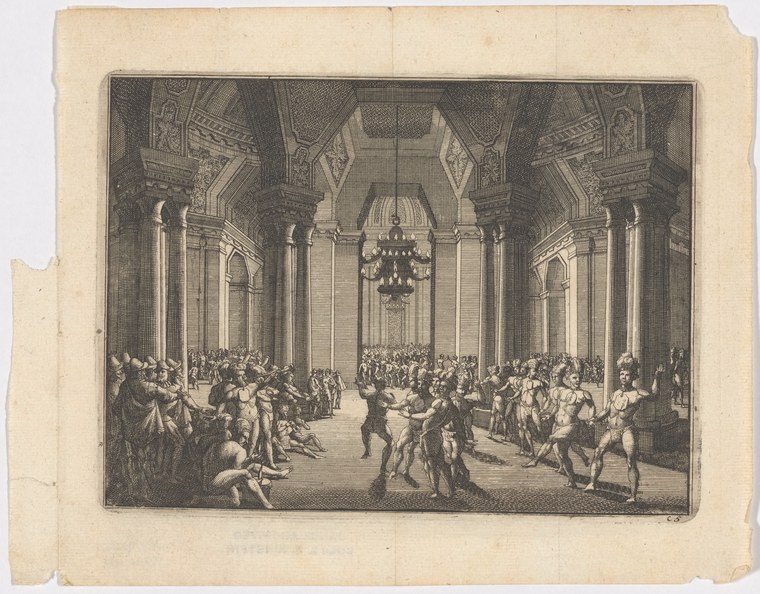
Ballroom scene including men in minimal clothing
Unknown artist
- Collection:
- Prints depicting dance
- Source:
- New York Public Library
- Rights:
- Public domain — free to use, share and adapt.
- Recorded as:
- Public Domain
This work demonstrates how dance was embedded in courtly social ritual and visual culture. It shows the architectural and social context in which formal ballroom dances were practiced, and reveals what artists chose to emphasize—the spectacle of the gathering rather than the technical precision of the movement. For historians of dance and manners, it is evidence of how dancing was one component of a broader social performance.
What you are looking at
A grand interior hall filled with numerous figures in animated conversation and movement. The space is defined by a colonnade of tall classical columns supporting a barrel-vaulted ceiling with coffered decoration and lunette windows. A chandelier hangs centrally. The crowd is densely arranged across the floor, with figures in various states of social interaction—some standing in clusters, others moving or gesturing. The lighting is even and cool, cast from the high windows. The engraving style creates a theatrical sense of aristocratic assembly, yet the catalogue's description of "men in minimal clothing" does not match the visible dress: the figures wear period clothing consistent with 17th or early 18th century formal wear, including coats, breeches, and what appear to be stockings. A few figures in the foreground appear to be engaged in movement or gesture that might suggest dancing, but the overall composition reads as a social gathering or assembly rather than an organized dance performance.
The dancing
The figures are distributed across the floor in small groups and pairs. Those in the foreground on the left show active posture—some with raised arms or forward-leaning weight—while others stand more formally. The dress and bearing suggest nobility or courtiers. No clear partnered dance hold is evident in the visible figures; instead, poses suggest conversation, flirtation, or social display. The density and variety of gesture create an impression of mingling and social interaction rather than synchronized or formalized movement.
The dance depicted
This appears to be a ballroom or court assembly scene rather than a depiction of a specific dance performance. If dancing is occurring, it is embedded within broader social activity. The architectural setting and dress are consistent with 17th or early 18th century court life, when ballroom dancing was a central courtly practice. However, the composition emphasizes the gathering and social interaction over any particular dance structure. Without clearer evidence of a hold, line formation, or recognized period movement vocabulary, identification of a specific dance style is unreliable.
How it was made
This is an engraving, executed in the linear style typical of 17th or 18th century European printmaking. The fine parallel lines create tone and volume; the perspective is geometric and recessive. Engraving allowed wide circulation and reproduction, making such scenes accessible to a broad educated audience as documentation of courtly life and behavior. The technical skill required to render the architecture and the crowd suggests a work of some standing in its time.
About this work
A baroque or early rococo engraving depicting a crowded ballroom or reception in a grand colonnaded hall. The work captures the social spectacle of aristocratic assembly—the mingling, gesture, and informal movement of courtiers in formal dress. While ballroom dancing was central to court life in this period, the image prioritizes the broader scene of social interaction over the choreography of dance itself. It is a valuable document of how elite social life was visualized and circulated in print during the early modern period.
How to look at it
Attend to the composition of the crowd—how the artist has arranged figures in depth and across the picture plane to suggest both formal gathering and informal movement. Note the architectural framing, which emphasizes the grandeur of the setting and the importance of the space itself. Look at individual gestures and postures to catch moments of courtship, conversation, or incipient movement. The engraving's linear technique creates a sense of order and deliberation even in a scene of social activity.
The period
In the 17th and 18th centuries, the ballroom was a central institution of European court life. Dances such as the minuet, gavotte, and various French court dances structured social interaction among the nobility. Engravings and prints of court scenes were popular among the educated classes, documenting and disseminating ideals of courtly behavior, dress, and deportment. Artists depicted ballrooms, processions, and festivities as expressions of royal power and aristocratic refinement.
Where it lives
The work is catalogued in the New York Public Library's collection of prints depicting dance. It is an engraving, likely produced in the 17th or 18th century as a multiple, and represents the type of visual culture through which ballroom scenes were documented and circulated among educated European audiences.
Dance in this work
Questions about this work
Is this a specific ballroom dance or just a party?
The image appears to be a general ballroom or court assembly scene rather than a depiction of a specific choreographed dance. While ballroom dancing was central to such gatherings in the 17th and 18th centuries, the artist has chosen to emphasize the social spectacle—the mingling, dress, and setting—rather than to illustrate the steps or holds of a particular dance.
Why are the figures so small and crowded?
The engraver has created a bird's-eye or elevated perspective to show the ballroom as a whole and to convey the scale and splendor of the architectural space. This technique was common in prints documenting court festivals and social events, allowing viewers to see the entire scene at once and to appreciate both the building and the gathering it contained.
What does the catalogue mean by 'men in minimal clothing'?
This description does not match the visible dress in the engraving. The figures wear formal 17th or 18th century court clothing—coats, breeches, stockings, and formal footwear. It is possible the catalogue entry is incorrect, or the description refers to a different work. The image clearly shows clothed, formally dressed figures.
More dance artwork





