49 works in this view — arrow keys or swipe to move between them.
Dance in Art
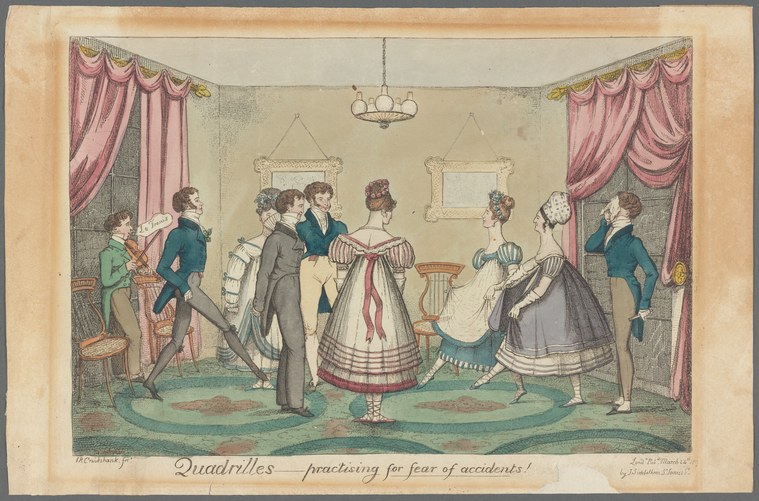
Quadrilles--practising for fear of accidents!
Unknown artist
- Collection:
- Prints depicting dance
- Source:
- New York Public Library
- Rights:
- Public domain — free to use, share and adapt.
- Recorded as:
- Public Domain
This engraving is a rare direct illustration of quadrille practice in the Regency era, showing not just the dance itself but the pedagogical context—'practising for fear of accidents' suggests this is a lesson in an intimate setting, not a public ball. For historians and dancers, it documents the quadrille's dominance in social dance during a pivotal period and captures the anxieties around performing it correctly. The precision of the print's recording of dress, posture, and room layout makes it a valuable source for understanding both the aesthetic and the social discipline of Regency ballroom culture.
What you are looking at
A parlor or ballroom scene set in the Regency or early Victorian era, depicted in a hand-colored engraving. The room is framed by swags of pink silk damask curtains hung from gilt cornices, with a chandelier suspended from the center ceiling. In the foreground, four couples stand in quadrille formation on a teal-colored floor marked with geometric patterns. The couples face each other in the formal arrangement of the dance: two couples form the top and bottom of the square, two others the sides. The women wear high-waisted empire-silhouette gowns with puffed sleeves, their skirts reaching the ankle and adorned with horizontal stripes, ribbons, and decorative hems; their hair is dressed high with ringlets and ornaments. The men wear dark tailcoats and breeches typical of the period. Around the dancing couples, standing figures—male chaperones and perhaps musicians or observers—occupy the corners and edges of the room, establishing the social context of a formal private dance. The print's title at the bottom reads 'Quadrilles—practising for fear of accidents!' in script, suggesting a humorous commentary on the dancers' caution or inexperience.
The dancing
The four couples are arranged in the characteristic square formation of the quadrille: bodies held upright in the formal posture of Regency ballroom deportment, with women's arms positioned at their sides or lightly raised, men's arms similarly controlled. The nearest couple in the foreground show the dancers at a moment of stillness or transition within the figure, neither mid-leap nor in obvious motion, which suits the satirical tone of the title—they appear tentative rather than assured. The surrounding standing figures gesture with hands and turn toward the dancing couples, watching with interest. The spacing and symmetry of the four couples reflects the quadrille's strict geometric structure, where each couple maintains its position and performs prescribed figures in sequence with the others.
The dance depicted
This is unmistakably a quadrille, the dominant social dance of the Regency and Victorian ballrooms. The quadrille originated in France in the late eighteenth century and became the fashionable dance of the English upper and middle classes by the 1810s–1820s, performed at private assemblies and public balls. It required four couples arranged in a square, executing a sequence of figures (les pantalons, l'été, la poule, la trénis, and the finale) to music in 2/4 time. The title's reference to 'practising for fear of accidents' suggests this is a lesson or rehearsal rather than a polished performance, implying that quadrille dancing, despite its rigorous formality, could go comically wrong. The engraving documents both the dance itself and the social ritual surrounding it—the dress, the room, the attendance of chaperones and witnesses.
How it was made
This is a hand-colored engraving, likely aquatinted or stipple-engraved, printed and then colored by hand with watercolor or gouache. The technique allowed for fine linear detail in the figures and furnishings and broad areas of flat color in the drapery and floor. Hand-coloring was the standard method for mass-producing colored images in the early nineteenth century, before lithography and chromolithography took over. The presence of hand-coloring and the print's satirical tone suggest it was produced for a middle-class audience—likely a series of social or dance-related prints sold as humor or moral instruction. The engraving's precision and the careful rendering of dress indicate it was made by a professional printmaker or publisher catering to readers interested in ballroom fashion and behavior.
About this work
This is a satirical engraving of a Regency-era quadrille lesson or social dance, recording the costume, setting, spatial arrangement, and decorum of one of the era's most important dances. The quadrille was the dominant ballroom dance of the English upper and middle classes from roughly 1810 onward, and this print—whether made in the 1820s, 1830s, or 1840s—documents its appearance and social function with precision and humor. The title's suggestion of caution or mishap adds a layer of social comedy: despite the dancers' careful dress and the formality of the setting, something might go awry. The work belongs in a dance gallery because it is both a direct depiction of quadrille practice and a window into how dance was taught, performed, and viewed in its historical moment.
How to look at it
Look first at the spatial geometry of the four couples: the quadrille's strict square formation is the organizing principle of the entire composition. Notice how the two couples in the foreground face each other across the floor while the two flanking couples occupy the sides—this is not accidental but the essential structure of the dance. Observe the formality and stillness of the figures' postures: the quadrille, unlike the waltz or cotillion, did not emphasize continuous turning or hold; it was a series of geometric patterns performed with upright carriage and controlled arms. The title's humor lies in the contrast between this formal restraint and the hint of disaster: these dancers are 'practising for fear of accidents,' suggesting that even in a strictly patterned dance, something might go wrong. The surrounding witnesses—the figures standing at the edges—remind us that this was a semi-public event in a private space, observed and judged by peers.
The period
The quadrille emerged in France in the late 1780s and became the fashionable dance of London ballrooms and assemblies by the 1810s, coinciding with Regency fashion and sensibility. By the 1820s and 1830s, it had become the standard opening dance at formal balls and a staple of dancing masters' curricula. The exact date of this print is uncertain, but the costume (high-waisted empire gowns, the style of the men's tailcoats and breeches) and the engraving technique point to the period 1815–1845. The Regency and early Victorian periods saw a proliferation of satirical prints on social manners and fashion, often produced for middle-class consumption. Such prints simultaneously documented current dress and behavior and mocked the anxieties of social performance—in this case, the fear of dancing 'accidents' in a highly prescribed and formal dance.
Where it lives
The print is held in the New York Public Library's collection of prints depicting dance. The catalogue record is sparse: no artist is recorded, the date is unknown, and the medium is listed as not recorded. The hand-coloring and engraving technique suggest professional publication, likely in the early nineteenth century.
Dance in this work
Questions about this work
What is a quadrille?
A quadrille is a ballroom dance for four couples arranged in a square, originating in France in the late 1780s and becoming the dominant social dance in English ballrooms from about 1810 onward. It consists of a sequence of prescribed figures—usually five: les pantalons, l'été, la poule, la trénis, and the finale—performed to music in 2/4 time. Unlike the waltz, it does not involve continuous turning or close partnering; instead, couples take turns moving within the square while others stand in place.
Why would dancers practice the quadrille 'for fear of accidents'?
The title is satirical, playing on the formality and precision required of the quadrille. Despite its rigid geometric structure, the dance demanded coordination among four couples and the ability to remember and execute the correct figures in sequence. Missteps, collisions, or confusion about which figure was being danced could cause embarrassment or physical mishap. The print gently mocks the anxiety of social performance in an era when ballroom decorum was considered crucial to one's reputation.
How was this image made and who saw it?
This is a hand-colored engraving, a print made by etching a design into a metal plate, inking it, and printing it on paper, then hand-coloring the impressions with watercolor or gouache. Such prints were produced in editions of dozens or hundreds and sold to middle and upper-class readers interested in fashion, dance, and social satire. The technique allowed for fine detail and broad color, making it ideal for documenting costume and setting while remaining affordable enough for middle-class parlors.
What does the room tell us about where this dance took place?
The silk damask curtains, gilt cornices, and chandelier indicate a wealthy private residence, not a public ballroom or assembly hall. The quadrille was danced in both settings, but this image shows the intimate, domestic context—a private dancing lesson or family gathering. The presence of chaperones and standing observers reflects the social protocol of the era: even in a private space, dancing was a semi-public performance watched by others.
More dance artwork





